The Stubble Wars: Defending the Sidewall and the Smart-Dual Revolution
In our foundational Part 1: The Agricultural Tire Bible, we dissected the mechanics of soil compaction and the VF (Very High Flexion) revolution. However, mastering flotation is only half the battle. In the modern harvested field, your tires aren't just weight-bearers; they are targets for thousands of bio-engineered "spears." Welcome to Part 2 of the ultimate tire guide for heavy-duty farming, where we tackle stubble forensics, the dual-tire infrastructure, and the speed-load logistics of 2026.
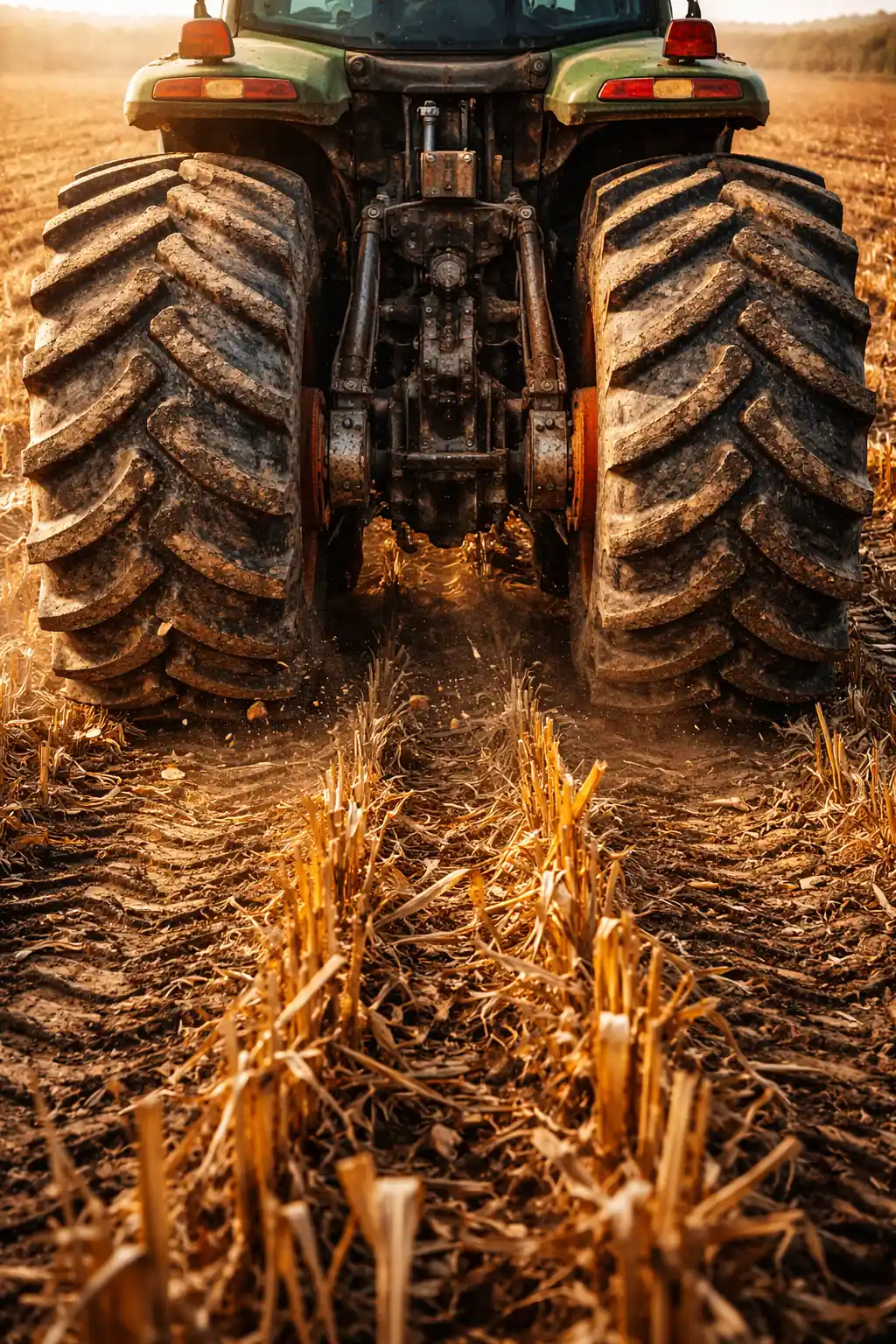
I. Stubble Forensics: Why Your Tread is Dying Early
If you’ve walked through a harvested corn or soybean field recently, you’ve felt the change. Modern crops are bred for standability—the ability to resist high winds and heavy ears. This means the stalks are no longer soft organic waste; they are silica-rich, rigid spears. In this tire guide edition, we have to address the "Stubble Pecking" phenomenon that is costing farmers millions in early replacements.
As the tire rolls, the stalks pierce the "valleys" between the lugs. This constant pecking creates micro-cracks that eventually reach the nylon or steel cords. Once moisture enters the carcass, the tire is essentially a ticking time bomb. When you look to buy a tire online, specifically for high-yield regions, you must look for Stubble Guard Compounds. These are proprietary rubber mixes (often used by Michelin and Firestone) that add high-density polymers to the tread area to repel punctures.
🛡️ The Mechanical Shield: Stubble Stompers
Don't rely solely on the rubber. "Stubble Stompers"—metal plates mounted to the header or tractor frame—push the stalks down before they can meet the tire vertically. Even the most expensive tire online will fail without mechanical protection in 2026 cornfields. We consider this the #1 maintenance habit for longevity.
II. The Dual vs. Single Logistics: Finding the Balance
Choosing between "Big Singles" (Low Ground Pressure tires) and "Duals" (Ikerkerek) is a decision that impacts every aspect of your operation, from transport width to fuel burn.
Dual-Tire (Iker) Advantages
By splitting the load across four tires on one axle, you can drop tire pressure to extreme lows (8-10 PSI). This provides incredible stability on hillsides and allows for a "Spare" mentality—if one tire has a slow leak, you can often make it back to the barn.
Large Single (LGP) Advantages
Wide singles (like the 1050/50R32) eliminate the "Pinch Row" effect. In dual setups, the soil between the tires is compressed from two sides, creating a hard ridge that can stunt early crop growth. Singles offer a clean, even footprint.
The Physics of "Road Looping" in Duals
When you take a dual-tire tractor onto the road, physics works against you. During a turn, the outer tire must travel a greater circumference than the inner tire. Because they are bolted together, one of them must slide or "scrub" against the asphalt. This is why road transport is the #1 wear-factor for Ag tires.
The wider your dual spacing, the more rubber you literally leave on the highway during every turn. For heavy roading, narrower dual spacing is actually better for tire life.
III. The Speed-Load Trap: Asphalt Destroys Ag Rubber
In 2026, tractors are faster than ever. Machines like the Fendt 1000 series can reach 31-40 MPH on the road. Most Ag tires found when browsing a tire online store are rated for "A8" (25 MPH) or "D" (40 MPH). If you run an A8 tire at 40 MPH while fully ballasted, the centrifugal force will pull the tread off the carcass.
Heat is the silent killer here. Ag tires have massive lugs that act as heat sinks. When driving on the road, these lugs flex, generating internal heat. If the tire pressure is set for the field (low PSI) but driven on the road (high speed), the tire can reach temperatures of over 160°F, leading to an immediate structural failure. Always adjust pressure for road transport or invest in a Central Tire Inflation System (CTIS).
IV. Digital Traction: The ISOBUS Integration
The modern tire guide isn't just about rubber; it's about data. We are seeing a massive shift towards ISOBUS-connected tires. These tires have sensors embedded in the inner liner that report not just tire pressure, but also "Carcass Temperature" and "Load Stress."
By monitoring the slip-rate via GPS and comparing it to tire stress, the tractor's computer can suggest the optimal speed to prevent "Power Hop"—that rhythmic bouncing that can shake a transmission to pieces. Smart farming in 2026 starts with the contact patch.
🏁 The Final Harvest Verdict (Part 2)
Agricultural tires are no longer just "donuts for the dirt." They are complex logistical tools. By understanding the stubble menace, managing the road-scrub of dual setups, and respecting the speed ratings, you are protecting a $20,000+ investment. Remember: the cheapest tire found when searching for a tire online is the one that lasts 10 seasons, not the one with the lowest price tag today.
From the furrow to the highway, we keep you rolling. Read more in our tire guide.
*As an Amazon Associate, we earn from qualifying purchases to support our farming community.*