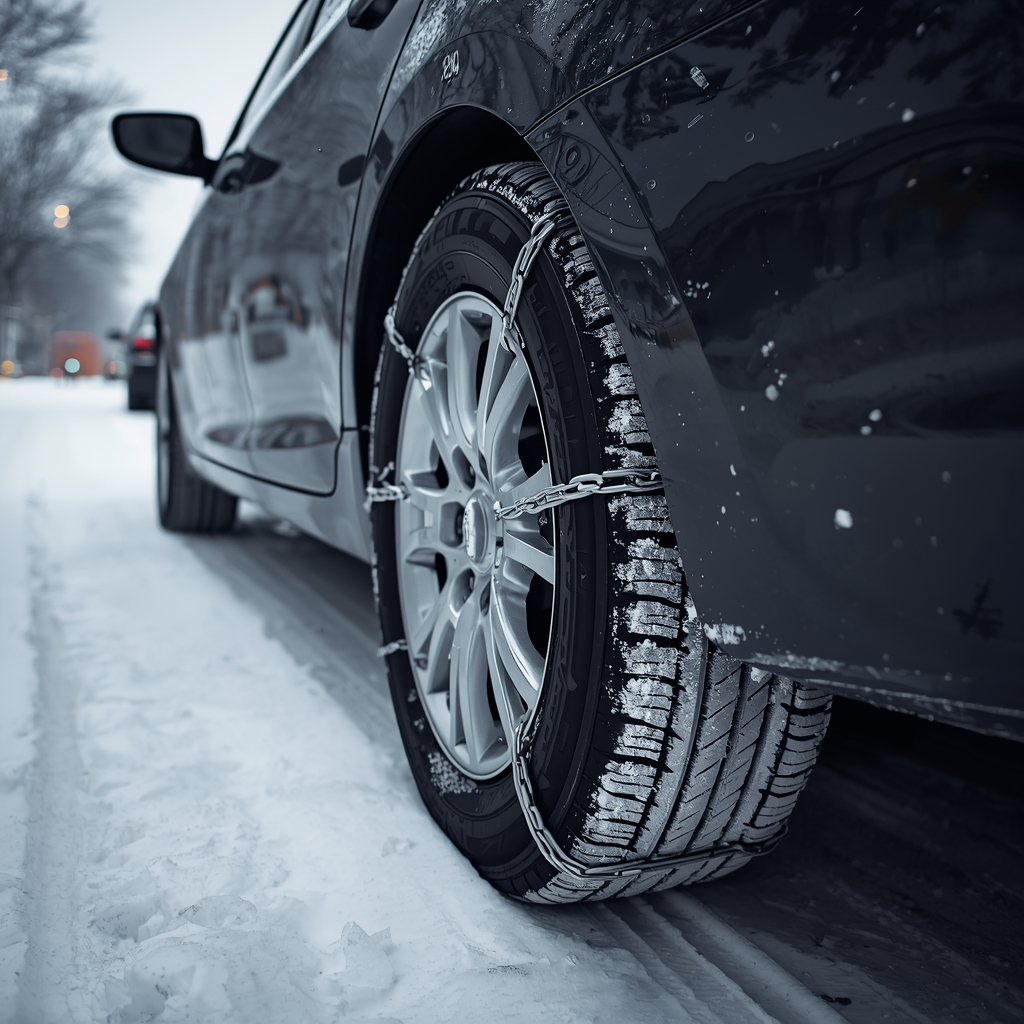
Winter Storm Fern is not a typical snow event. Meteorologists are calling it a "Bomb Cyclone," a rapidly intensifying storm that has dropped pressure significantly over the last 24 hours. For drivers in the Northeast, this means one thing: the roads are no longer roads—they are obstacle courses.
Whether you are a healthcare worker who needs to get to Mount Sinai, a utility worker restoring power, or a parent caught in the chaos, standard All-Season tires will not cut it. Even standard 4WD systems are failing in the 3-foot drifts reported in Buffalo and Syracuse.
🛑 THE "DON'T DIE" CHECKLIST
Before reading about chains, acknowledge these rules. Breaking them today could be fatal.
- No Empty Tanks: If you slide into a ditch, you might be there for 12 hours. A full tank is your only source of heat.
- No Cotton: Do not wear jeans or cotton hoodies. If they get wet installing chains, they lose insulation. Wear wool or synthetics.
- Carbon Monoxide: If you are stuck and the engine is running, YOU MUST clear the snow from the exhaust pipe every hour.
Part 1: The Science of Traction (Why You are Sliding)
Why do cars slide? It’s simple physics. The coefficient of friction on dry asphalt is about 0.7. On ice, it drops to 0.1 or less. Your 4,000lb SUV essentially becomes a hockey puck.
Snow chains work by mechanically piercing the surface. Unlike winter tires which rely on rubber compounds remaining soft, steel chains use the weight of the car to bite into the ice layer. This is why, in conditions like Storm Fern, chains outperform even the best snow tires.
Part 2: The Best Chains for 2026 (Detailed Reviews)
We have analyzed the current stock availability on Amazon amidst the panic buying. Here are the three systems you can rely on.
🥇 The Gold Standard: Peerless Auto-Trac (Series 023)
Most people hate snow chains because they are hard to tighten. You put them on, drive 10 feet, stop, get out in the slush, and tighten them again. The Peerless Auto-Trac solves this. It uses two high-impact polycarbonate ratchets that automatically tighten the chain as the wheel spins.
- Self-tightening (Install and forget)
- Diamond pattern (Better cornering than ladder chains)
- Class S clearance (Fits most SUVs)
- Slightly more expensive than manual chains
- Ratchets can freeze if stored wet (Dry them!)
Best for: Daily drivers, Commuters, and anyone who hates freezing their hands.
Check Availability & Price🥈 The "Impossible Wheel" Solution: SCC Super Z6
Do you drive a Tesla Model 3/Y, a BMW, or a modern sedan? You likely have less than 1 inch of space between your tire and your suspension strut. Regular chains will rip your brake lines out.
The Super Z6 uses a cable system instead of linked chains. It requires only 6mm (0.25 inches) of sidewall clearance. It works like a coil spring wrapping around the tire.
Find Size for My Car🥉 The "Emergency" Fix: AutoSock
If you are physically unable to wrestle with chains, the AutoSock is a textile cover. It uses high-friction fabric technology developed in Norway. It literally pulls on like a sock.
Warning: These are for snow ONLY. If you drive on dry asphalt with them for 5 miles, you will shred them. But for getting out of an unplowed driveway in Queens? Perfect.
Shop AutoSockPart 3: Legal Requirements & Fines (NY, NJ, PA)
👮♂️ OFFICER WARNING
During a State of Emergency, police powers are expanded.
- New York: Under "Tier 3" restrictions, chains may be mandatory on mountain passes. Fine: Up to $150 + Towing fees.
- Colorado (I-70 Reference): $500 fine for blocking traffic without chains. While NY isn't this strict yet, blocking the LIE (I-495) will result in your vehicle being aggressively towed to clear the lane for plows.
- Speed Limit: With chains on, the absolute maximum speed is 30 MPH (50 km/h). Exceeding this can cause the chain to snap, acting like a steel whip that destroys your wheel arch.
Part 4: The "Trunk of Life" – Beyond Chains
You have the chains. Good. But if the engine dies, chains won't keep you warm. Here is the curated list of survival gear that is selling out fast.
🔋 1. The Power Plant
Cold weather kills car batteries. A lithium jump starter is essential. Don't rely on strangers for a jump cable.
Get NOCO Booster🔦 2. The Sun in Your Hand
Changing chains in the dark is impossible. You need a high-lumen headlamp (keep hands free).
Get Headlamp⛏️ 3. The Excavator
A plastic scraper will snap. Get a collapsible aluminum shovel. You need to dig out the wheels.
Get Shovel🧥 4. Thermal Protection
Mylar blankets reflect 90% of body heat. Keep a 4-pack in the glovebox.
Get BlanketsPart 5: How to Install Chains (Without Losing Fingers)
Practice in your driveway NOW. Do not learn on the side of the highway in a blizzard.
- Lay it out: Untangle the chain on the ground. Make sure hooks face UP (away from tire rubber).
- The Slide: Slide the cable behind the tire (for cable chains).
- The Connect: Pull the ends up over the tire and connect the inner latch first, then the outer latch.
- The Center: Adjust the chains so they are centered on the tread.
- The Drive: Drive 15 feet forward. Stop. Retighten. (Unless you bought the Peerless Auto-Trac).
Conclusion: Respect the Storm
Storm Fern is historical. The snow depth in Central Park hasn't been this high since 2016. Your vehicle is a machine, not a tank. If you don't have to go out, stay home.
But if duty calls, gear up. Buy the chains, fill the tank, and drive slow. We will see you on the other side of the thaw.