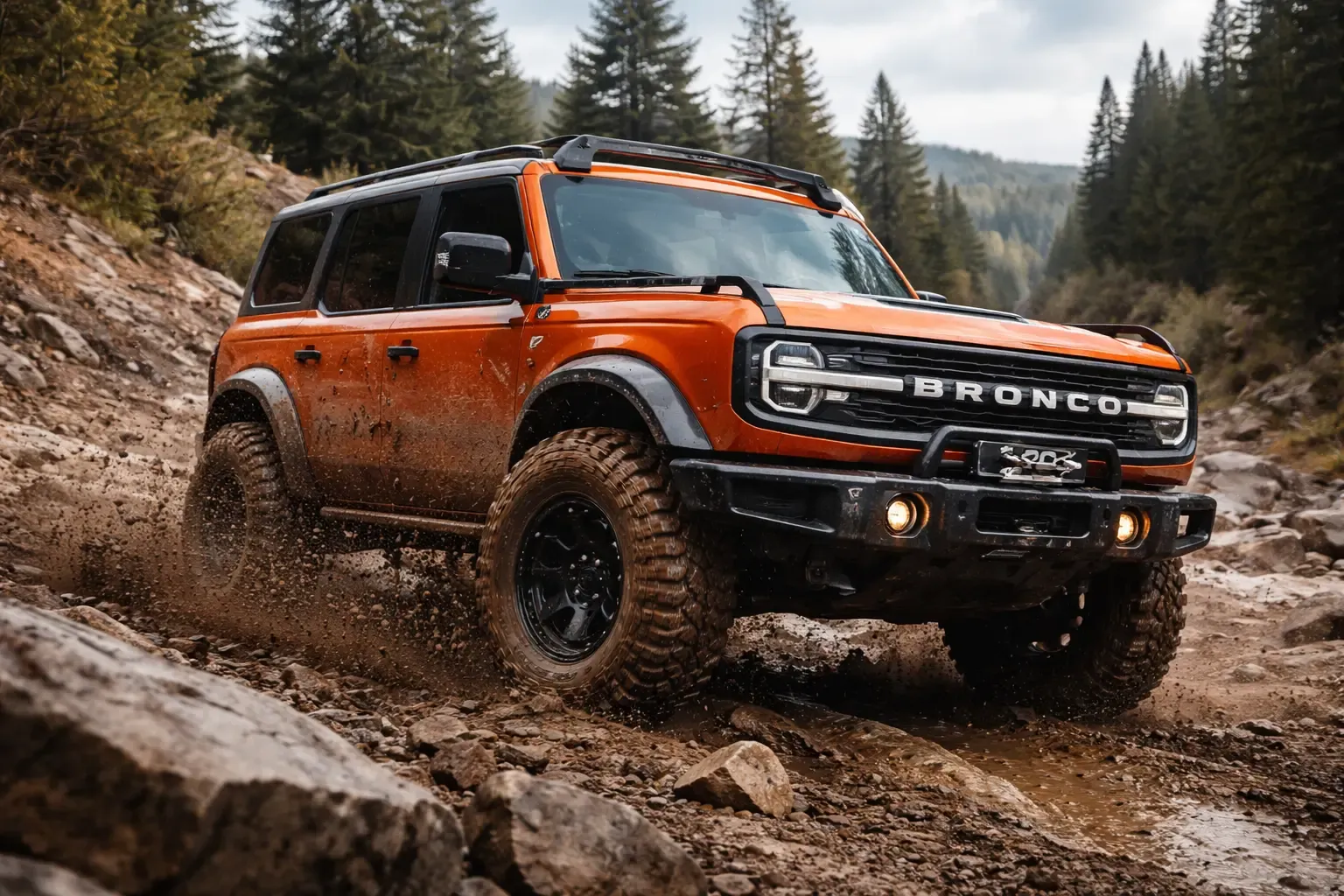
The **2026 Ford Bronco** is not merely an SUV; it is a mechanical system engineered to overcome friction coefficients that would halt standard vehicles. Unlike unibody crossovers, the Bronco utilizes a **body-on-frame chassis** to manage torsional stress, while its advanced locking differentials manipulate torque vectoring in real-time. This analysis explores the technical capabilities of the Bronco in mud, snow, and extreme terrain.
1. Powertrain Mechanics: Torque Multiplication
Effective off-roading requires precise low-RPM torque delivery. The Bronco's engine options are tuned to maximize force at the wheel before traction is lost. Coupled with a **10-speed automatic transmission** and a low-range transfer case, the crawl ratios allow for surgical precision over obstacles.
Engine Output Analysis:
• 2.3L Turbo I4: 300 hp / 325 lb-ft (High Efficiency)
• 2.7L Twin-Turbo V6: 330 hp / 415 lb-ft (Max Torque)
• Mechanical Advantage: Electronic Locking Differentials (Front/Rear)
RESULT: ZERO-SLIP CRAWLING CAPABILITY
• 2.3L Turbo I4: 300 hp / 325 lb-ft (High Efficiency)
• 2.7L Twin-Turbo V6: 330 hp / 415 lb-ft (Max Torque)
• Mechanical Advantage: Electronic Locking Differentials (Front/Rear)
RESULT: ZERO-SLIP CRAWLING CAPABILITY
In the **G.O.A.T.™ Mud/Ruts Mode**, the ECU recalibrates throttle sensitivity. This prevents the "digging" effect common in high-horsepower applications, allowing the tires to float over viscous surfaces rather than excavating them.
2. Contact Patch & Ground Clearance
The geometry of the **2026 Bronco** dictates its survival rate in deep terrain. A larger tire diameter increases the **contact patch** (footprint), reducing ground pressure (psi) on soft surfaces like snow and mud. Below is a comparison of factory capability based on trim levels.
Tire Diameter & Traction Potential
❄️ Winter Dynamics Advisory
Snow requires a different physics approach. In **Slippery Mode**, the system dampens throttle input to prevent sudden wheelspin on ice. However, physics still applies: high ground clearance helps avoid "high-centering" on snowbanks, but dedicated winter tires are essential for stopping on frozen surfaces.
3. The PSI Factor: Airing Down
One of the most critical techniques for deep mud and snow is lowering your **tire pressure (PSI)**. By reducing pressure, you increase the surface area of the rubber, effectively acting like a snowshoe.
🚨 CRITICAL OFF-ROAD PROTOCOL:
⚡ Get a High-Flow Air Compressor
Dropping tire pressure increases traction significantly, but you must reinflate before returning to highway speeds. Driving on low-pressure tires at high speed causes dangerous heat buildup and sidewall failure. Always carry a portable air compressor.
4. Interior Durability & Tech Specs
The Bronco's cabin is designed with the understanding that the outside environment will eventually get inside. The engineering focuses on water resistance and cleanability.
- Hydro-Management: Marine-grade vinyl and rubberized floors with active drain plugs.
- Visual Physics: The **360-degree camera system** provides vector-based overlays, allowing drivers to see tire placement on rocks that are physically obscured from the driver's seat.
5. Essential Recovery Physics
Even with advanced 4WD, the coefficient of friction in deep mud can be near zero. Self-recovery gear is not optional; it is a mathematical necessity when traction fails.
- Traction Boards: Artificial friction surfaces for self-rescue.
- Kinetic Straps: Utilizing potential energy to snatch stuck vehicles.
- All-Weather Protection: Maintaining interior friction and hygiene.
In summary, the **2026 Ford Bronco** excels because it respects the laws of physics while providing the mechanical tools to manipulate them. Whether in **G.O.A.T. Mud Mode** or navigating frozen passes, it offers a calculated advantage over standard SUVs.