The Agricultural Giant: How the Right Rubber Boosts Your Yield
In modern farming, the tractor is the heart, but the tires are the lungs. If the lungs are constricted, the heart works harder, burns more fuel, and ultimately fails. Agricultural tires are arguably the most complex engineered rubber products on earth, designed to carry 10 tons of weight while exerting less pressure on the ground than a human foot. In this 3,000-word tire guide, we explore the science of flotation, traction, and the revolutionary VF technology.
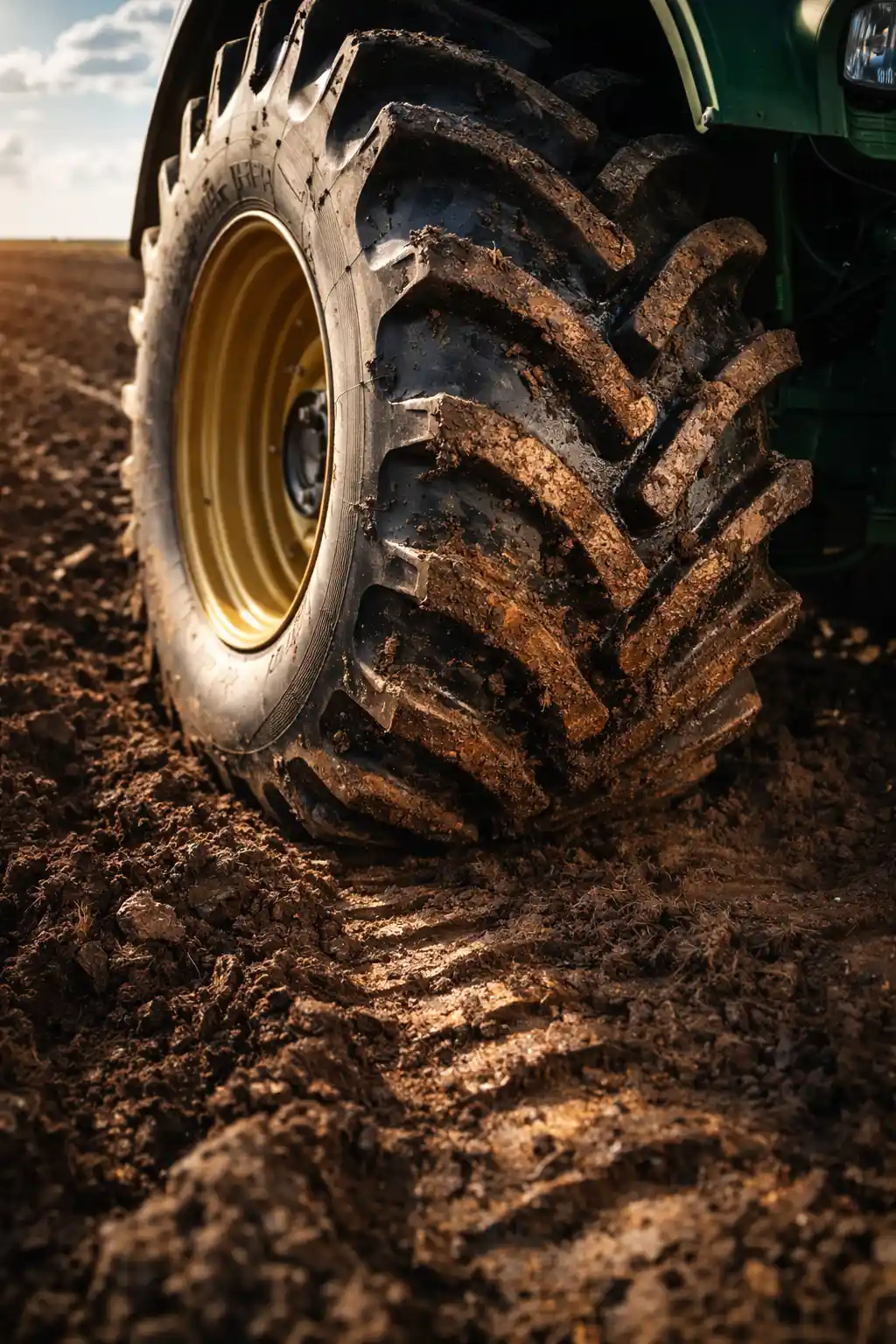
I. Soil Compaction: The Invisible Yield Thief
The biggest enemy of a farmer isn't always the weather; often, it’s the equipment itself. When a heavy machine rolls over a field, it compresses the air pockets in the soil. This "Soil Compaction" prevents roots from reaching nutrients and stops water from penetrating the earth. Studies show that compacted soil can reduce crop yields by up to 25%.
The solution is Flotation. By increasing the size of the contact patch, you distribute the weight. This is where tire pressure management becomes a financial tool. On the road, a tractor needs high pressure for stability and speed. In the field, it needs low pressure (often as low as 6-10 PSI) to "float" over the soil. Managing these two extremes is the hallmark of a professional operation.
🔬 The VF (Very High Flexion) Revolution
In the past, lowering pressure meant risking the tire's structure. Today, VF Technology allows tires to carry 40% more load at the same pressure as standard tires, or carry the same load at 40% lower pressure. This is the single greatest advancement in agricultural history, allowing for massive machinery to operate without destroying the land.
II. Traction and The Traction Equation
In farming, "Slip" is the enemy. If your tires are spinning at a 15% slip rate, you are effectively burning 15% of your fuel just to stay in place. Ideal slip for most soil conditions is between 8% and 12%.
The Traction Equation:
Traction is a result of the tread design (Lugs), the weight of the machine, and the flexibility of the carcass. When you look to source a tire online for your tractor, you must choose the correct "R" rating:
| Rating | Terrain | Best For |
|---|---|---|
| R-1 | General Farming | Dry to moist soil, general utility. |
| R-1W | Wet/Heavy Soil | 20% deeper lugs for mud and clay. |
| R-2 | Extreme Mud/Rice | Extra-deep lugs for standing water. |
| R-4 | Industrial/Hard Surface | Tighter blocks for construction and gravel. |
III. Liquid Ballast and Weight Management
Sometimes, a tire is too light to provide traction. Farmers use "Ballasting"—filling the tires with liquid (usually a Calcium Chloride solution or Beet Juice) to add weight directly to the contact patch without stressing the axles.
Warning: Liquid ballast makes the tire's internal tire pressure much more volatile. You must use specialized "Air-Liquid" valves and gauges, or you will ruin your equipment within one season.
IV. The Gas Laws in the Field
Because of the massive volume of air in an Ag tire, temperature changes are amplified. A large 710/70R42 tire can contain over 300 gallons of air. A sunny morning can raise the pressure by 4-5 PSI just from solar radiation on the black rubber. For a VF tire running at a precise 9 PSI, a 4 PSI jump changes the contact patch entirely, leading to increased soil compaction.
The Pressure-Temperature relationship in a 500-liter Ag tire means that "setting it once" is never enough. Professional farmers now use CTIS (Central Tire Inflation Systems) to adjust on the fly.
V. Buying Ag Tires Online: The Logistics Challenge
Buying a tire online for a tractor is a different beast than buying for a Toyota. You aren't just looking for a price; you are looking for Load/Speed Index compatibility. An "A8" speed rating means the tire is safe up to 25 MPH. If your modern Fendt or John Deere does 40 MPH on the road, an A8 tire will disintegrate under the centrifugal force.
- Verify the Hub: Ensure the rim width is compatible with the "Stubble Guard" technology of the tire.
- Freight Logistics: These tires weigh 800+ lbs. Ensure your online seller provides lift-gate delivery to the farm.
- Date Codes: Ag tires can sit in inventory for years. Demand rubber less than 24 months old to ensure the ozone-inhibitors are still active.
🏁 The Final Harvest Verdict
In the world of agriculture, your tires are your profit margin. By switching to VF technology, maintaining perfect tire pressure for the specific soil type, and selecting the right "R" tread pattern when buying a tire online, you can save thousands in fuel and earn thousands more in yield. Don't treat your tractor tires like an afterthought—treat them like the yield-generating assets they are.
Maximizing the field, protecting the land. Read more in our tire guide.
*As an Amazon Associate, we earn from qualifying purchases.*