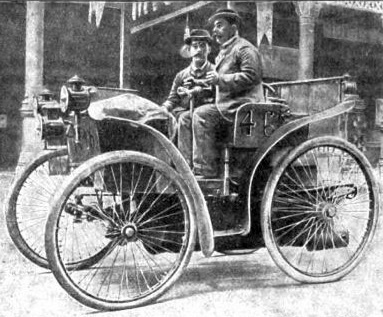
Imagine a world where every pebble on the road felt like a hammer blow to the spine. In the late 1800s, this was the reality for early motorists. Automobiles used wooden wheels with iron or solid rubber rims. That was until two brothers from Clermont-Ferrand, France, decided to change the course of history forever.
The Minds Behind the Rubber: André and Édouard Michelin
André Michelin (1853–1931) was the visionary businessman, while his younger brother, Édouard (1859–1940), was the engineering genius. Together, they took over their grandfather's struggling rubber factory in 1889.
Their journey began when a cyclist arrived at their factory with a flat tire. At the time, pneumatic tires were glued to the rim, taking hours to repair. Édouard developed a detachable pneumatic tire that could be fixed in minutes. After conquering the bicycle world, their next goal was the "horseless carriage."
Read the Michelin History on Amazon1895: The Year the "Lightning" Struck
Automobile manufacturers of the era were extremely skeptical. They believed that a heavy vehicle would instantly crush air-filled tubes. To prove them wrong, the brothers built their own car: L'Éclair (The Lightning). It was a Frankenstein's monster of a vehicle, utilizing a Peugeot chassis and a 4-hp Daimler engine.
| Feature | 1895 Michelin L'Éclair Spec |
|---|---|
| Engine | Daimler V2 V-Twin |
| Power | 4 Horsepower (4 hp) |
| Top Speed | 15 mph (24 km/h) |
| Tire Technology | Hand-made Pneumatic Rubber |
| Weight | Approx. 1,400 kg (Extremely heavy for its time) |
22 Flat Tires and a Historic Finish
The brothers entered L'Éclair in the 1895 Paris–Bordeaux–Paris race, a grueling 1,178 km endurance test. The car was so difficult to steer due to the experimental tires that it zigzagged across the road—hence the name "Lightning."
During the race, they had to change tires 22 times. The roads were littered with horseshoe nails and sharp stones. Despite the constant delays and finishing last, they achieved something incredible: they finished. They proved that air-filled tires could carry the weight of a car, providing a level of comfort and speed previously thought impossible.
The Ancestor of Modern Tires:
The wheels of L'Éclair were made of wood, with the tires held in place by special bolts. This was the earliest ancestor of the "beaded" tires we use today.
Classic Car Maintenance GearThe Legacy
Barely ten years after L'Éclair's debut, almost every major car manufacturer had switched to pneumatic tires. The Michelin brothers didn't just reinvent the wheel; they created the foundation of modern driving: comfort and safety at high speeds.
Today, when we choose tires for our 2026 models, we are using technology that André and Édouard pioneered with a zigzagging, flat-prone, but unstoppable vehicle in 1895.