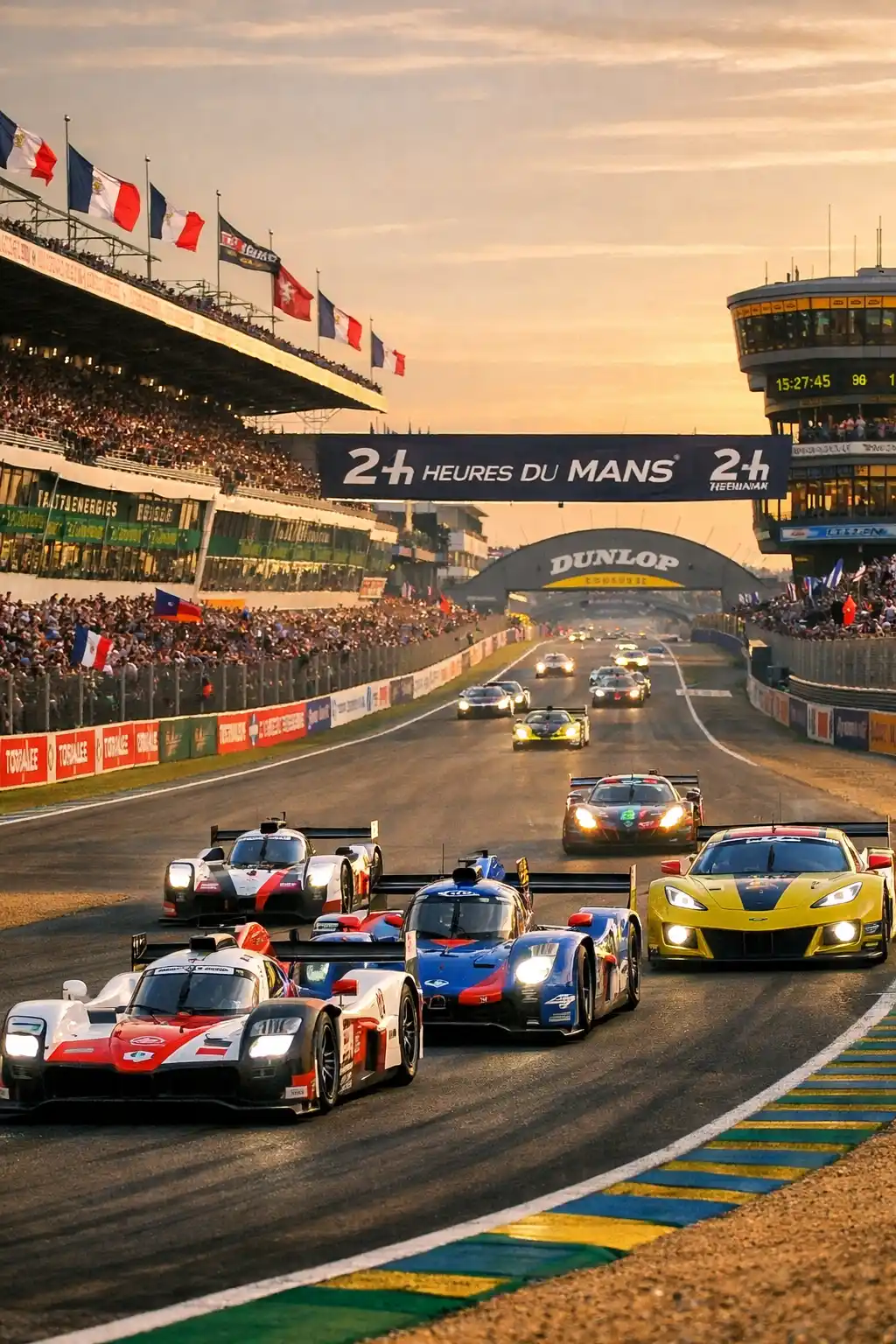
The 24 Hours of Le Mans is not merely a race; it is the ultimate theatre of human drama and mechanical torture. Unlike Formula 1, where pure speed is king, Le Mans is about survival. Over the last century, the Circuit de la Sarthe has witnessed bitter corporate rivalries, cars that defied the laws of physics, and engineering miracles that were never supposed to work.
From the terrifying darkness of the Mulsanne Straight to the glowing brake discs at 3:00 AM, here are the three most incredible stories from the history of endurance racing.
I. The Grudge Match: Ford vs. Ferrari (1966)
The story of the Ford GT40 is perhaps the most famous rivalry in automotive history. It wasn't born out of a desire to race, but out of a pure, burning desire for revenge.
In the early 1960s, Henry Ford II wanted to buy Ferrari. The deal was done, audits were finished, and millions were spent. However, at the eleventh hour, Enzo Ferrari—"Il Commendatore"—abruptly cancelled the deal. He refused to hand over control of his beloved racing team, Scuderia Ferrari. To add insult to injury, Enzo reportedly told Ford's executives that they built ugly cars in an ugly factory.
The Weapon: Ford GT40 Mk II
It wasn't easy. The early prototypes were dangerous and unreliable. But with the help of Carroll Shelby and test driver Ken Miles, they perfected the beast. By 1966, the GT40 Mk II, powered by a massive 7.0-liter American V8, was ready.
The race was a brutal war of attrition. While the sophisticated Italian V12 Ferraris suffered from overheating and mechanical failures trying to match the American pace, the Fords dominated. The result was a historic 1-2-3 finish for Ford, ending Ferrari's reign forever.
Get the Book: "Go Like Hell"The definitive true story behind the movie.
II. When Cars Fly: The Mercedes CLR Nightmare (1999)
In the world of aerodynamics, downforce is king. It pushes the car into the track, allowing for immense cornering speeds. But in 1999, Mercedes-Benz discovered the terrifying consequences of aerodynamics gone wrong.
Mercedes arrived at Le Mans with the CLR, a stunningly low and sleek prototype. However, the car had a fatal flaw: it was extremely sensitive to "pitch." If the nose of the car lifted even slightly while following another car over a crest, air could rush underneath the flat floor, turning the car into an airplane wing.
Miraculously, the driver survived, but the footage of a silver Mercedes spinning through the sky remains one of the most shocking moments in TV history. Mercedes withdrew the remaining car immediately and did not return to the top class of Le Mans for decades.
Shop Iconic 90s Le Mans Model KitsIII. The Scream of the Rotary: Mazda's 1991 Victory
Before 1991, no Japanese manufacturer had ever won Le Mans. Furthermore, no car had ever won using a Wankel (rotary) engine. The rotary was unique: instead of pistons moving up and down, it used a triangular rotor spinning inside a chamber.
Mazda brought the 787B. It was painted in a vibrant orange and green livery, but its defining feature was the sound. The 4-rotor engine produced a high-pitched, ear-splitting scream that sounded more like an F1 car than an endurance racer.
While the favorites (Mercedes and Jaguar) broke down under the strain of 24 hours, the lightweight Mazda ran like clockwork. Johnny Herbert drove the final stint, dehydrated and exhausted, crossing the finish line to make history. The very next year, rules were changed, effectively banning rotary engines—making the 787B the only rotary winner in history.
F1 vs. Le Mans: The Technical Divide
How does a Le Mans Hypercar compare to a Formula 1 car? They are built for completely different purposes.
| Spec | Formula 1 Car | Le Mans Hypercar |
| Philosophy | Pure Speed & Sprint | Reliability & Efficiency |
| Duration | ~2 Hours (300 km) | 24 Hours (~5,000 km) |
| Weight | 798 kg (Light) | 1,030 kg (Heavy) |
| Top Speed | ~360 km/h | ~340 km/h |
| Cockpit | Open | Closed (AC required) |
Own a Piece of History
Whether you are a fan of the classic Ford vs. Ferrari era or the modern Hypercars, collecting diecast models is the best way to keep the passion alive on your desk.
Browse Le Mans Diecast Collection on Amazon