Your tire’s sidewall is full of critical information that affects safety, fuel economy, and performance. While it may look confusing, every number and letter has a specific meaning. This guide explains tire markings in plain English.
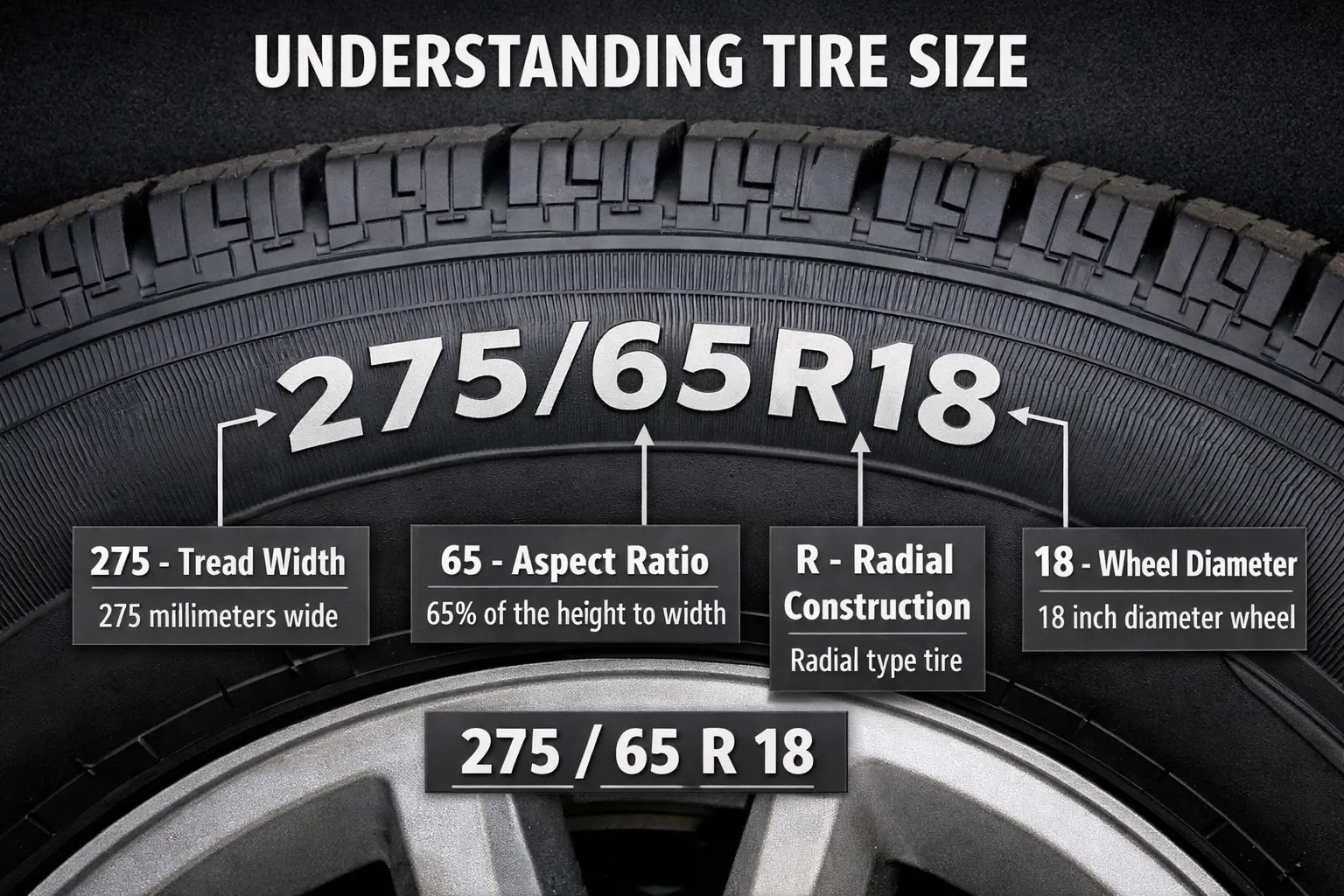
1. Tire Class: P vs LT
The first letter indicates the type of vehicle the tire is designed for:
- P (Passenger) – Designed for cars, crossovers, and many SUVs. Prioritizes comfort and fuel efficiency.
- LT (Light Truck) – Built for pickups, heavy towing, and off-road use. Features stronger internal construction.
2. Section Width (275)
The section width is the tire’s width in millimeters. In our example, 275 means the tire is 275 mm wide from sidewall to sidewall.
3. Aspect Ratio (65)
The aspect ratio is the sidewall height as a percentage of the width. A 65 means the sidewall is 65% of 275 mm. Higher numbers generally mean a "taller" tire and a smoother ride.
4. Tire Construction (R)
The letter R stands for Radial. This is the industry standard for modern vehicles, where internal cords run perpendicular to the direction of travel.
5. Wheel Diameter (18)
This is the diameter of the wheel (rim) in inches. An 18 means the tire must be fitted on an 18-inch rim. This measurement must match your wheels exactly.
6. Load Index (114)
The load index indicates the maximum weight each tire can carry. A 114 rating corresponds to approximately 2,601 lbs per tire.
7. Speed Rating (T)
The speed rating (S, T, H, V, Z) tells you the maximum safe speed for the tire. T is rated for up to 118 mph, common for SUVs and family vehicles.
8. DOT Code & Age
The DOT code indicates the production date. Look for the last four digits: 3522 means the 35th week of 2022. Most experts recommend replacing tires every 6 years due to rubber aging.
9. Severe Weather Markings
- M+S: Mud and Snow (standard all-season).
- 3PMSF: 3-Peak Mountain Snowflake (certified for severe snow performance).
Why It Matters
Choosing the correct size ensures speedometer accuracy, safe braking, and proper load capacity. Always refer to the placard inside your driver's side door for the manufacturer's recommended specs.