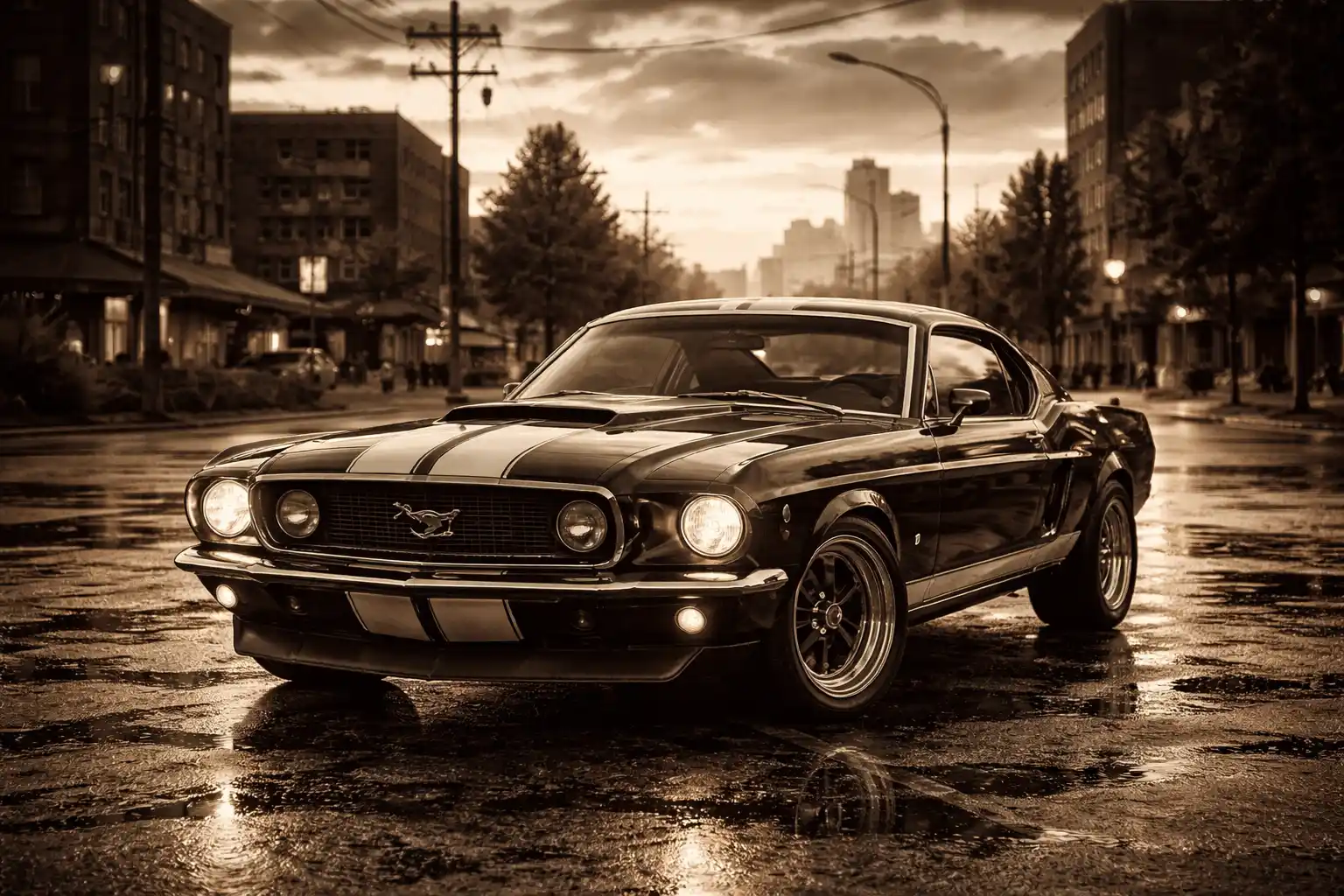
1967 marked the first major redesign of the Mustang. Lee Iacocca knew the competition was heating up (the Camaro arrived that same year), so the Mustang had to get bigger. It grew 2 inches wider and added massive engine bay clearance. Why? To fit the "Big Block" engines that would define the muscle car era.
1. Under the Hood: The 390 FE "Thunder Jet"
While the 289 Hi-Po small block was nimble, 1967 was all about torque. The star of the show was the 390 cubic inch (6.4L) FE V8. This cast-iron monster produced a gross rating of 320 horsepower and a pavement-wrinkling 427 lb-ft of torque.
Unlike modern engines, these powerplants used carburetors (typically a Holley 4-barrel) to mix air and fuel. This is mechanical physics at its finest: the engine creates a vacuum, sucking fuel through calibrated jets. It’s visceral and responsive but requires precise tuning.
⚙️ 1967 GT390 Specifications
- Engine Type: V8 FE-Series "Big Block"
- Displacement: 6,391 cc (390 cu in)
- Fuel System: Holley 4-Barrel Carburetor
- Compression: 10.5:1
- Horsepower (Gross): 320 hp @ 4,800 rpm
- Torque: 427 lb-ft @ 3,200 rpm
- 0-60 MPH: ~7.3 seconds (Tire limited)
CRITICAL OIL TECH: ZINC (ZDDP)
Classic flat-tappet engines like the 390 FE require motor oil with high Zinc (ZDDP) content to lubricate the camshaft. Modern synthetic oils lack this. Running modern oil in a 1967 Mustang can wipe out your camshaft lobes in under 1,000 miles. Always use a zinc additive or dedicated classic car oil.
➡️ Protect Your Engine: Shop ZDDP Zinc Additives
2. The Suspension Reality: Leaf Springs & Live Axles
Driving a '67 Mustang is a physical experience. The rear suspension uses a solid live axle suspended by leaf springs—technology dating back to horse carriages. While great for drag strip launches, this setup is prone to "axle hop" under hard braking or acceleration on uneven surfaces.
The front suspension uses coil springs on upper and lower control arms. A common issue is the "positive camber gain" during cornering, which reduces grip. To fix this, modern restorers often perform the "Shelby Drop"—lowering the upper control arm mounting points by 1 inch to improve geometry.
🛠️ Shop Suspension Rebuild Kits
3. Tires: Bias-Ply vs. Modern Radials
This is the most critical safety section. In 1967, Mustangs rolled off the line on Bias-Ply tires (like the F70-14 Firestone Wide Oval). These tires had stiff sidewalls and a narrow contact patch. They "wandered" on the highway, following every groove in the road.
Today, almost every owner switches to Radial Tires. Radials offer superior grip, better wet weather performance, and highway stability. However, they transfer more stress to the suspension components.
Classic Fitment Guide:
- Original Size: F70-14 (Approx. 195/70R14)
- The "Bullitt" Look: 15x7" American Racing Torq Thrust wheels.
- Recommended Modern Size: 215/65R15 or 225/60R15.
- Tire Pressure: Run lower pressures than modern cars! Typically 28-30 PSI is ideal for classic Mustangs to maintain a flat contact patch.
🛒 Shop The Look: BFGoodrich Radial T/A
4. Braking: The "Widowmaker" Drums
Standard 1967 Mustangs came with 4-wheel drum brakes. While adequate for 1960s traffic, they are terrifying in modern driving conditions. Drum brakes are prone to "brake fade"—after one or two hard stops from 60 MPH, they overheat and lose 50-80% of their stopping power.
If you own one, the single best upgrade is a Front Disc Brake Conversion Kit. This reduces stopping distances dramatically and prevents the car from pulling sideways during emergency braking.
🛑 60-0 MPH Stopping Distance Reality
Original Drum Brakes (Bias-Ply Tires) ~240 ft
Disc Conversion + Radial Tires ~140 ft
*Modern traffic stops much faster. The original setup is unsafe for highway tailgating.*
🔥 Shop Disc Brake Conversion Kits
5. Summary: Preserving the Soul
The 1967 Mustang Fastback isn't just a car; it's a time machine. It smells of unburnt hydrocarbons, vibrates with mechanical harmony, and demands your full attention to drive. It doesn't have ABS, traction control, or airbags.
Maintaining one requires a different mindset. You are the computer. You adjust the carburetor for altitude. You pump the brakes. But when that 390 FE roars to life and the rear end squats on those leaf springs, there is no modern car that can replicate the feeling.