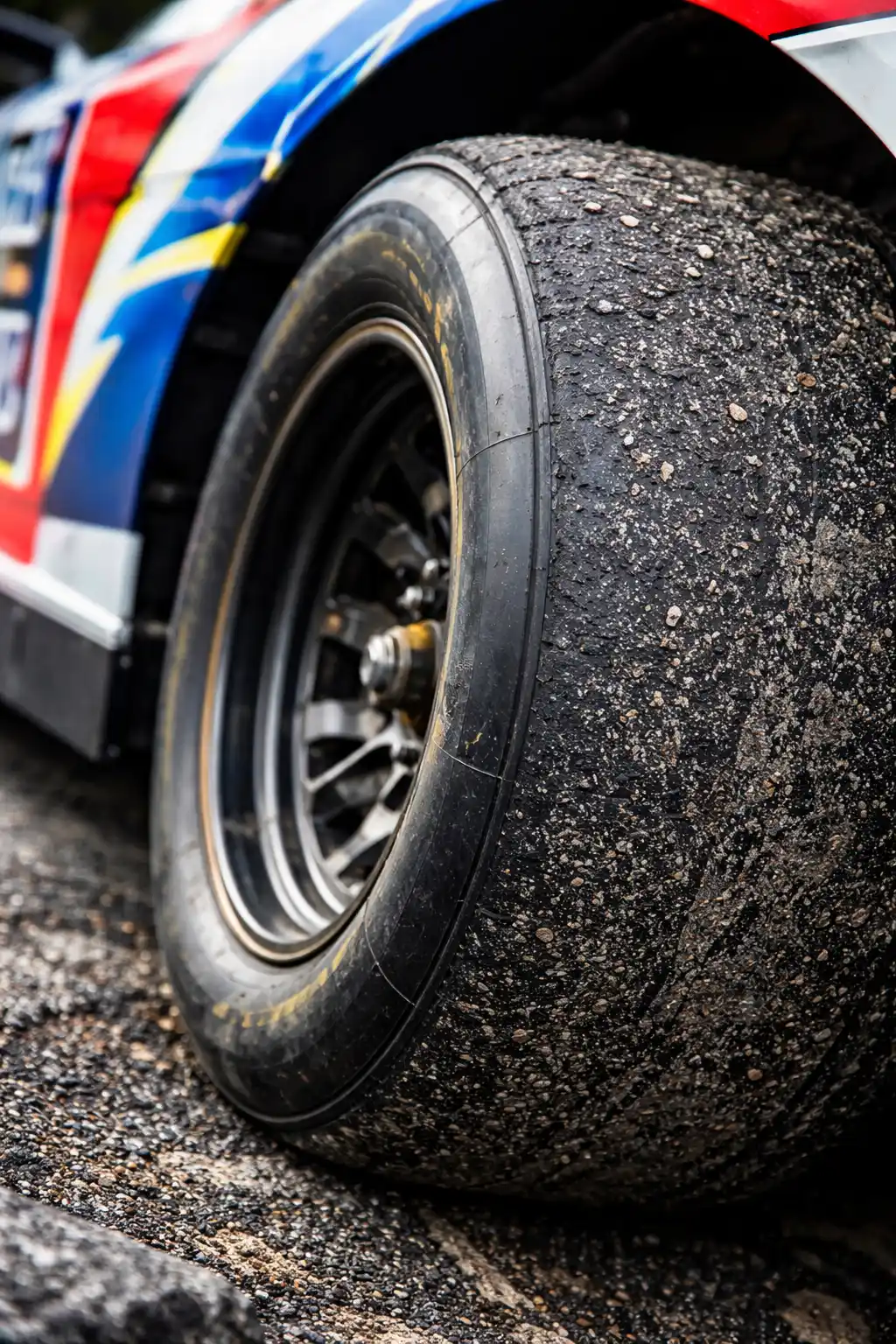
To the casual observer, a NASCAR tire looks like a simple, wide slab of black rubber. But peel back the layers, and you’ll find more engineering in one **Goodyear Eagle** slick than in the entire suspension of a standard road car.
From tires that are intentionally different sizes on the left and right, to safety systems hidden *inside* the air chamber, here is everything you need to know about the rubber that keeps cars on the track at 200 mph.
I. The "Stagger": Why NASCAR Cars Turn Left Automatically
Have you ever rolled a plastic cup on a table? It doesn't roll straight; it rolls in a circle because the top is wider than the bottom. NASCAR engineers use this same physics principle, called **Stagger**.
The tires on the **right side** of the car are slightly larger in circumference than the tires on the **left side**. This size difference means that for every single rotation of the axle, the right wheel travels a longer distance than the left wheel.
II. Nitrogen vs. Air: The Battle for Pressure
You will never find an air compressor in a NASCAR garage. Teams exclusively use **Nitrogen**. Why? Because normal air contains moisture (water vapor).
When a tire heats up from 80°F to 250°F during a race, that water vapor expands unpredictably, causing tire pressure to spike. Nitrogen is a "dry" gas, providing consistent, predictable pressure rise.
Shop Pro Nitrogen-Ready GaugesIII. The Safety Secret: The "Inner Liner"
In the Xfinity and Truck series (and formerly in Cup), Goodyear uses a technology that saves lives: **The Inner Liner**. It is essentially a "tire within a tire."
Inside the main slick, there is a second, smaller, high-pressure tire. If the outer tire blows out at 180 mph, the car doesn't instantly drop onto the metal rim. instead, it lands on this inner safety tire, giving the driver control to slow down safely.
IV. Tire Strategy: "Fall-off" and The Option Tire
Unlike F1, where durability is key, NASCAR *wants* tires to wear out. This is called **Tire Fall-off**. A brand new tire might be 2 seconds faster per lap than a tire that is 20 laps old. This forces teams to make strategic pit stops.
The New "Red" Option Tire
Introduced in 2024, the "Option" tire (marked with red sidewall lettering) is a softer compound. It provides incredible grip for short sprints but degrades rapidly. Teams must decide: go fast now, or survive later?
V. Can you buy these for your car?
The actual racing slicks are illegal for street use. They have no tread for rain, and their construction is too fragile for potholes. However, Goodyear produces the **Eagle Exhilarate** and **Eagle F1** series for street cars, using data derived directly from the track.
| Feature | NASCAR Slick | Street Goodyear Eagle |
| Tread | None (Bald) | Asymmetric Pattern |
| Weight | ~24 lbs | ~28-32 lbs |
| Cost | $2,500 / set (Leased) | $1,200 / set (Owned) |
| Life | ~60 miles | ~30,000 miles |
Fans often collect used race tires as memorabilia. You can find tire fragments and diecast models below.
Shop NASCAR Collectibles & Models