It's almost two years ago now that we gave the century-old Autocar road test its last major facelift. Our 2024 re-jig was significant for changes in many parts, but none more significant than to the road test itself, which we adjusted so it had more to say about electric cars and PHEVs, more scrutiny in the way it tested them and more flexibility to address the relevant facets of any given new car.
One of the tests we added was an extra efficiency test schedule intended to give EVs and hybrids a fairer way to demonstrate one of their key strengths. We call it the ‘everyday’ economy test. Two years into its life, I thought now might be an interesting time to review which cars have excelled at it – and which have disappointed.
Before we added the ‘everyday’ bit, electrified cars had only the same efficiency tests that we habitually put all of our test subjects through as a way to show their potential. Those included a ‘track’ efficiency test schedule, showing the economy of a test car while actually being performance tested; a ‘touring’ test schedule done on the proving ground’s high-speed bowl for the sake of repeatability but designed to reproduce the economy returned on a 70mph highway cruise; and an overall test average – what the test car returned over the entirety of its test loan with us, irrespective of type of usage.
 View Price on Amazon
None of these really gave electric cars or hybrids a fair chance, because the efficiency of EVs rises above others when they’re running at lower speeds (because they lose much less energy to waste heat than combustion-engined cars do) and when they have a chance to regenerate energy when slowing down.
The ‘everyday’ economy test, therefore, is made up of four concurrent laps of Horiba MIRA’s ‘Number Two’ circuit (in effect a 2.2-mile, two- or three-lane, equilateral triangle). These are taken at 10mph increments from 20-50mph, with two full stops per lap made for the test car to regenerate and redeploy energy.
As with all of the road test’s economy schedules, we depend on the car’s trip computer for the data we record. The trip is reset before every test, and the cars cover hundreds more miles away from the test track in the hands of our testers. That extraneous use gives us plenty of time to keep tabs on whether those trip computers are accounting accurately.
We’ve tested 55 new electric cars since that reinvented road test issue. Only one of them failed to post a better result in that ‘everyday’ test than it managed in the 70mph-typical, longer-distance ‘touring’ test, and given that was the 2013 horsepower Lotus Evija, we can consider it the exceptional outlier that proves the validity of the test.
To the cream of the crop, then. Nine of those cars posted a result of 5.0 miles per kilowatt-hour or better. Some were the small, light kind of EVs you would expect to be capable of running efficiently – but one or two, not so much.
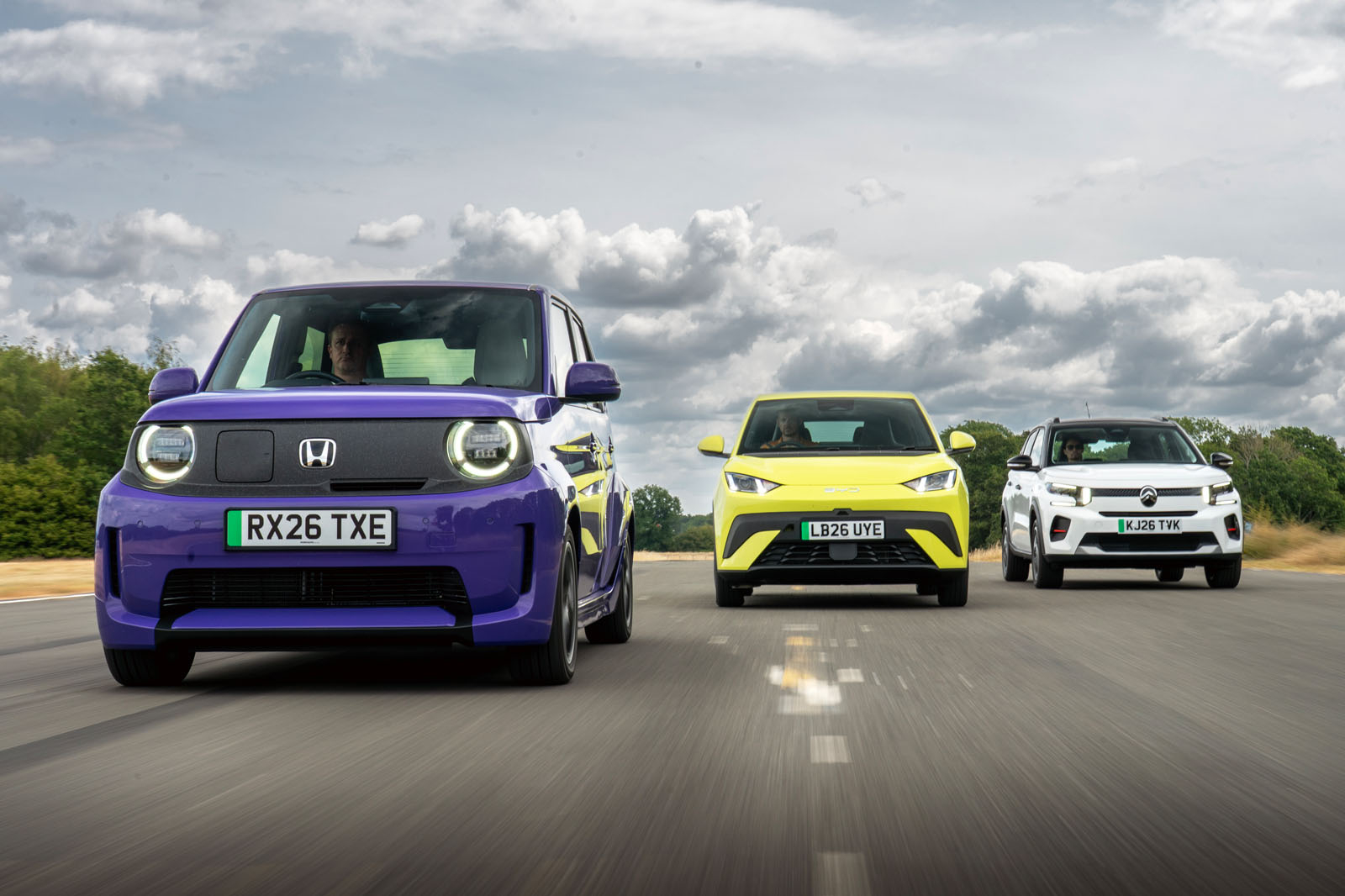
The Renault 5 and Hyundai Ioniq both just nudged over that particular 5.0 miles per kilowatt-hour line, for example, but the Honda e and BYD Dolphin Surf both eased over it with room to spare, at 5.6 miles per kilowatt-hour each.
Earning all the more credit allowing for the bit of extra bulk they carried, take a bow the Renault 4 E-Tech (5.6 miles per kilowatt-hour), the MG 4 EV Urban (5.5 miles per kilowatt-hour), and the only car yet to breach six miles per kilowatt-hour: the Ford Puma Gen-E (6.2 miles per kilowatt-hour).
Which leaves two genuinely outlying cars that show that efficiency can come in unexpected places where electric vehicles are concerned. One is the Volvo ES90 Extended Range Single Motor, which posted 5.0 miles per kilowatt-hour exactly despite weighing more than 5,000 pounds; the other is the Cupra Born VZ, which cruised its way to 5.1 miles per kilowatt-hour despite having 20-inch wheels, 402 lb-ft of torque and a pretty overt performance brief.
Among the cars you might have expected efficiency from but which didn’t really deliver it were the Volvo EX30 Single Motor Extended Range at 3.6 miles per kilowatt-hour, the Citroën ë-C3 (4.0 miles per kilowatt-hour) and the Mini Aceman SE (4.3 miles per kilowatt-hour).
Big, fast, heavy electric cars are, of course, always unlikely to use less energy, as they consume more energy to move.
Source: autocar.co.uk