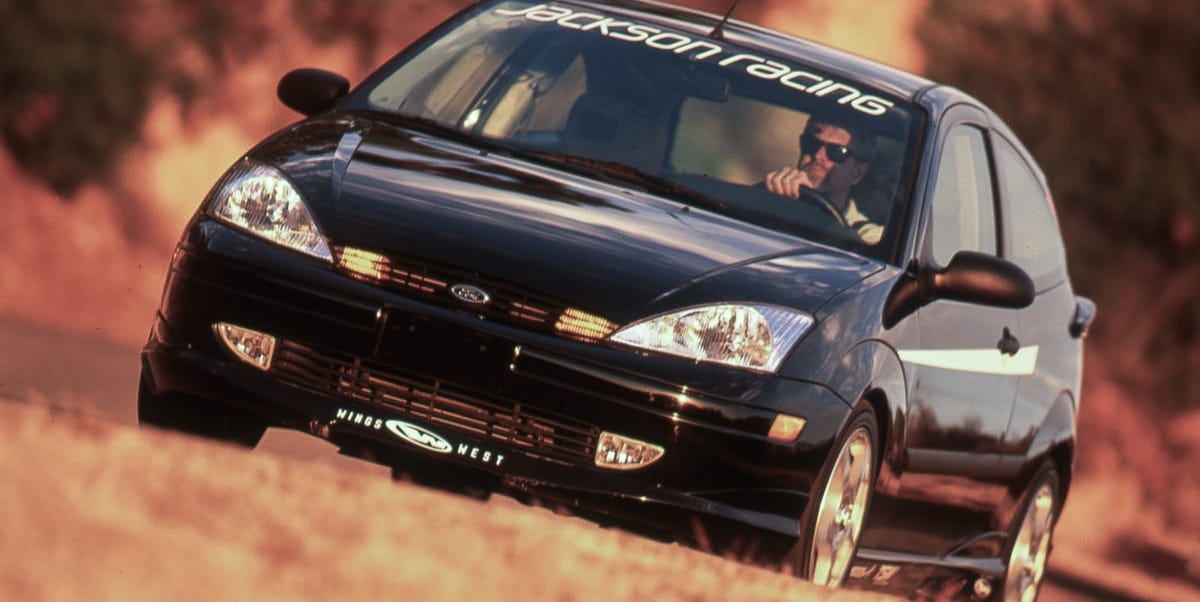
Is it quick enough to outrun its own price tag? That's the question we aimed to answer back in April 2002, when we first got our hands on the Jackson Racing Supercharged Ford Focus ZX3 for a Car and Driver test.
We usually have a simple formula for evaluating tuner cars (TC): their worth is inversely proportional to the square of the size of the entourage (E) accompanying them during a test, multiplied by the inherent goodness of the untouched stock vehicle (SV). So, according to our TC = SV/E² formula, a modified machine arriving with two minders is only a quarter as good as one with a single handler—and a tuner car with four attendants? Forget about driving it. But Jackson Racing simply handed over their supercharged Ford Focus ZX3 and told us to return it when we were finished. Zero people attached. So much for a rule of thumb when its denominator vanishes.
At 47 years old, Oscar Jackson was already twice the age of many small-car tuners when we first met him. His journey began with Hondas, dating back to a time when the cutting-edge trick involved stuffing high-compression Gold Wing motorcycle pistons under the cylinder heads of early Civic CVCCs. Since the mid-1990s, his focus has shifted to developing supercharger systems for four-cylinder Hondas and Acuras, the Mazda Miata, and most recently, Ford's Focus ZX3. It's no surprise that the objectives of this tuning veteran are considerably more mature than the nihilistic bravado often displayed by younger enthusiasts.
 View Price on Amazon
At the core of Jackson's performance kit is the Eaton supercharger—the identical Roots-type blower found in diverse vehicles like the Mercedes SLK230, the formidable Ford SVT F-150 Lightning, and the luxurious Jaguar XJR. For the Focus, Jackson employs the smallest 45-cubic-inch twin-rotor Eaton unit, bolting it to the 2.0-liter DOHC 16-valve Zetec four-cylinder engine. This supercharger operates at 1.73 times the engine's speed and features an integrated bypass valve, allowing for a modest 6.0 pounds of boost. Jackson’s primary objective isn't to convert the Focus into an aggressive track weapon (despite its numerous decals) but rather to enhance everyday driving performance.
Positioned neatly between the firewall and the engine block, the supercharger draws air through the factory throttle body, air-mass sensor, and air filter before pushing it into a custom-cast manifold. Jackson’s Focus also features "shorty" headers from Focus Sport, priced at $349. Regardless of their actual power-boosting effectiveness, they certainly enhance the engine bay's aesthetics. These headers then feed into the original catalytic converter and a Focus Sport stainless steel exhaust system, costing $600. Aside from a supplementary electronic fuel controller secured with hook-and-loop fasteners to the battery cover, the entire setup appears so seamless it could almost be mistaken for a factory Ford installation.
On Jackson Racing’s Dynojet chassis dynamometer, a stock Focus ZX3 typically generates peak figures of 103.4 horsepower and 110.7 pound-feet of torque at the wheels. (For context, Ford states the Zetec four produces 130 horsepower and 135 pound-feet at the flywheel.) With the addition of the supercharger, headers, and exhaust, Jackson’s tests reveal significantly improved numbers: 150.2 horsepower and 129.5 pound-feet at the wheels. Notably, the power peak shifts closer to the engine’s 7,000-rpm redline, a considerable jump from the 5,300 rpm peak claimed by Ford for the stock ZX3 (and confirmed by Jackson’s testing).
Running on 205/45VR-16 Yokohama A520 tires, which are 0.9 inches shorter in diameter than the stock ZX3’s 205/50VR-16 Goodyear RS-A rubber, the supercharged Focus accelerated to 60 mph in 8.4 seconds. This is a notable improvement over the 9.1 seconds recorded for a stock ZX3 tested on the same day. It also completed the quarter-mile sprint in 16.6 seconds at 84 mph, while the stock model managed 16.9 seconds at 81 mph. Even more impressive were its mid-range acceleration figures: the 30-to-50-mph time dropped from a stock 15.0 seconds to 11.1, and the 50-to-70-mph run decreased from 13.8 to 12.7 seconds. While certainly quicker, these gains aren’t quite the dramatic boost one might anticipate from a 47-horsepower increase in a lightweight vehicle. Furthermore, the Jackson Racing Focus couldn't quite match the performance of Ford’s own recently launched 170-hp, six-speed SVT Focus, which hits 60 mph in a swift 7.8 seconds, covers the quarter-mile in 16.1 seconds at 87 mph, and goes from 30 to 50 mph in 11.2 seconds.
Source: caranddriver.com

