The EV Tire Crisis: Why Your Electric Car is a Rubber-Eating Monster
You bought an EV to save the planet and save on gas. But then came the first 15,000-mile service, and the technician dropped the bomb: "You need four new tires." Welcome to the dark side of electric mobility. In this comprehensive tire guide, we explain the physics of EV tire wear and why regular rubber just won't cut it anymore.
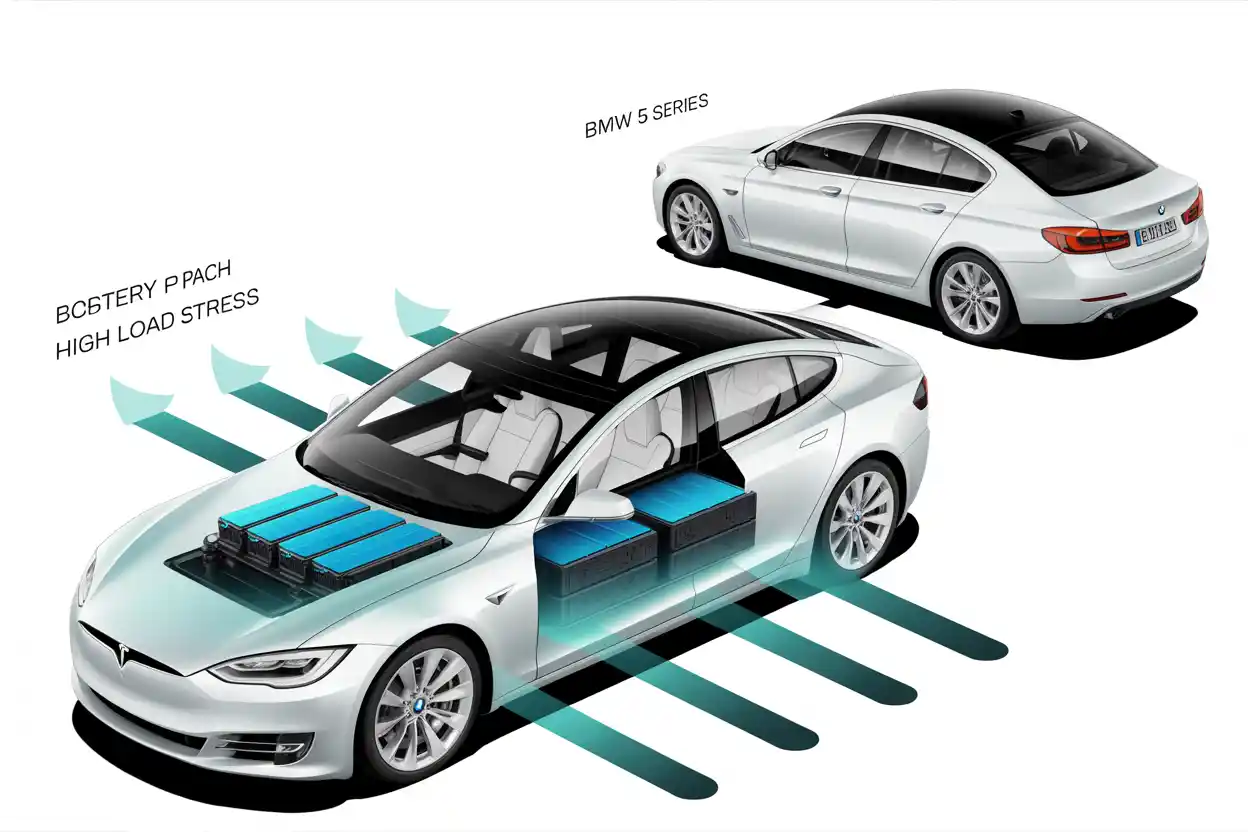
1. The Physics of Heavy Batteries: Why EVs are Different
An electric vehicle is significantly heavier than its internal combustion (ICE) equivalent. A Tesla Model 3 weighs roughly 1,000 lbs more than a BMW 3-Series, primarily due to the massive lithium-ion battery pack sitting in the floor. This constant "dead weight" puts an enormous strain on the tire's structure.
In the world of tire pressure, EVs require extreme precision. Because the car is so heavy, even a 2 PSI drop can lead to a massive increase in rolling resistance, which doesn't just kill your tires—it kills your range. For an EV, a tire is not just rubber; it is an extension of the battery management system.
2. Instant Torque: The Silent Tread Shredder
The beauty of an EV is the instant torque. 0 to 60 in 3 seconds feels like a roller coaster, but for your tires, it's an abrasive nightmare. Unlike a gas engine that builds power linearly, an EV motor delivers 100% of its twisting force at 0 RPM. Every time you "launch" at a green light, you are micro-sliding the rubber against the asphalt.
This creates a unique type of wear called "Torque Striation." When you look for a tire online, you must look for "EV-Specific" compounds. These tires use a more rigid tread block design and high-silica content to resist being torn apart by 500+ foot-pounds of instant torque.
⚠️ Look for the "HL" Mark
In 2026, the new industry standard is the HL (High Load) rating. Regular tires are SL (Standard) or XL (Extra Load). If your EV manual calls for HL tires and you install XL tires to save money, the sidewalls will flex excessively, causing the tire to overheat and potentially delaminate at highway speeds.
3. The Sound of Silence: Acoustic Foam Technology
Without an engine to mask the noise, tire roar becomes the loudest sound in an EV cabin. This has forced manufacturers to reinvent the internal structure of the tire. If you cut open a premium EV tire bought online, you will find a thick layer of polyurethane foam glued to the inside of the tread.
This foam acts as a "hush kit," absorbing the high-frequency vibrations that cause cabin drone.
The Trade-off: These tires are more expensive and harder to repair. A standard plug kit might not seat properly because of the foam lining. This is why every EV driver needs a specialized roadside kit.
4. Range vs. Grip: The $1,000 Compromise
When choosing tires for your EV, you are choosing between two extremes:
| Feature | Standard Tire | EV-Optimized Tire |
|---|---|---|
| Rolling Resistance | High (Bad for Range) | Ultra-Low (Extra 20-30 miles) |
| Road Noise | 72 dB (Loud) | 67 dB (Silent) |
| Tread Life | Short (Fast Wear) | Long (Harder Compounds) |
5. Maintenance: The "No-Rotation" Myth
Many EV owners believe that because the car has "One-Pedal Driving" (regenerative braking), the brakes and tires last longer. This is only half-true. Regenerative braking actually puts more stress on the tires because the motor is constantly pushing and pulling against the rubber to slow the car down.
Our tire guide for EV owners is strict: Rotate your tires every 5,000 miles. Because of the rear-bias torque in most EVs, the rear tires will bald twice as fast as the fronts. If you miss a rotation, you'll be buying a new set 10,000 miles early.
🏁 The Final Verdict: Is it a Scam?
EV tires are not a marketing gimmick. They are a mechanical necessity. Between the weight, the torque, and the noise requirements, your electric car is a high-performance machine that requires high-performance maintenance. Keep your tire pressure high (usually 40-42 PSI for EVs) and always buy the correct load-rated tire online. Your range—and your wallet—will thank you.
Driving into the future? Do it on the right rubber. Check out the rest of our tire guide.
*As an Amazon Associate, we earn from qualifying purchases.*