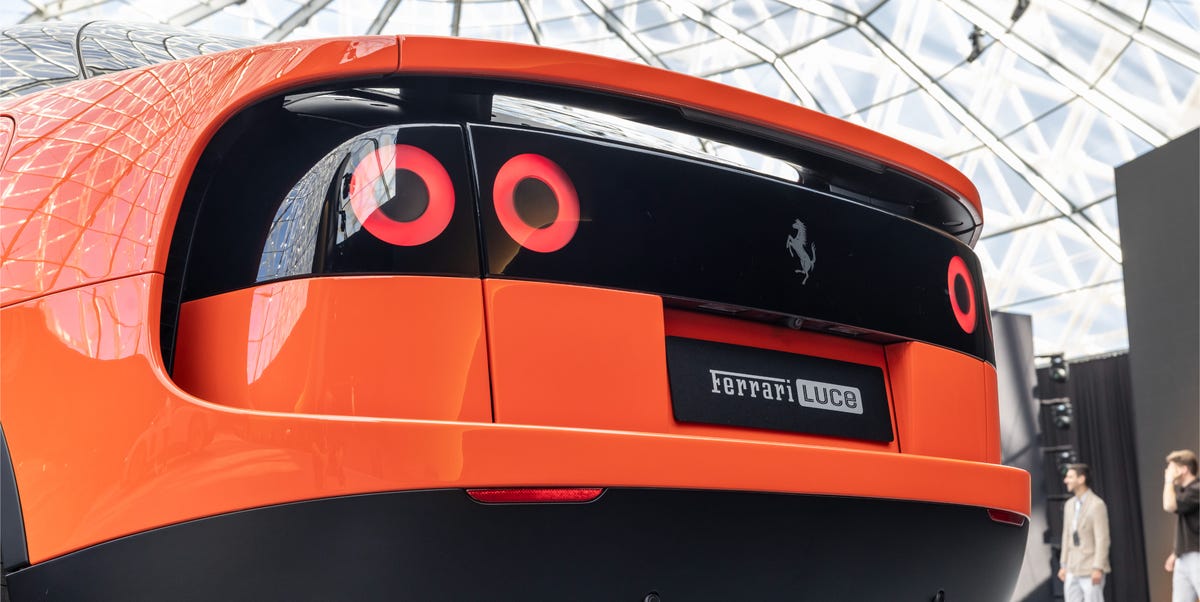
The decision to turn the Luce into a larger five-seater was born from the brand's approach to tech development. Ferrari's first crack at an electric vehicle arrived this week to a visceral reaction. Not only does the Luce not pack one of the brand's legendary combustion engines, it also happens to be the largest (and most controversial-looking) vehicle that Ferrari has ever developed. The bold four-door/five-seat layout wasn't exclusively prescribed by the top brass to turn units, but rather came to be as a result of Ferrari's general approach to new technology development.
The Luce—which was designed in partnership with Silicon Valley-based firm LoveFrom—is a significant departure from Ferrari models of yesteryear on both the styling and layout fronts, but thematically it isn't entirely unique. The brand has long offered machines that blend sporting intent with a more comfort-oriented experience, whether that be the 400, 412, 612 Scaglietti, FF, or GTC4 Lusso. This isn't Maranello's first take on the SUV segment either, with the Purosangue striking a similar balance to the Luce. That said, whereas the Purosangue was always intended to be a crossover, the Luce's development didn't begin with that same mission.
 View Price on Amazon
"We didn't start from the point that we need to have a bigger car," Ferrari product manager Pietro Virgolin told R&T at the Luce debut event. "We started to say we would like to have an electric car because we can manage all the technology. We have the naturally aspirated engine, we have a turbo engine, and we have the hybrid engine, so we are able to manage the electric engine. And then we say, 'Which are the key performance of the electric platforms?' Great, strong acceleration, a lot of torque, and so on. And then we say there are still other good things that came from this kind of technology?"
Virgolin specifically noted the precise amount of control that a four-motor powertrain provides the engineering team, as well as the undeniable noise, vibration, and harshness improvements that accompany electric motors. "For example, you can have no noise for a long trip... You can have space," Virgolin said. "Every time that we approach a new technology, we ask, 'What can we bring from this area of technology from any point of view?' Our focus is the performance. Every time, we need to increase the performance, but then, if there is a technology that can permit us to achieve other targets, we will use it."
The brand naturally began to lean into those principles as Luce development continued. The nature of an electric "skateboard" platform allowed the brand to really play with packaging requirements, particularly when it came to the interior. All of the brand's combustion cars feature an engine mounted between the axles, which necessitates a transaxle for ideal weight balance. These gearboxes eat up space in the cabin, which Ferrari says is why it has never offered a genuine five-seater. Ferrari execs also argue that the shapes we view as "sporty" today are only viewed that way as a result of traditional packaging requirements.
Source: roadandtrack.com

