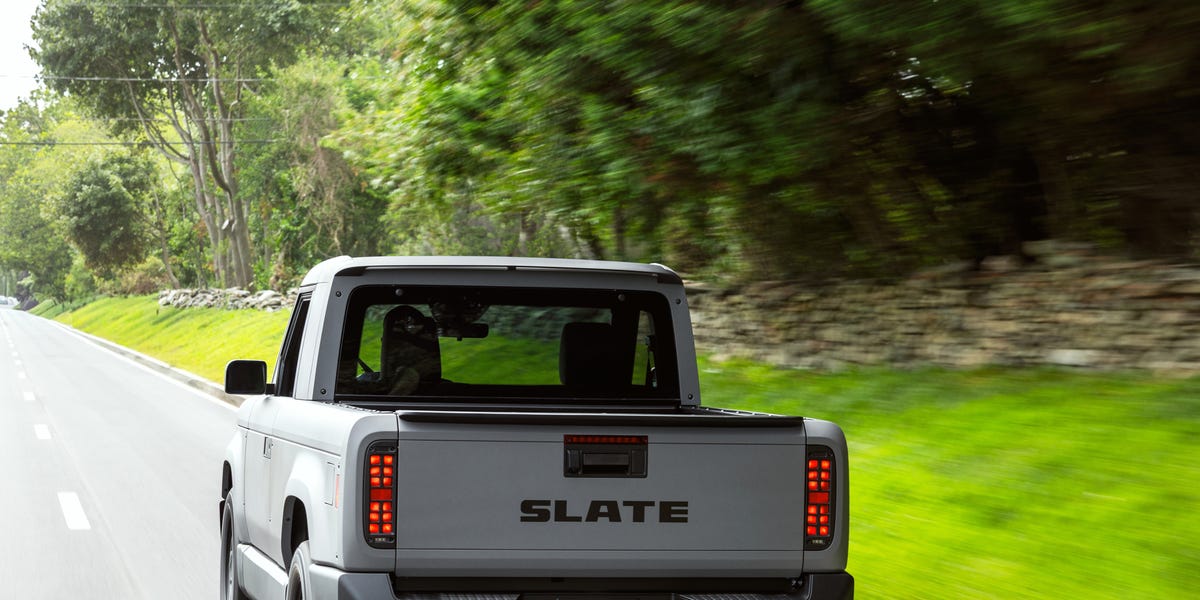
The aptly named Blank Slate is a springboard for the imagination, but its ultrabasic foundations may not be for everyone. We haven't met a single person who has leapt for joy over the fact that the average new-car transaction price is hovering around the $50,000 mark. In fact, the chorus of people crying out for something genuinely affordable to the bottom half of the K-shaped economy continues to grow. Enter Slate, a plucky startup that hopes to break into the market with its ultra-modular electric truck that forgoes nearly every creature comfort to keep its base price well below $30,000.
We headed to Rhode Island to take a brief spin in a prototype and see if Slate's got the sauce ahead of its fourth-quarter debut. We've already discussed the Blank Slate's buy-only-what-you-want modularity in depth, so we'll keep it brief here. On its face, it's a fabulous idea: You buy the stripped-out, bare-bones truck for $26,400, then buy the piecemeal upgrades you want, whether at the point of purchase or later on down the road. Most can be installed yourself with time and patience, but trickier things—like the two-row SUV body conversion or one of the many vinyl wraps on offer—can be farmed out to professionals for better results.
The Slate truck we drove was nearly a full-on stripper, with the speaker upgrade for demonstration purposes and little else. There's no getting around the fact that nearly every touch point in the cabin is, well, hard: The plastic's graining is yet to be finalized, but no matter what pattern is stamped into it, there's no cushiony support to be found anywhere but the seats, not even the door's armrests. Our model lacked a center armrest; instead, there was a long, low tray comprising most of the standard interior storage. It's capacious enough for everything in your pockets, though, and a taller center console is an available upgrade.
 View Price on Amazon
The Slate's powertrain is a simple, humble thing, but that proves fine when dealing with a vehicle that has an estimated curb weight that begins with a 4. A 181-hp electric motor feeds the rear wheels, getting its juice from a 63-kWh lithium-ion battery pack, instead of the 45-kWh one that was announced earlier. Slate's internal estimates keep changing, but as of this writing, the company expects this change alone to up the standard range from 150 miles to a handy 205 miles.
Previously, the company said the truck would charge via its standard NACS port at rates up to 120 kilowatts, but after playing around with the thermal management, that number has dropped to 90 kilowatts. That's not quick, but with a small battery, DC fast-charge times should remain acceptable, and you can always bypass that by plugging in overnight at home. However, with the Slate's price point likely to appeal to renters and other folks who may not have access to home-charging infrastructure, you might see a good number of Slates populating your local Superchargers.
Our time behind the wheel was brief, limited to about half an hour on Newport-area roads just as the evening commute started to pick up steam, but that was enough to get a taste of what buyers should expect. Despite being equally light on curb weight and features, Slate didn't strip every inch of civility out of its truck; the doors close without sounding hollow, and the key fob feels better than some from automakers charging twice as much. Pushing the fob into its dedicated dashboard slot starts the car, and shutting the whole thing down is as easy as pulling it back out.
The Blank Slate's 181-hp electric motor provides ample around-town motivation. At no point did we feel lacking for power in on-ramp maneuvers or while darting through traffic. Hell, with an empty bed, you can get the rear wheels to break loose with a bit of aggressive driving.
Source: caranddriver.com