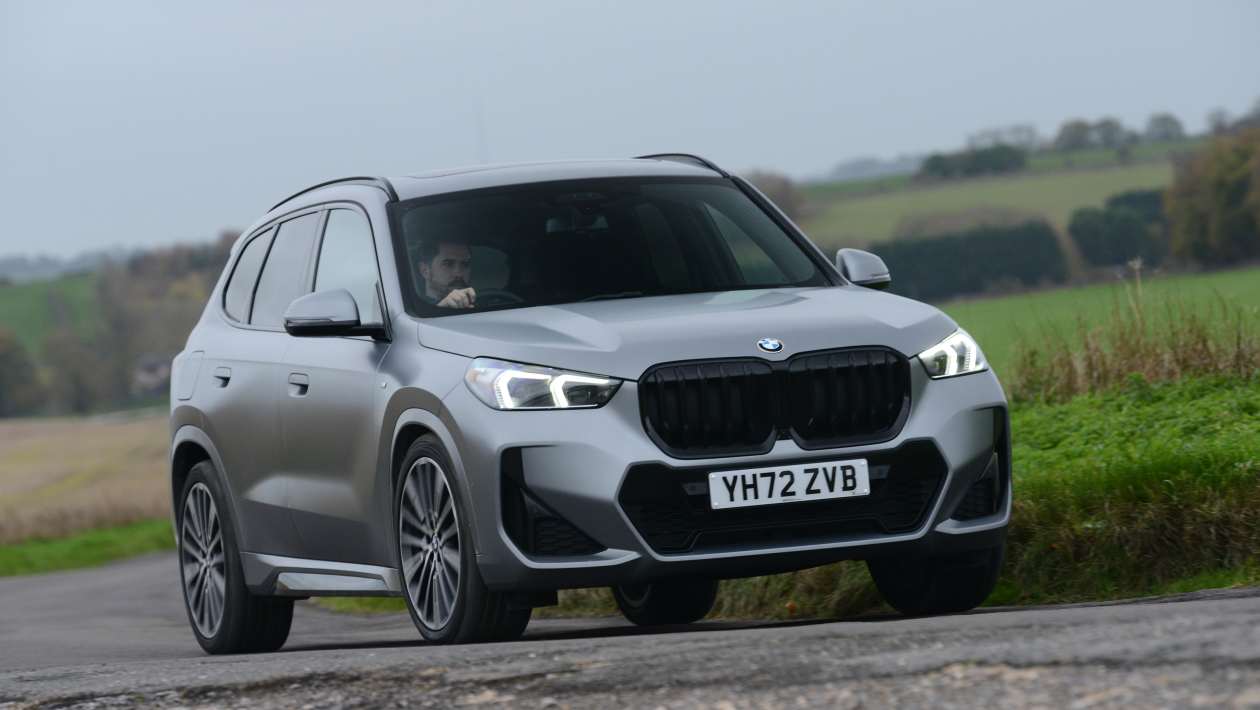
Bmw's hit rate is better than most. The company has produced very few poor cars in recent years, despite its designs being sometimes controversial. The Bmw X1 and Bmw iX1 are just what you would expect from the brand, because they are user-friendly with truly excellent infotainment systems, feature high-quality cabins, they’re generally good to drive (firm ride notwithstanding), and they’re also efficient.
In short they’re easy to live with, but the iX1 has a fairly significant flaw in that its range isn’t as good as it should be. If that isn’t a deal breaker for you, the upside is that used iX1 values are fairly keen. If it is a deal breaker, the ICE X1 makes for a very decent substitute.
After Bmw introduced the X5 to enormous acclaim in 2000, it was inevitable that it would expand its customer base by offering smaller and more affordable SUVs. By 2004, the X3 had arrived, then five years later came the first-generation X1. All proved to be smash hits, and since those first editions we’ve had numerous generations of each, with the latest X1 – the third generation – also available in electric form as the iX1.
 View Price on Amazon
We ran an X1 xDrive23i and iX1 eDrive20 on our long-term fleets and thought they were both excellent in most respects: fun to drive, efficient, high-quality and easy to live with; the X1’s firm ride grated after a while, but that was about the only problem. Buy one and you’re unlikely to be disappointed in any meaningful way, which is why we presented Bmw’s smallest crossover with our Small Premium SUV of the Year award in 2023.
When Bmw launched the third-generation X1 in May 2022, it also came in fully electric form as the iX1. For those wanting to stick with a petrol engine, there was the 215-horsepower xDrive23i with a 2.0-liter engine. Diesel fans could choose between the 148-horsepower sDrive18d and the 208-horsepower xDrive23d, both with a 2.0-liter engine. Bmw also offered two plug-in hybrids: the 241-horsepower xDrive25e and the 321-horsepower xDrive30e. The electric iX1 was first offered as the 309-horsepower eDrive30.
A new entry-level petrol model joined the line-up in spring 2023 – the 168-horsepower sDrive20i – shortly followed by the X1 M35i xDrive range-topper, which came with a 296-horsepower twin-turbo 2.0-liter four-cylinder petrol engine. Within weeks a new entry-level model was also added to the iX1 range. The eDrive20 had 201 horsepower sent to the front wheels.
All of the regular petrol and diesel models come with mild-hybrid tech as standard; only the M35i misses out on this. Expect a real-world 35-40 miles per gallon from the petrol engines and 50-55 miles per gallon from the diesels. The plug-in hybrids typically give 45-55 miles per gallon, but can give much more depending on journey length and driving style.
Both derivatives of the iX1 have a 64.7-kilowatt-hour battery; Bmw claims that the eDrive20 gives up to 296 miles while the xDrive30 can do up to 272 miles on a charge. Our long-term eDrive20 averaged 3.7 miles per kilowatt-hour to give a real-world range of about 230 miles. Choose between Sport, X Line, M Sport and M Sport Pro trims, all of which are well equipped and get ever sportier with their design and equipment, the further up the model range you go.
The entry-level petrol and diesel models are quick enough, but the posher editions are really pretty rapid; the xDrive30e can do 0-60mph in just 5.6 seconds (the same as the iX1 xDrive30), whereas the sDrive18d takes 8.9 seconds.
But the performance is just a small part of the picture, because all X1s and iXs are among the best in their respective classes, when it comes to driving enjoyment. The X1 has the edge when it comes to steering feedback and brakes, while M Sport editions have a firm ride that you might find uncomfortable, but overall the driving experience is very good.
Source: autoexpress.co.uk