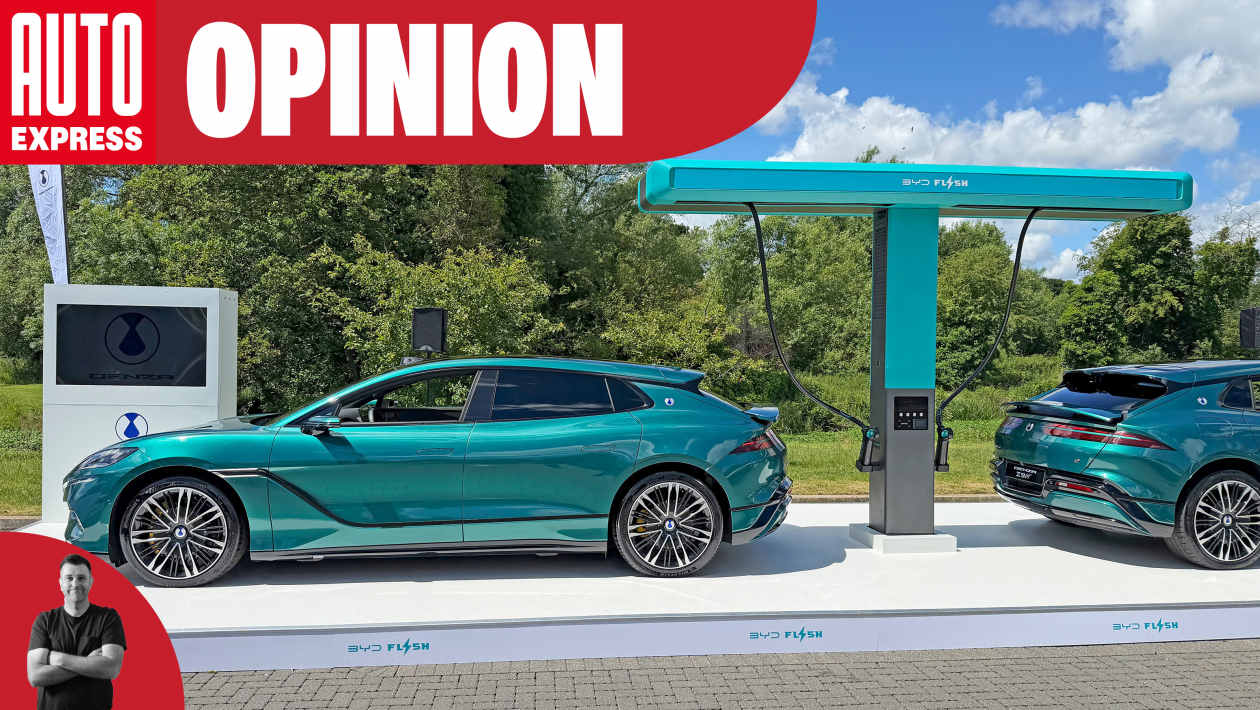
BYD has demoed its much heralded Flash Charging system in the UK, boasting an ambitious roll-out plan that will see these battery-assisted, 1.5-megawatt chargers popping up around the country with the promise of never-before-seen charging speeds for EV owners. Flash Charging is four times quicker than the fastest EV chargers, meaning a typical full charge on a big-battery EV could take nine minutes or less.
We're getting into the realms of EV charging timescales equalizing with those for a traditional fill-up with gasoline – albeit one where you also get $30 out of the cash machine and spend three minutes battling your conscience while browsing the chocolate bar rack. But it's all just a gimmick. Nobody is going to turn down the opportunity to perform a menial task like refueling a car more quickly, all other things being equal, but ultra-rapid charging isn't going to transform the EV experience for owners.
 View Price on Amazon
With modern EVs easily offering 300-mile driving ranges in the real world and some nudging 500 miles in the official tests, the scenario where you need to add an 80 percent charge to your battery in double-quick time just doesn't present itself for the vast majority of drivers. You might need another 50 miles of range to reach your destination, but you can already add that in a few minutes at a standard rapid charger. The beauty of EVs is that our cars sit idle for 95 percent of the time, and that is the perfect opportunity to charge them.
The name might not exactly inspire confidence – the last thing I want to see when plugging a 1,500-kilowatt cable into my electric car is a 'flash' – but BYD's Flash Charging stations can contribute to removing one of the bigger barriers to EV adoption. The resistance to change is strong in the American public, and the idea of charging an EV in the same amount of time needed to fill a gasoline tank is reassuring and seductive, even if the practical value is questionable.
BYD is proposing to offer its Flash Charger network at a price of 50 cents per kilowatt-hour to owners of its cars, but admits that the price of getting access to suitable locations at garages, supermarkets, and service stations may be prices that are equalized with rapid charger networks that are already there. This means paying up to around the US average price for rapid charging of around 80 cents per kilowatt-hour.
This is the inequality of EVs. Much has been done by manufacturers to increase choice and improve range. The EV Grant, and competition from Chinese brands such as BYD, has cut prices. Yet, if you can charge at home, you might pay around 26 cents per kilowatt-hour on the current price cap or 8 cents per kilowatt-hour overnight on a special EV tariff.
The cost of charging an electric car for people without access to home chargers is the real problem, not the speed at which a full charge can be pumped into the giant 122-kilowatt-hour battery of a $100,000, four-door GT. In urban areas, where the air quality benefits of EVs could be most keenly felt, people without private parking are being prevented from making the switch because of the cost and inconvenience of the public network.
Source: autoexpress.co.uk