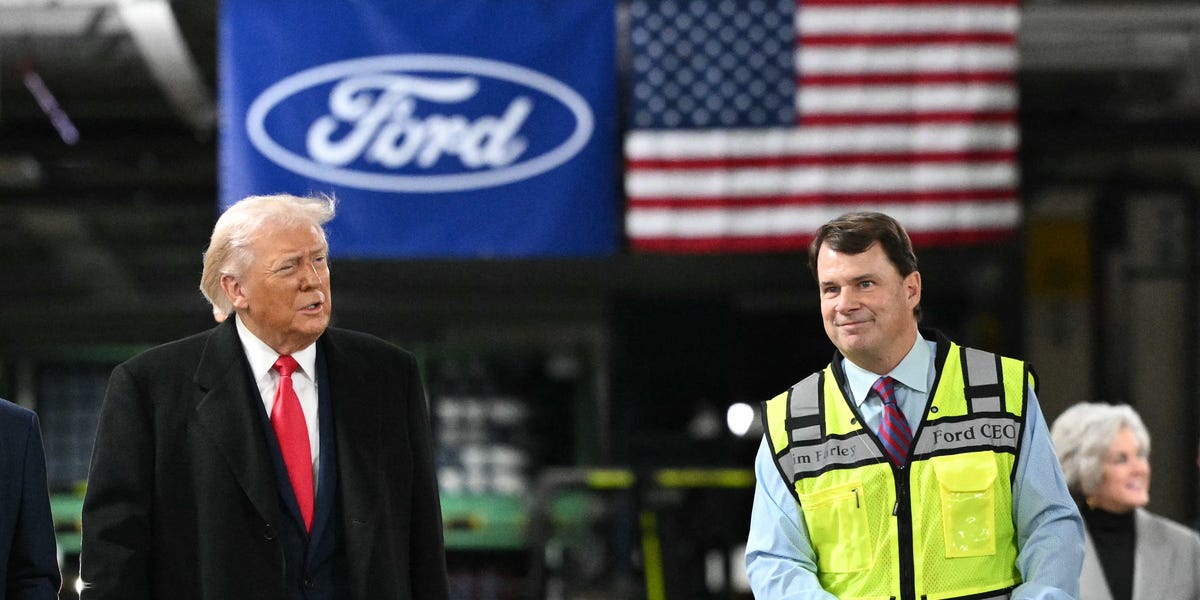
The president finds the fight 'strange' and says the federal government is going to do something to help owners. In a recent Oval Office meeting to discuss upgrading coal plants, President Donald Trump mentioned a June 3 visit he had with representatives from Ford, General Motors, and Roger Penske, the race team owner and leader of an auto-dealer empire. They had met to discuss Right to Repair laws with the president, who made it sound like this was the first time he had heard of such legislation, calling it "strange" and claiming that automakers "don't want people to fix their car."
Trump also made some comments about people he knew in his youth who "weren't too good at arithmetic" but could "fix an engine blindfolded." It wasn't clear what specific legislation the president was referencing, as there are multiple bills in Congress that aim to preserve an owner's right to repair their vehicle. Trump wasn't specific about any solution, either, but said the federal government would "get it all straightened away."
 View Price on Amazon
In a brief video interview, the Detroit Free Press got a response from Ford CEO Jim Farley about Trump's comments. Farley defended the automaker's desire to restrict Right to Repair, couching them as safety-related, saying that he can fix a 1973 Ford Bronco, but if someone wants to fix a new Bronco at home, it "would put people's lives at risk." In his response, Farley also noted that Ford doesn't want owners doing warranty work at home, although that's not really at the core of Right to Repair. Plenty of owners want to be able to repair and maintain their vehicles themselves both in and outside of the warranty period.
Farley also said owner repairs have to be done at a reasonable cost, but he didn't elaborate on what that means in terms of Right to Repair. If anything, that could be an argument for more affordable access to the specialized tools necessary to diagnose and work on modern cars. Ford has been in the news recently with an ad campaign designed to steer Ford owners to its dealers for service and repair instead of independent shops. This comes as car owners are keeping their vehicles longer than ever, with the average vehicle age now at 13 years.
Data from Cox Automotive also shows that dealer service revenue has declined 12 percent since 2018. This reduction in turnover of the national fleet has obvious financial implications for automakers selling vehicles and their dealers working on and servicing them. Along with the safety claims, automakers—through the Alliance for Auto Innovation lobbying group—point out that there are security ramifications associated with allowing access to computers in vehicles.
There is an argument to be made there, as connected vehicles raise the possibility of bad actors gaining access to and potentially controlling vehicles, either locally or remotely. Consumers argue that they're being locked out of even the diagnostic information on vehicles, which manufacturers consider proprietary information, the intellectual property that separates one company from another. That argument makes more sense than the safety or security reasoning and is likely the main driver of companies' opposition to Right to Repair.
This is not the first time Right to Repair has come up in relation to the auto industry. A 2014 memorandum of understanding signed by groups representing the major automakers agreed to provide private owners and independent repair facilities with the diagnostic and repair tools and supporting information needed to work on vehicles produced from 2002 on.
Source: caranddriver.com

