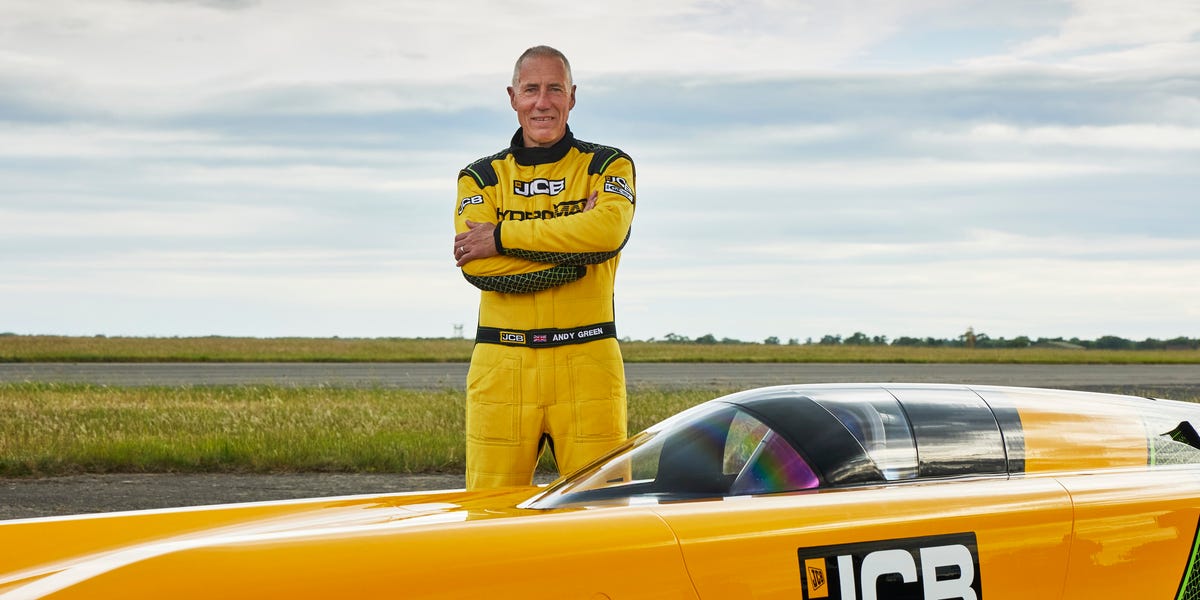
Former RAF pilot Andy Green went supersonic with the Thrust SSC, reaching a two-way average of 763.03 mph in Nevada's Black Rock desert in October 1997. Now, he's targeting 350 mph in the hydrogen-powered Hydromax. Records are made to be broken, and few significant benchmarks go unchallenged for long. But Andy Green has been the holder of the world land speed record for nearly three decades, and remains the only person to have traveled at supersonic speeds in a wheeled vehicle on the surface of the planet.
Back in October 1997, he drove the Thrust SSC to a two-way average of 763.03 mph in Nevada's Black Rock desert. Since then, the only person who has got close to surpassing that achievement is Green himself, who was also the driver for the now-cancelled Bloodhound SSC/ LSR project that included a run at 628 mph. Now 63 years old, and retired from his parallel career as a combat jet pilot in the U.K.'s Royal Air Force, Green is preparing for another record attempt.
 View Price on Amazon
This one is targeting less than half the speed achieved by Thrust SSC, but will be run on hydrogen power. After going supersonic, Green drove to a 350-mph diesel speed record in 2006 in the JCB Dieselmax, a car funded by the British manufacturer of construction machinery. Now, as it invests heavily in hydrogen combustion engines, JCB wants to set a hydrogen-powered speed record with the very similar-looking JCB Hydromax.
The ambition is to go faster than the record set by Dieselmax and also to beat both the hydrogen internal combustion speed record (185.5 mph, set by BMW in 2004) and the fuel cell record (302.9 mph, set by Ohio State's Buckeye Bullet 2 in 2009.) Beyond the change of fuel and the technical advances of 20 years, the basics of the JCB Dieselmax and JCB Hydromax are pretty similar. Both cars share similar dimensions and the powertrain configuration of two engines, one driving the front wheels and one driving the rear ones.
JCB's existing four-cylinder turbocharged hydrogen engine has been heavily modified with input from engineering consultancy Ricardo. Power output for each engine has increased from the stock 74 hp to 800 hp, the rev ceiling has gone from 2200 rpm to 4500 rpm, and torque has risen from 325 lb-ft to 1300 lb-ft. Drive is delivered to each axle through a transmission from racing supplier X-Trac. Prodrive has built the chassis, and will be running the car though its record attempt.
Source: roadandtrack.com