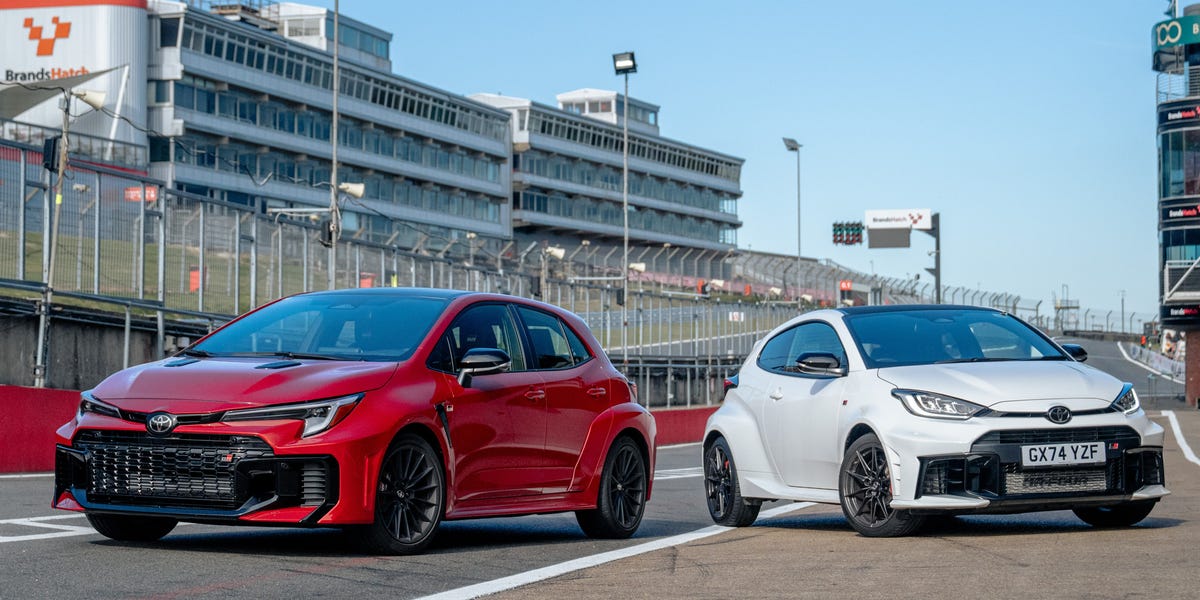
The GR Corolla's switch to European production gave Road & Track the chance to experience it alongside its smaller sibling at Brands Hatch. Some parts of the world are lucky enough to be able to buy both the Toyota GR Corolla and the smaller GR Yaris that share the same turbocharged inline-three engine and torque-biasing all-wheel-drive system. Sadly, neither the U.S. nor Europe make that list; American buyers are restricted to the Corolla, Europeans only get the Yaris.
But after Toyota took Road & Track to see the new GR Corolla production line at the company's Burnaston plant in England—where all American-bound cars will now be made—the company added a second opportunity: the chance to drive both the GR Corolla and GR Yaris back-to-back on the Brands Hatch race circuit in Kent. So are we getting the better side of this either-or deal?
The drive at Brands wasn't on the full circuit made famous as a venue for the British Grand Prix during Formula 1's more thrilling era, rather the shorter 1.2-mile Indy configuration normally used for driver experiences and clubman racing. But this truncated layout still includes Brands's most famous corner—the fast, plunging, right-hand Paddock Hill bend, which did indeed provide plenty of thrills in both GR models.
 View Price on Amazon
The GR Yaris has the appeal of forbidden fruit and does look pretty special parked next to a freshly assembled U.S.-spec GR Corolla in the Brands Hatch pit lane. The Corolla is a true hot hatch, sharing its body shell with its mainstream sibling. The Yaris is essentially an exotic homologation special—with a two-door body that is unrelated to the four-door Yaris supermini that is still sold in Europe. The GR Yaris also has a similar sibling in the Toyota Rally1 car that competes in the WRC, although there is no technical relationship.
That's because the GR Yaris uses almost exactly the same engine and driveline as the GR Corolla, both cars having the same transverse-mounted 12-valve 1.6-liter three-cylinder turbocharged engine driving a torque-splitting all-wheel-drive system through either a six-speed manual transmission or an optional eight-speed automatic.
The GR Yaris makes slightly less power than the GR Corolla, this apparently due to tougher European emissions standards rather than a deliberate attempt to differentiate the two cars from each other. For 2026, the GR Yaris makes peaks of 276 horsepower and 287 lb-ft, while the GR Corolla has 300 horsepower and 295 lb-ft. On the other side of the balance, the Yaris weighs less. Different testing methods on both sides of the Atlantic deny an exact figure on that—I didn't have a set of scales—but on Toyota's numbers the 2878-pound manual-transmission Yaris is 407 pounds lighter than the 3285-pound GR Corolla. Meaning the Yaris has a slightly better power-to-weight ratio and torque-to-weight ratio.
I start out driving the GR Corolla, which is like returning to an old friend. Despite being a Brit, I've spent much more time in the Corolla than the Yaris, and it felt instantly familiar at Brands Hatch: the little engine revving with a fizzing enthusiasm and filling the cabin with the compellingly strange sound of a hard-worked triple. Wanting to relearn the track, I start out in a car with the automatic gearbox, which isn't the sharpest system when it comes to changing gears using the paddles, but there isn't much need—almost the whole lap of the Indy configuration can be done in just third and fourth.
The Corolla is perfectly matched to the short-track layout, with no chance of growing bored by the relatively modest performance before the next corner arrives. The GR is a car that's been engineered to relish borderline abuse, willing to tolerate late braking and aggressive steering inputs, as well as to digest generous quantities of the track's striped corner curbing. It's not a dynamic scalpel or one of those cars that encourages ultimate precision, rather an endlessly playful partner that's happy to adjust a line midcorner by trimming or tucking.
Source: roadandtrack.com