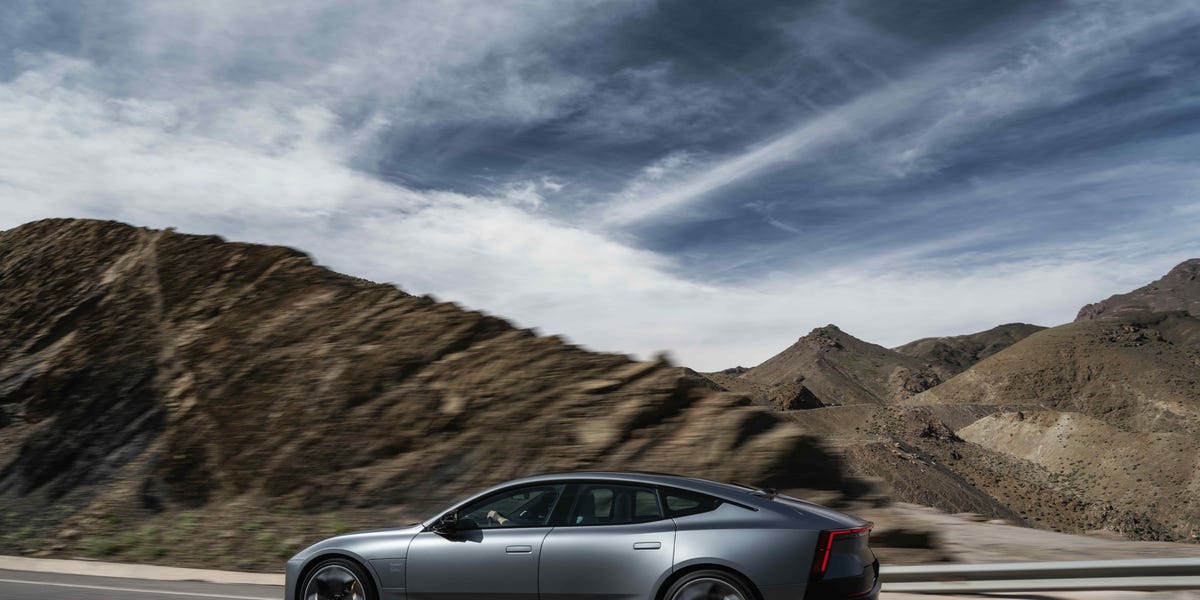
The auto industry works to timescales that often fail to align with trends within the wider world. That's why you are reading lots of reviews about new, exciting, and tech-packed luxury EVs even as demand for expensive electric models slumps in the US and is failing to meet projections in many other parts of the world. The investment decisions behind these models were made back when EV adoption rates were spiking and full electrification seemed inevitable pretty much everywhere. These are, in essence, bets that were placed a while back.
The Polestar 5 is another addition to a crowded part of a not-especially-fast-moving market, positioned in the same space as the Porsche Taycan, the Lucid Air, and the forthcoming Jaguar Type 01. It is Polestar's halo model, a slinky coupe-sedan that sits above the existing Polestar 3 SUV and Polestar 4 crossover. It also sits on another new architecture, this unrelated to that of either of its siblings, meaning the Swedish brand now has three different models sitting on three different platforms. Which isn't generally an efficient way to make cars.
 View Price on Amazon
The Polestar 5's underpinnings are the grandly named Polestar Performance Architecture, this using a structure made from bonded aluminum. It's the same technique that both Aston Martin and Lotus have been using for more than 20 years, well suited to low-volume high-end models. Which is why it is unsurprising to realize there is a British connection here, the Polestar 5 having been engineered in large part by a U.K.-based R&D team, although it is set to be manufactured in China, an issue for US sales given the size of the tariff wall.
The basics are as we previously reported. Two versions of the Polestar 5 will be offered initially, both with all-wheel drive from a motor at each axle. The entry-level Dual Motor can deliver peaks of 738 horsepower and 599 lb-ft, while the punchier Performance gets 872 horsepower and 749 lb-ft. The car uses an 800-volt electrical architecture, a first for Polestar, with both versions using the same 106-kWh battery pack. DC fast-charging at up to 240 kW is supported, with the usual disclaimer of having to find a socket capable of delivering that. There is no EPA range estimate yet, but the European WLTP figures of 260 miles for the Dual Motor and 220 miles for the Performance will likely translate to around 240 miles and 200 miles. The rear motor can also disengage when cruising to improve efficiency, with this further enhanced by a claimed 0.24 drag coefficient.
Beyond the increase in power and the decrease in range, the big hardware difference between the two versions is standard active dampers for the Performance in place of the Dual Motor's passive shock absorbers. Both ride on steel springs in a part of the market where air suspension is increasingly common, and there is no torque-biasing differential or rear-axle steering. For a high-end EV, it's pretty lacking in tricks. The Performance can also be ordered with 22-inch-diameter wheels, an inch up on the standard rims, these coming shod with Michelin Pilot Sport 5S sports tires in place of the regular Pilot Sport EVs.
The question of how to add dynamic character to an EV remains a fascinating one. Some automakers have chosen to digitally synthesize it—to add artificial sounds and even seat-shaking vibrations to what is essentially a near-silent powertrain, plus a pretense of a combustion-adjacent driving experience through simulated gearshifts. That's the approach taken by the Hyundai Ioniq 5N and also by the forthcoming BMW iM3 and AMG GT 4-dr.
The other way is purer but much harder to pull off: keeping the tranquility intrinsic to EVs but creating personality through the fidelity of control responses and the way a car behaves when pushed hard. Of cars in this category, the Porsche Taycan, still Road & Track’s EV benchmark, has been the most successful.
Source: roadandtrack.com