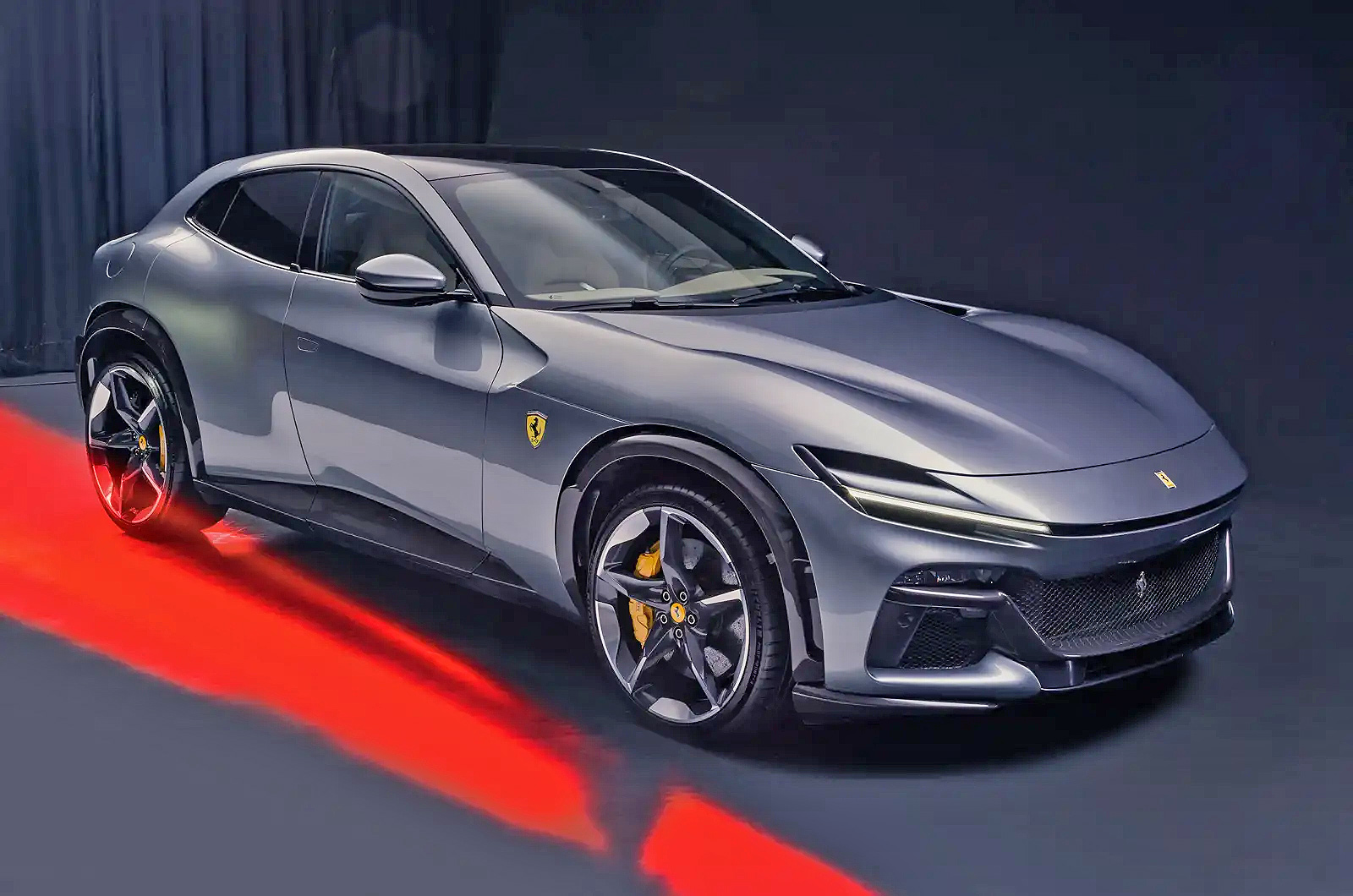
A Ferrari soft-roader? It's a very fast V12-powered soft-roader, and one that may even introduce the Maranello wail to Dubai’s Big Red, a huge, shifting sand dune that needs traction and torque in spades to be successfully crested. But a maker of cars designed to go as fast as possible to point B from point A, a maker that has forever harnessed the benefits of low centers of gravity and sleek frontal areas does not sound like a maker of vehicles featuring neither of these desirables. Still, the Ferrari Purosangue SUV is about as far removed from a World War Two Jeep as an iPhone is from a payphone.
It’s also what the market wants and accurately judging that fickle arena of desire has produced a lengthy line-up of cars that, at one time, would have been unthinkable progeny for their creators. Some have been jarring additions to their makers’ ranges. Some have fallen from grace with equally jarring effect. And others, unexpectedly, have become lynchpins for their makers.
 View Price on Amazon
What we said then: “Rolls has, like Porsche did with the first Cayenne, tried to put clear Rolls-Royce cues into the design. Maybe they just don’t translate to an SUV, or maybe we’re just not used to it yet.” The market demanded an SUV of Rolls-Royce and the market got it. An off-roading Rolls-Royce is not such an alien idea. The robustness of the early cars meant they were frequently used off road in Arabia, courtesy of Lawrence, and as armored cars during WW1. But as with the first Cayenne, the Cullinan’s look is troubling but may well improve with familiarity.
What we said then: “To the majority of buyers of today’s conventional city cars, the launch of the new Aston Martin Cygnet must rank as one of the daftest this century.” Apart from hijacking the innards of a Toyota iQ, the Cygnet struggled to find takers but, perversely, has become sought after now since deletion, and holds its value very well.
What we said then: “The most radical road-goer to wear four rings since records began.” Audi channelled its inner Lamborghini with the superb R8, a model introduction all the more surprising because Ingolstadt actually owned the Italian supercar maker. Even more surprising were the R8’s entertaining dynamics and a ride better than any other Audi’s, A8s included.
What we said then: “Brilliant package with neatly designed seating arrangement, all for a good price.” This underwheeled cargo carrier was among the first supermini-scale MPVs. Despite a body as ugly as it was voluminous, the Yaris Verso sold moderately well but it was still an image-compromising product.
What we said then: “It’s another electric vehicle that, we can’t help but conclude, would be better with its own power source on board. But the Twizy has a loveable character.” It is loveable, too, and quite unlike any Renault, ever. But the appeal palls in rain and cold, both penetrating the tandem occupant zone copiously without the optional semi-enclosing doors. It doesn’t go all that far on a charge, either, although that may be a good thing. Great on the right day, in the right weather. Which is why it has no rivals.
What we said then: “If there’s one word that seems to define the VW Phaeton it’s ‘why?’”. Ferdinand Piëch’s folly, the VW Phaeton made sense only to VW’s boss and, eventually, Chinese buyers, whose liking for big saloons prolonged the life of this supposed VW flagship for longer than it deserved. Piech’s ambition for VW was admirable – the same upmarket thrust yielded the successful Touareg – but it made as much sense as selling billionaire jewellery in a mainstream department store.
Source: autocar.co.uk