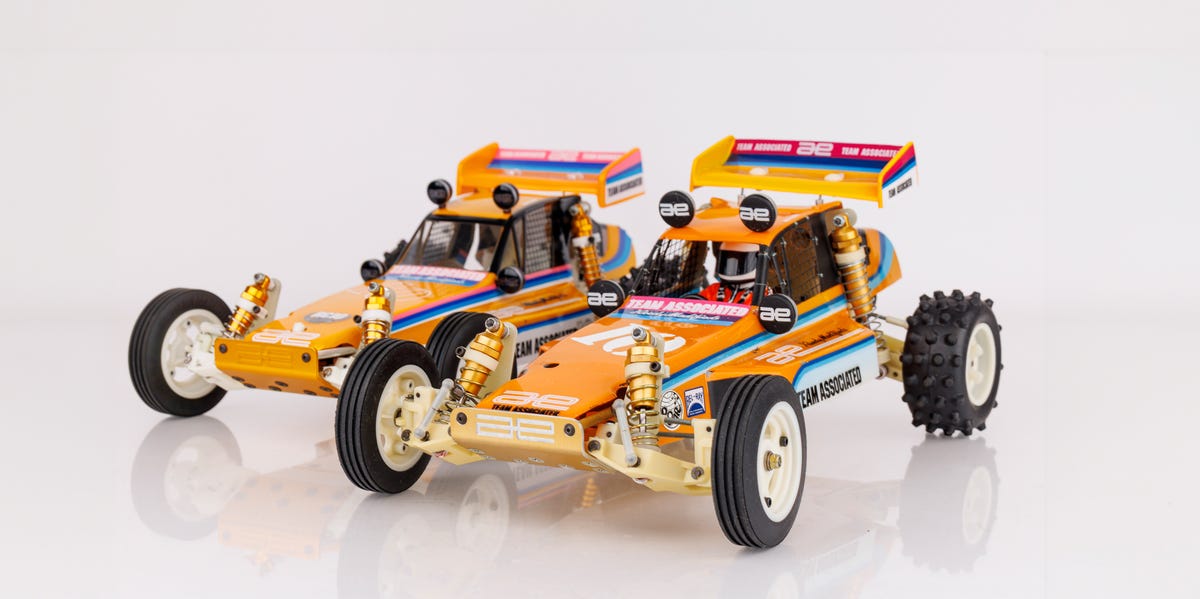
Team Associated's RC10 launched in 1984 and helped usher in the golden age of radio-controlled (RC) cars. The RC10's roots date back to 1964, when two actual rocket scientists, Roger Curtis and Lee Yurada, founded a slot-car company. By the next decade, they were building 1:8-scale, nitromethane-powered RC cars that dominated racing. Yurada left the company, and former full-size-race-car builder Gene Husting joined it.
In 2024, Team Associated celebrated four decades since the release of the original RC10 with the release of the 40th Anniversary Edition kit. As the '70s rolled into the '80s, nitro RC cars began playing second fiddle to electric ones. For Team Associated, electric power started on asphalt with the 1:12-scale RC12E. Rival company Tamiya, however, unleashed a boom in 1:10-scale electric buggies.
 View Price on Amazon
Team Associated hosted the 2025 Vintage Off-Road Championships in Las Vegas, celebrating the 40th anniversary of the RC10’s first IFMAR world title. The event returns to Las Vegas in September. Team Associated went the opposite direction of Tamiya, designing for racers, not the mass market. The RC10 sported an aluminum tub and was easy for racers to tune to their liking. This is the legacy of the RC10. It's a pivotal RC car that has taken home well over a dozen International Federation of Model Automobile Racing (IFMAR) world championships at the hands of pros while also inspiring generations of engineers and car builders.
Every piece of the RC10 was designed on paper and machined by hand. This was long before the prevalence of CAD, CNC, and 3-D printing. Every component is a jewel of industrial design. The RC10 entered the market with a gold-anodized 6061-T6 aluminum tub. Lower control arms were a performance revolution compared with the VW-type sand-rail trailing arms other cars were using.
Source: caranddriver.com