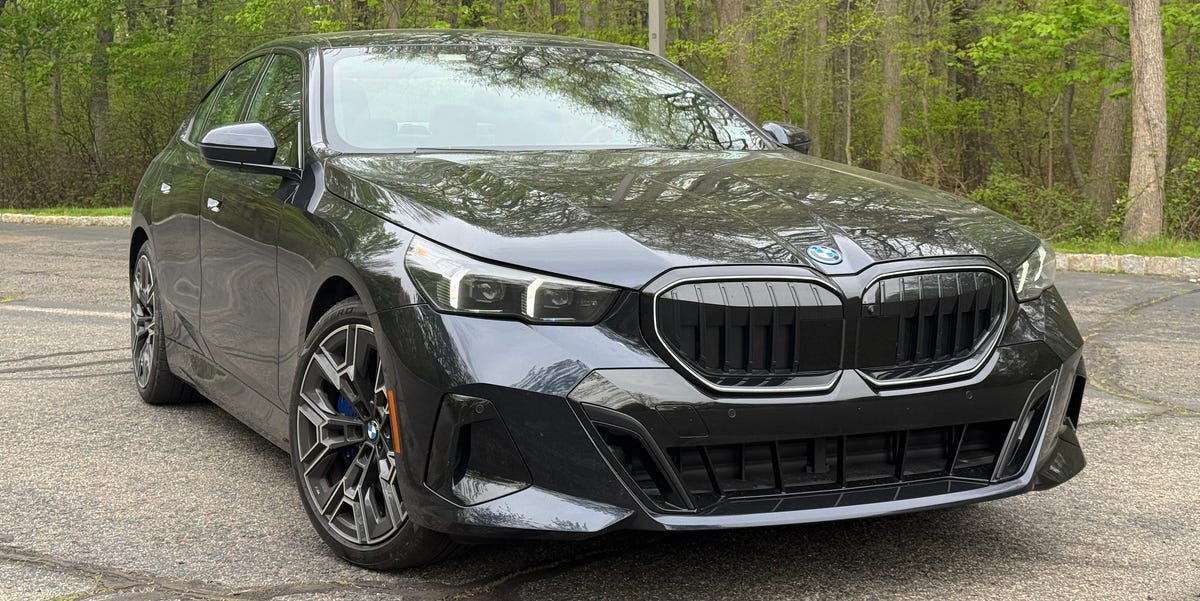
The M5 certainly has its delights, but its six-cylinder hybrid sibling charms in its own way. Plug-in hybrids often wind up being seen as a jack-of-all-trades-master-of-none proposition. Sure, there are the occasional high-performance models that seem to have added a charge port under duress—but for the most part, the PHEV delivers middling electric performance with hundreds of pounds of added mass that slows you down once the battery runs out.
It is both a crummy EV and an overburdened hybrid. But every coin has two sides. Flip it, and the plug-in hybrid becomes the most logical car for many people, capable of executing the average driver's daily needs on pennies of electrons but offering the limitless range and easy refueling of internal combustion for long journeys, without the added complication of public charging.
 View Price on Amazon
BMW wants buyers on both sides to feel at home. These days, it offers the full spread of powerplants in many of its model lines, including quite a few plug-in hybrids for those who like to see the gas tank and the battery alike as half full. For the venerable 5 Series, that's the iconic M5 . . . as well as the less-intense 550e.
The current-generation 5 Series, code-named G60, is the eighth and the first to offer a choice of internal-combustion, plug-in hybrid, and pure electric powertrains, though the latter use the i5 nomenclature. The 550e is the sole PHEV offered in America by BMW that isn't part of the M lineup, as the M5 now also boasts a combination of electric motor and gas engine. But while the M5 uses a V-8 to turn petroleum into power, the 550e uses one of BMW's famously smooth inline-sixes.
More Specs: Powertrain: 3.0-liter turbocharged I-6 + electric motor & 19.4-kWh battery. Power: 483 hp @ 5000–6500 rpm. Torque: 516 lb-ft @ 1750–4700 rpm. 0-60 MPH: 4.1 sec (mfr claim). Transmission: 8-speed automatic. Weight: 4894 lbs. EPA Fuel Economy: 68 mpg-e electric / 25 mpg gasoline only.
BMW has been making inline-sixes since 1936, and the company does it well, as you might expect of an automaker whose middle name is Motor. The turbocharged 3.0-liter B58 engine here makes 318 hp on its own, but it rarely acts alone, as an electric motor in the gearbox housing adds an extra 194 hp to the mix whenever needed.
The combination is strong and smooth, delivering a strong rush of power that feels made for the autobahn. The only time it felt even a little lacking to me was when I climbed straight out of the 671-hp Bentley Continental GT S and into the 550e, which, admittedly, is hardly fair to the Bimmer. The claimed 4.1-second 0-to-60-mph time feels typical-for-BMW conservative, especially in light of the grip provided by the standard all-wheel drive.
Source: roadandtrack.com

