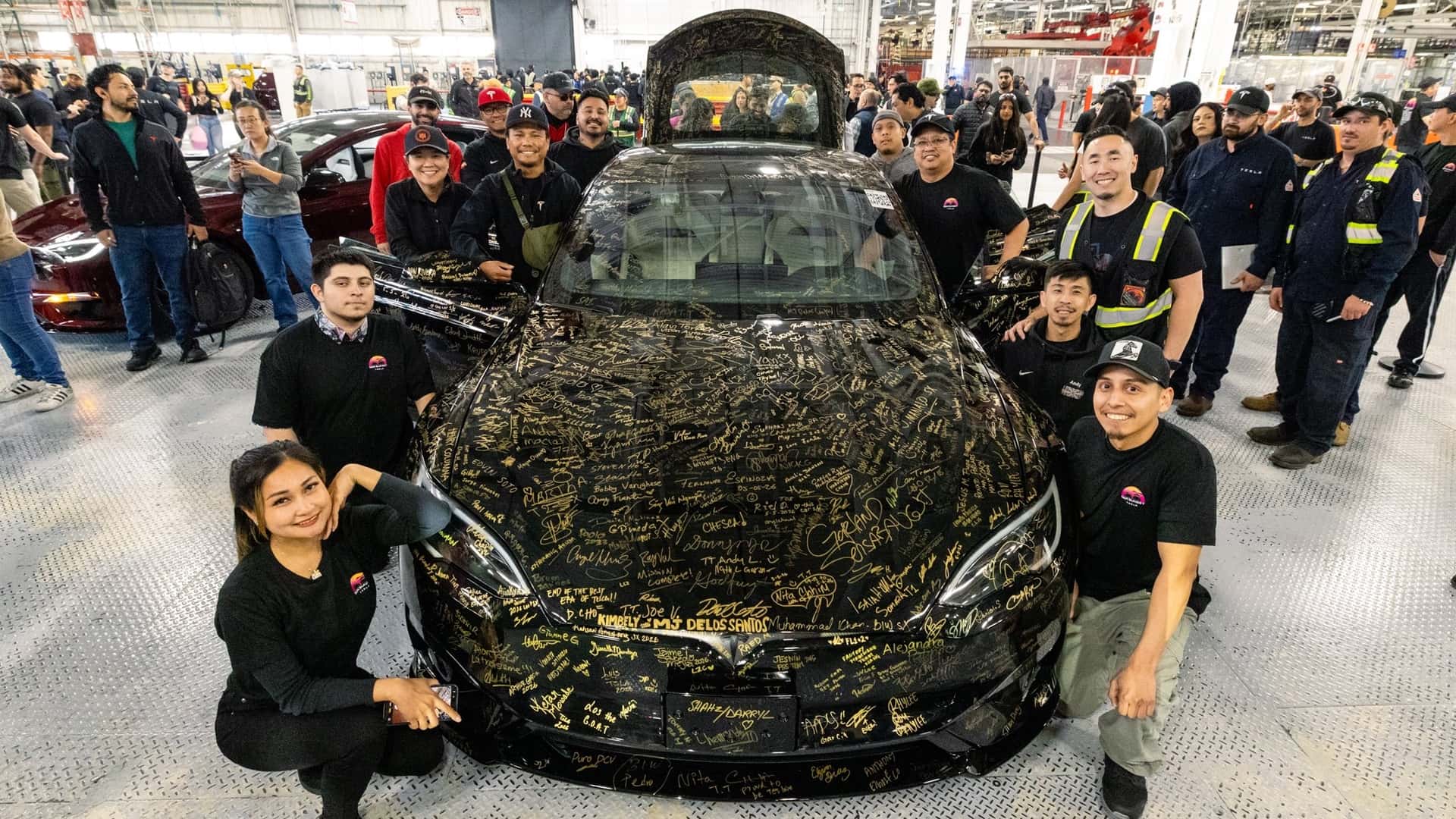
For 14 years, the Tesla Model S set the benchmark of what defines a luxury electric vehicle. The Model X brought those qualities to a bigger, three-row form factor for the last 11 years. Despite constant competition and slipping sales, the two models have remained a core part of Tesla's lineup. The Model S era finally came to an end on Saturday as the last cars rolled off the assembly line in Fremont, California.
Tesla announced the end of the era via a post on X, showing off a pair of the cars painted in Ultra Red, as well as a Model S in black adorned with the signatures of assembly workers. Tesla's Model S in particular was an incredibly important car—not just for Tesla, but for electric vehicles as a whole.
When it launched in 2012, Tesla's mission was a bit different than it is today: make an increasing variety of increasingly affordable electric cars. The sedan proved that electric vehicles could be desirable and fast, giving the company the cache it needed to forge ahead and a revenue stream to develop more cars. The Model 3 came out about five years later, followed by the Model Y. Eventually, the Model Y became the world's best-selling car. None of that would be possible without the Model S and X.
 View Price on Amazon
The Model S was also a pretty amazing vehicle no matter how you cut it. The base model cost $59,900 in 2012, which is about $87,000 today when accounting for inflation. Granted, that came with just 160 miles of range, but if buyers were willing to splurge a bit, they could squeeze more than 250 miles out of a charge. That range might seem puny, but remember that this was 2012—the only other electric vehicle really on the map at the time was the Nissan Leaf, which cost half as much and had around one third of the range.
Later on, the Model S became the first electric vehicle in the U.S. to crack the 300-mile-range barrier. Then it was the first to pass 400 on the EPA scale. Future iterations of the Model S put it in straight-up supercar territory. The Model S Plaid managed to achieve a zero-to-60 mph time of 1.99 seconds with a price tag of just over $100,000. Eventually it was crowned king of the quarter mile with a record-breaking 9.2-second sprint. Pretty impressive when that could outrun something like the $3.8 million Bugatti Chiron Super Sport.
Early Tesla was weird in an exciting way. Tesla was taking massive risks and trying out bizarre ideas. Not only to see what stuck, but to show the world that electric vehicles were a viable alternative to gas cars—not just green machines driven by hippies and Hollywood celebrities. The S and X represented that better than anything else Tesla ever built.
In time, the S and X also became victims of Tesla's own success. Once the Model 3 and Model Y became volume sellers, S and X sales became less of a priority for Tesla, turning them into aging halo cars. Even its last refresh felt like a meeting that could have been an email. So the market moved on and luxury electric vehicle competition exploded with players like Porsche, Lucid, and Rivian innovating in their own ways.
And now Tesla is tearing down the Model S and X production line to build what it believes is its next breakthrough product: humanoid robots. The end of the Model S and X might seem insignificant today given the alternatives available on the market. However, if you think about these as not just products made in a factory, but as the ancestors of the modern electric vehicle, it feels like a bit more significant loss. Maybe the Optimus robots built in Fremont will one day follow in the tire tracks these two legends have left behind.
Source: insideevs.com