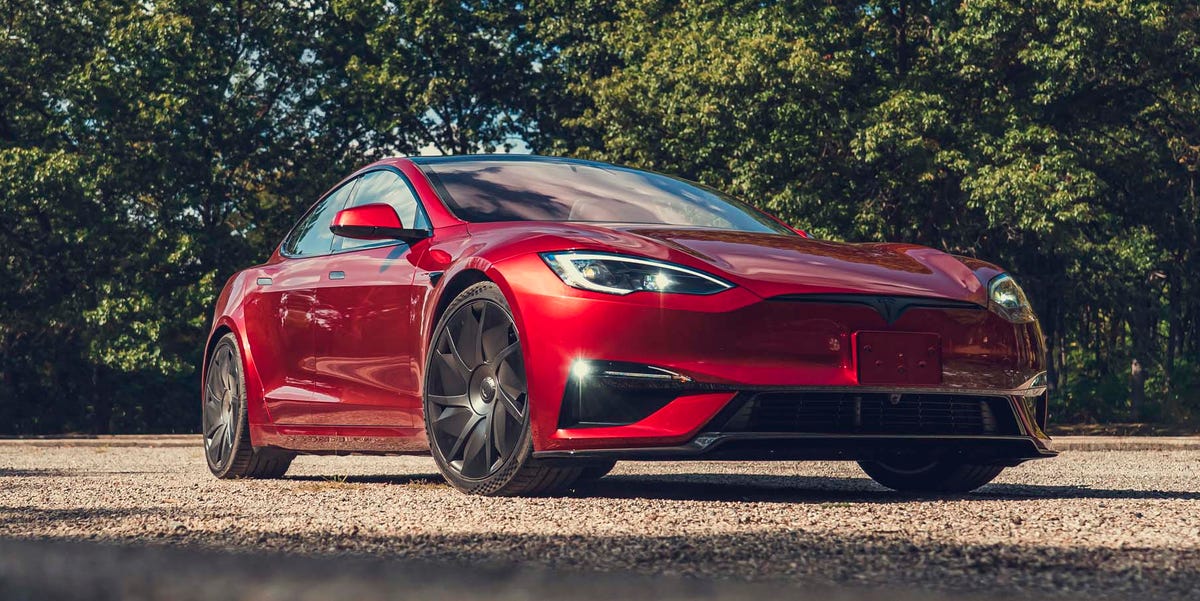
The last Model S and Model X have rolled off the production line in Fremont, California, marking the end of two influential EVs. Fourteen years ago, the idea of an electric car was widely considered completely nerdy. No shade on the original Nissan Leaf, but that EV had cribbed its personality from the first-generation Prius, environmentally conscious motoring blended with the sex appeal of an orthopedic shoe. Then, suddenly, a bolt from the blue struck the earth.
"The reality is that most electric cars simply haven't been very good," we wrote in our first instrumented test of the Model S back in 2012. "The Model S gets the job done. It's attractive, comfortable, fast, practical, technically fascinating, and not overpriced. Most important, it's not just a good electric vehicle, it's a good car."
And now, it's dead. As of this past weekend, the last Model S and Model X were built at Tesla's Fremont, California, production line. The company now leans on the Model 3 and Model Y as its bread-and-butter cars, with the Fremont facility now pivoting to produce a theoretical army of robots.

A 2015 Model S P85D was the first electric vehicle to undergo a Car and Driver long-term test, and despite a hefty $136,720 price, we came away impressed. The car's performance and features delivered in spades, but Tesla's real ace in the hole here was its growing charging network. In just under two years with the car, this grew from 188 locations in the United States to 325. Now, there are more than 3000 Tesla Superchargers in the continental U.S.
As for the Model S itself, the biggest compliment that could have been paid to it was the imitation of other automakers. Electrification was long a fascination of Ferdinand Porsche, who put light bulbs in his parents' home at the age of 18 and built a functioning electric vehicle before the dawn of the 20th century. Yet Porsche's first mass-produced EV, the Taycan, was a response to the Model S, not a pioneering effort.
Since then, the public has come to accept that electric vehicles may have potential limitations with range and reliance on charging networks, depending on where they are driven, but their performance can't be argued with. When the 1020-hp Model S Plaid turned up in 2021, its acceleration was brutally effective. The claimed top speed of 200 mph was a bit of a stretch. The car was electronically governed to 163 mph, and if you actually wanted to go that fast in a Model S, on a track or the autobahn, you'd really want the additional braking of the Track package that became available later. Even so, a 1000-hp sedan is a pretty stout riposte to any argument that EVs are glorified golf carts.
Alongside this headline-grabbing EV, the Tesla Model X provided much of the same performance in a family-friendly SUV. It wasn't much of a looker, and the gullwing-style "falcon" rear doors were a child's idea of what a car should have. But imagine being eight years old and your parents' car has rear doors that fold like a spaceship and also something called Fart Mode. You might start to get interested in cars.
The Model S and Model X ended in a fashion befitting their long run, with a special invite-only delivery event postponed with barely three days' notice and no explanation. If nothing else, Tesla has proved that making promises is more profitable than keeping them, at least on a projected timeline.
Source: caranddriver.com

