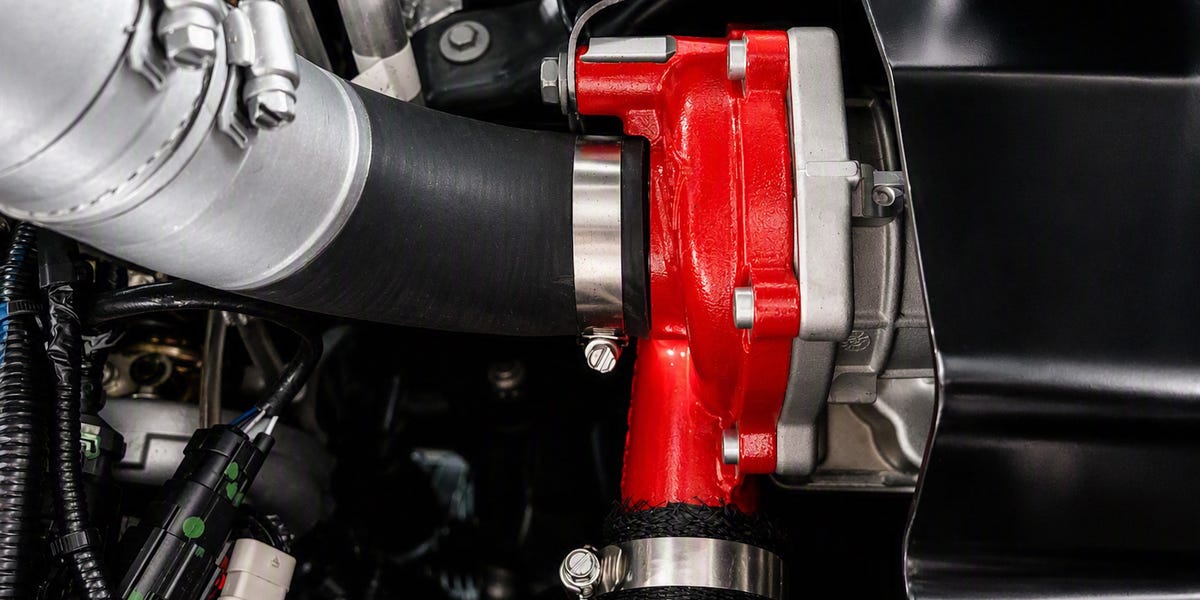
Known as the eBoost Air, this prototype hardware adds an e-compressor to the Hurricane inline-six. Turbocharging is so ubiquitous these days, it’s become noteworthy when a new car or truck arrives without the help of those air-pushing snails. But while turbos are capable of helping engineers to increase efficiency and performance without chasing displacement, they aren’t a perfect solution for every problem. On Thursday, Stellantis revealed that its SRT Performance Division is working to eliminate one of the turbocharger’s biggest issues, turbocharger lag, with a new piece of tech called eBoost Air.
In simple terms, a turbocharger is a form of forced induction that scavenges the exhaust gases already being produced by an engine. These gases enter the turbocharger, where a compressor wheel accelerates them and forces them back through the intake pathway, increasing the volume of air available for the combustion process while decreasing pumping losses. As turbo size increases, however, the amount of air that goes through it also increases, so the bigger a turbo, the longer the process of spooling the compressor tends to take. This is what we call “turbo lag.”
 View Price on Amazon
Many modern cars get around this issue by sizing the turbos a bit smaller and doubling up on them, or by way of other tricks, such as electrified turbochargers that use electrons to spin up the impellers to their ideal rpm. SRT’s eBoost Air system provides a different approach to that same idea. The eBoost Air system comprises what SRT is calling an “e-compressor,” an electrically powered turbine mounted in the intake pathway independent of the existing mechanical turbochargers that sit downstream from it.
The eBoost Air isn’t a traditional e-turbo, as it does not have an exhaust side, but it works in a similar fashion: when a driver makes a request for more torque and the turbos are below their operating speed, the eBoost Air starts pumping air down the pathway. This helps spool the turbos faster, until the system diverts the airflow back to the standard pathway. It’s not rocket science, but it works as intended. With the new system installed on a High Output Hurricane, SRT says the motor’s response is much closer to that of one of Dodge / Ram / Jeep’s supercharged V-8s.
“Enthusiasts aren’t interested in technology for the sake of technology. But when technology improves performance with no downside, they’re all in,” said Tim Kuniskis, head of American brands and marketing, North America. “eBoost Air delivers exactly that kind of tangible benefit. It's a smart, simple idea that attacks turbo lag head-on and reflects what SRT does best—moving fast, challenging assumptions, and chasing more performance.”
Source: roadandtrack.com