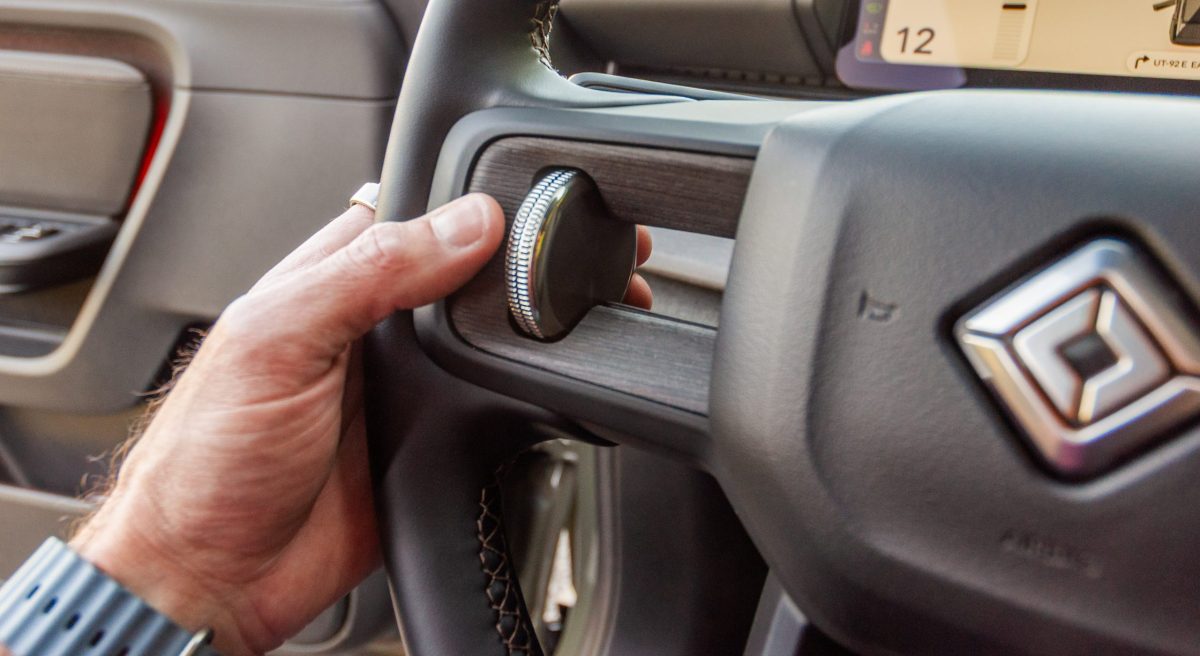
Rivian's R2 model features groundbreaking Halo wheels, blending software innovation with tactile feedback to enhance vehicle control and user experience. The startup automaker has taken criticism personally and over-engineered how you can interact with vehicle controls. In an exclusive interview, Rivian Founder and CEO RJ Scaringe said, "We wanted to have some more haptic experience, and so creating those [Halo] wheels was a big part of that, and a huge engineering effort."
Scaringe explained that engineering the Halo wheels wasn't easy. "Yeah, the haptic wheels that are on the steering wheel, that was a very large engineering effort because when you're rotating those and you hear the, feel the haptic clicks. That's actually software, so there's actually no indents like you'd have in a typical wheel that has that click," Scaringe said. Explaining the complex engineering effort in detail Scaringe said, "What it is, is it's a little motor that's creating that torque rise and torque fall." That's similar to how the silence/vibrate function now operates in an iPhone.
 View Price on Amazon
Scaringe continued, "Yeah, so it's all software-driven. And the beauty of that is that those wheels now are completely configurable. So while they have all the haptic clicks, when you go to a different screen, the wheels update, or if we have an over-the-air update we want to change some of the capabilities of the vehicle and have those haptic wheels do something different or behave in a different way, that's entirely possible.
Rivian Chief Software Engineer Wassym Bensaid told The Drive, "It's really a first principle way of thinking about how we can introduce a tactile experience, a touch experience, but then without cluttering the whole user interface." Bensaid continued, "And this is how we came up with the software defined haptics, which the beauty is that it provides you a different type of feedback depending on the action. And then we can configure them as we wish from a software standpoint."
Source: thedrive.com