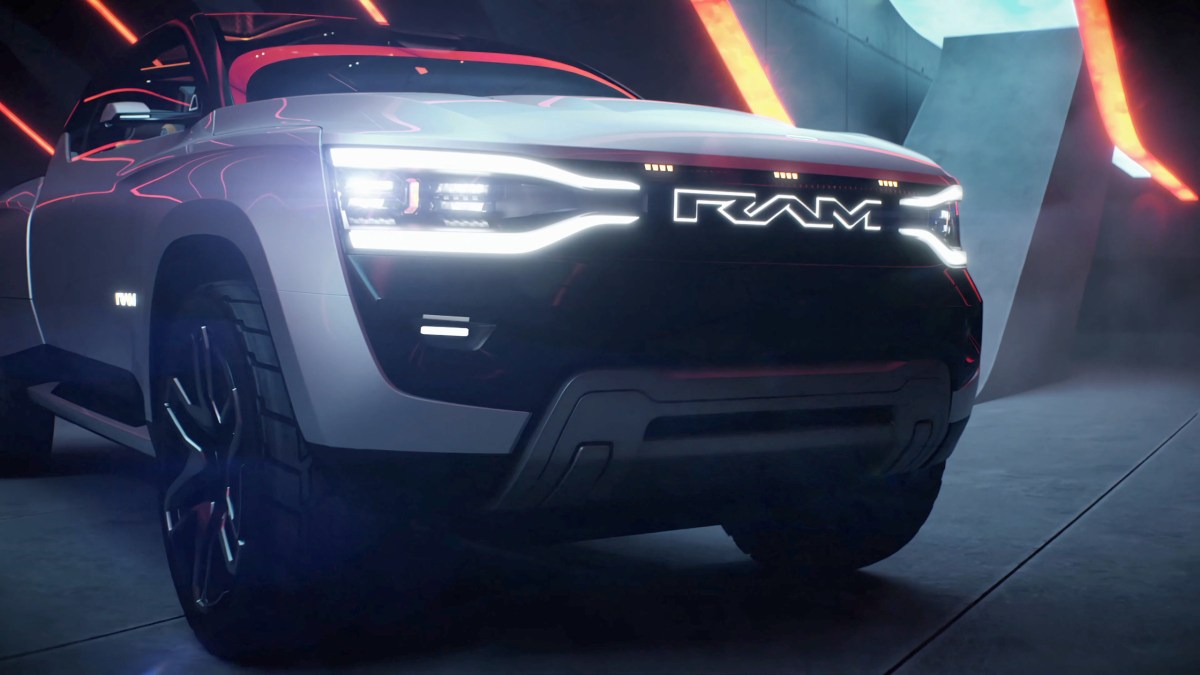
Stellantis has announced big plans for the next four years, including a massive product push that will see 60 new vehicles and 50 refreshes by 2030. Ram is a key player in this plan, and one of the models that will be part of this push is the brand's first SUV, the three-row Ramcharger.
The Ramcharger is set to arrive in the coming years and will open an entirely new door for the brand to capture buyers it can't touch today. But how does that work in the same showroom as its sibling, the Jeep Grand Wagoneer? Ram CEO Tim Kuniskis explained how the Ramcharger will be differentiated and appeal to different buyers than the Jeep.
Kuniskis confirmed that the Jeep Grand Wagoneer will stick with its turbocharged inline-six engine lineup, which is about to gain an EREV powertrain option later this year. The Ramcharger, on the other hand, will be more truck-like with a more V8-focused engine lineup. The Ramcharger will have a full trim walk, including an SRT-badged variant, which will likely feature a 5.7-liter Hemi V8, a 392 cubic-inch 6.4-liter Hemi V8, and a supercharged 6.2-liter Hemi V8 with 777 horsepower.
 View Price on Amazon
The competition manages to pull this scenario off with GM selling the Chevrolet Tahoe, GMC Yukon, and Cadillac Escalade, while Ford sells the Expedition and Lincoln Navigator. However, in both these scenarios, the models are sold in separate showrooms. Stellantis doesn't have that luxury, and so the Ramcharger and Grand Wagoneer have to be differentiated entirely beyond their exterior and interior designs.
Kuniskis noted, "So our whole intent was: look at what the other guys are doing with multiple versions in different showrooms and see how much we can differentiate these two sitting next to each other so it's not like, 'Hey, that one's got a Jeep badge on it and that one's got a Ram badge on it.' They needed to look, feel, and act different."
Continuing on that train of thought, Kuniskis said, "There's going to be people that are going to look at the Jeep and go, 'Oh, hell yeah, that's the one I want, I don't want that other one,' and there's going to be people that look at the Ram and say, 'Hell yeah, I want that one, not the other one.' I liken it exactly to Charger and 300 when we had them in the showroom together."
The Chrysler 300 and Dodge Charger were indeed the same car, but as Kuniskis noted, "They were absolutely different buyers, and that's exactly what we're trying to do with this. We want one to be very focused on who a Ram customer is and one very focused on who a Jeep customer is. And powertrain matters. Our intent is to leave the powertrains as is on the Jeep, as is as in the architecture. That doesn't mean that we won't have multiple versions, different power levels, but the architecture. And then the architecture of the Ram would be more V8-based."
Source: thedrive.com