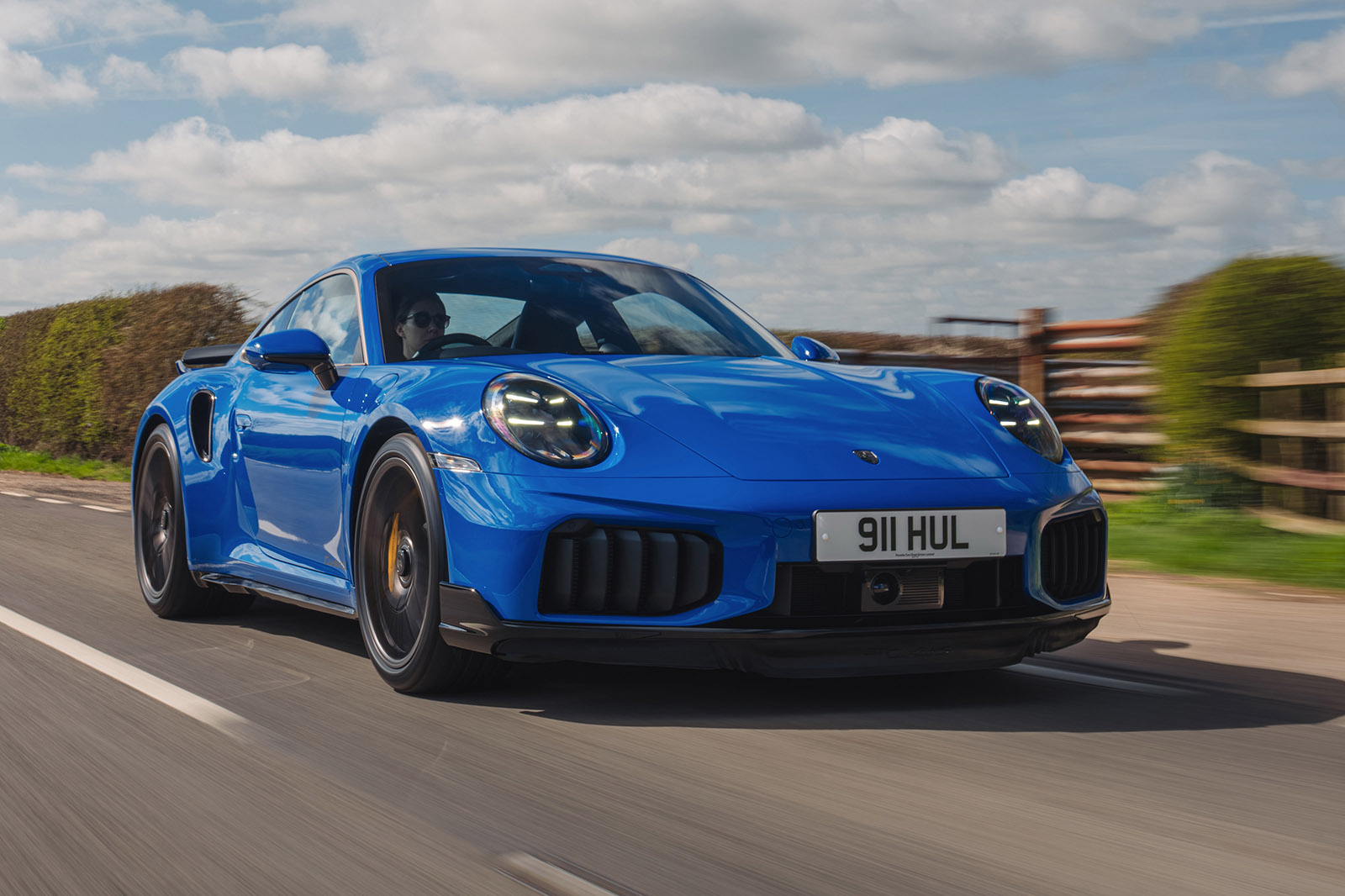
Versatility is a strange concept to find as a core quality at the heart of a 200mph super-sports car. Yet that is how the Porsche 911 Turbo has been defined for most of its 50-year life.
The first version, built from 1975, endured for a long time, but the early ‘930’ Turbos made an impression the car would spend decades trying to erase: the ‘Widowmaker’ cast a long shadow.
The memory of that car, combined with technology proven by the 959 supercar, was what motivated Porsche to make the four-wheel-drive ‘993’ Turbo of 1995 such a pioneer. But since even before then, the 911 Turbo was set on a path to prove itself the ultimate sports car. Not only the quickest-accelerating and most powerful series-production 911 but also ready to excel on road and track, as a long-distance-runner, a grand tourer, a circuit thriller and a usable everyday driver ready for almost any conditions; to represent absolutely everything any other 911 can do – only better; and more.
 View Price on Amazon
The idea has now spawned 12 generations of 911 Turbo; and today - with the '992.2' Turbo S - embraces hybrid-electric powertrain technology.
It is the hardware in the tightly packed rear that for the most part makes this 911 Turbo S different from not only any Turbo before it but also any other current 911.
The car adopts ostensibly the same 3.6-liter flat-six engine as that in the Carrera GTS. Relative to the pre-facelift 992 Turbo’s 3.7-liter lump, this has slightly smaller-bore cylinders, uses ‘finger follower’ valve actuation (just as the 911 GT3 does), and has reinforced pistons compared with the GTS.
Special smoked tint of various bits of exterior and interior trim, including the wheels, is what Porsche calls ‘Turbonite’ grey – the 992.2 Turbo S’s signature color. It’s very ‘911 Turbo’, if a little too understated for my taste.
The Turbo’s T-Hybrid induction and hybridization system is the big change. Just as in the GTS, the main constituent parts are a 109-horsepower, 139-lb-ft electric motor sandwiched between the engine and eight-speed dual-clutch automatic gearbox and a 1.9kWh, water-cooled NMC drive battery in the nose, just behind the frunk. Porsche adds electric turbochargers to this well-proven hybrid-drive concept, of course; but where the GTS has only one, the Turbo S uses a pair in a parallel-twin-turbo arrangement (one per cylinder bank), each of them smaller and more responsive than that used on the GTS.
As such the 911 Turbo S can now use direct electric motor ‘torque-fill’ to bolster its lower-end performance reserves while also getting the enhanced response of turbochargers driven by electric motors – which sounds like it should make a transformative difference.
What actually results is 701 horsepower from 6,500-7,000rpm – that’s 10 horsepower more than even the mighty ‘991’ GT2 RS could muster. And yet peak torque is only the same 590 lb-ft that the outgoing 992.1 Turbo S offered, albeit made available over a band of revs some 2,200rpm broader. Enhanced transient engine response, says Porsche, is how the new Turbo makes its biggest gains – how it feels quicker, in other words.
The 400V hybrid system has facilitated one other significant technical change: the adoption of a faster-acting, electrohydraulically controlled PDCC active anti-roll control system. There’s also an electronically controlled locking differential for the rear part of the car’s active four-wheel drive system. Specially tuned, adaptively damped PASM coil suspension comes as standard, with a lowered, PASM Sport alternative an option (our test car came without this).
The Turbo retains its predilection for width. Its body is 1.8 inches wider across the front arches than a regular ‘992’ Carrera and 0.8 inches wider across the rears. The car’s structure has been reinforced around the front suspension turrets and cross-member. It wears 325-section rear tires, 0.4 inches wider than those of the pre-facelift Turbo S. And it has the largest set of PCCB carbon-ceramic brakes yet fitted to any 911.
Source: autocar.co.uk

