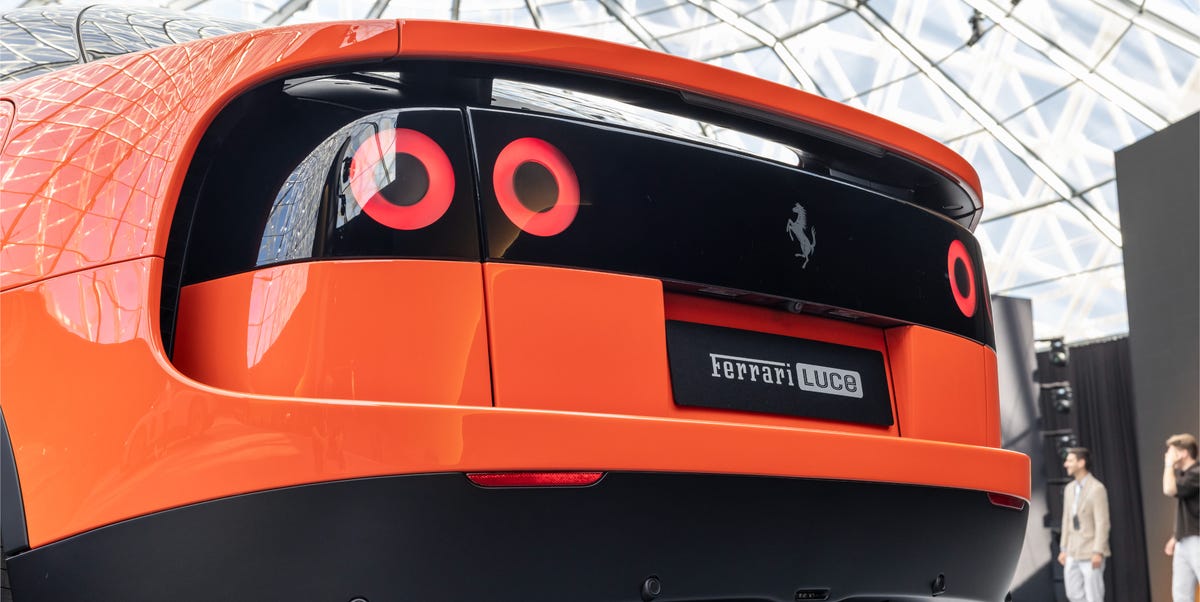
Hating the new Ferrari Luce has united the automotive world. And the automotive world is wrong. The Luce is both groundbreaking and firmly in the tradition of the best Ferraris from the past. It’s not only Ferrari’s first all-electric car, but the first true four-door. It’s not a cheesy cheat that swipes parts from lesser brands, nor is it a half-ass effort that “electrifies” an existing Ferrari. Like the greatest Ferraris, it’s a form-follows-function machine.
Admired. Even if the idea of an electric Ferrari is repellent to you. First, let’s admit that the Luce exists to fulfill government mandates. It’s unlikely many decision makers within Ferrari have a passion for electrics, but until this past December, the European Union (EU) was mandating a net-zero carbon emission from new vehicles in 2035. That’s been tweaked to a 90-percent reduction by the same date, but there’s simply no way to even come close to that goal without producing battery-fed electric vehicles. That’s why the Luce exists.
 View Price on Amazon
The easy play for Ferrari would have been creating an electric that mimicked mid-engine exotics. Automobili Pininfarina did that with its $2.4 million, 1877-hp Battista, and the market has been indifferent to it. Ferrari has allowed the Luce’s form to follow its function. Accommodating a big battery pack under the floor meant a long (116.6-inch) wheelbase and a tall cabin. That’s the logical and most efficient way to package an electric vehicle.
The Luce’s proportions are native electric, just as the great Ferraris of the past came by their proportions because of their engineering. Ferrari’s big front-engine GTs have long hoods because they have to cover long V-12 engines. The beloved 308 GTB from the 1970s was tightly drawn around a short wheelbase enabled by its transverse-mounted V-8.
Source: roadandtrack.com

