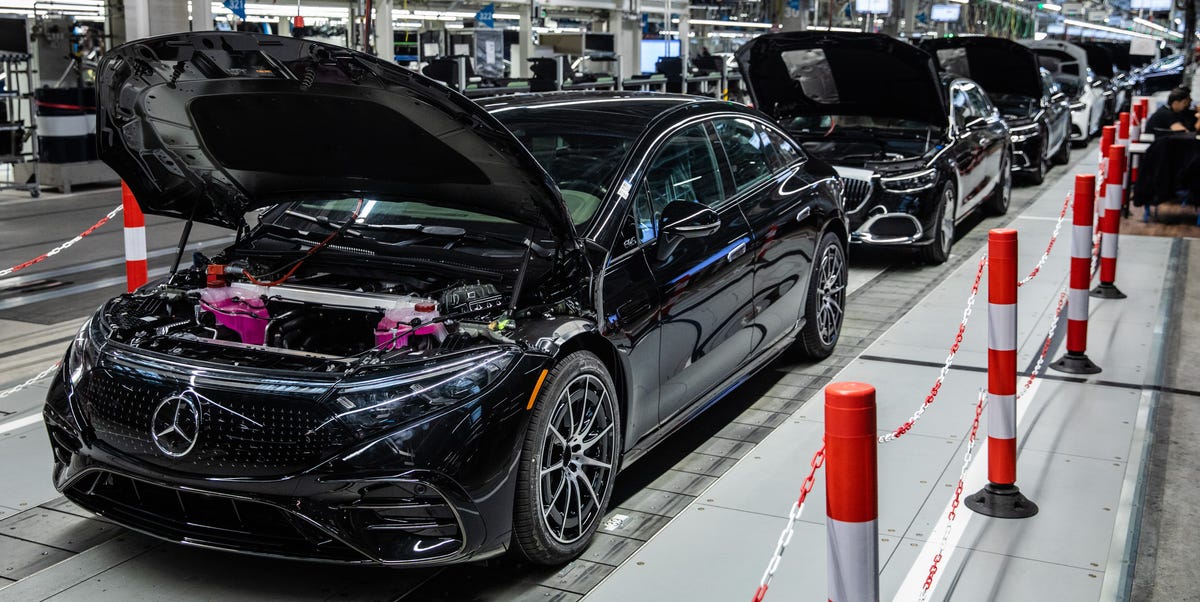
US lawmakers continue to crack down on businesses with Chinese ties, leaving Mercedes-Benz at risk. A new bill working its way through Congress could impose a sales ban on Mercedes-Benz, among other automakers, over their equity ties to China, according to a new report from Automotive News.
The bill, officially known as the Motor Vehicle Modernization Act of 2026, was introduced in the House of Representatives on February 5, and focuses on providing five years of federal funding for transportation and infrastructure. However, a recent amendment to the bill singles out Chinese influence as a danger to the domestic automotive industry. The new language aims to protect "the automotive industry from foreign adversaries," and prohibits a manufacturer controlled by a foreign adversary from selling, delivering, or importing any vehicle into the US directly, according to CNBC.
 View Price on Amazon
Lawmakers defined adversarial foreign control as an average ownership stake of at least 15 percent of the company, whether direct or indirect. This could quickly become problematic for Mercedes-Benz, as Beijing-based-and-state-owned automaker BAIC Group owns a 9.98 percent stake in the German automaker, while Li Shufu, founder of Zhejiang Geely Holding Group, holds a 9.69 percent stake in Mercedes. So, with a total Chinese holding share of 19.67 percent, Mercedes could be banned from US sales if the bill passes.
Mercedes-Benz, unsurprisingly, is paying attention to the problem. "We are in close talks with legislators and policymakers to understand the details of the legislation, and believe that a solution will be reached that protects—and does not damage—US manufacturing," a Mercedes-Benz spokesperson said to Automotive News.
CNBC first reported on the potential US sales ban on May 29. Press secretary for the US House Energy and Commerce Committee Daniel Kelly confirmed the details of the legislation to CNBC, though he declined to comment on the impact for specific automakers. Mercedes Group CEO Ola Källenius addressed the potential for a US sales ban during a media roundtable in Los Angeles on May 19, stating that he was "very confident that we will be able to handle that situation" and that "if and when we get there, you can rest assured that will be not a big deal to take care of."
Federal lawmakers are sharply focused on barring any Chinese technology from vehicles sold stateside. Senator Bernie Moreno (R-OH) and Senator Elissa Slotkin (D-MI) introduced the bipartisan Connected Vehicle Security Act on April 29, focused on banning vehicles, parts, and software manufactured in or in partnership with adversary countries, including China. As that nation continues to industrialize and expand its production prowess, US politicians are growing more concerned with protecting America's intellectual property and future manufacturing power.
“I think it's an issue of economic security and national security," Senator Slotkin told Road & Track in April. "You don't have to be a deep expert to understand that the Chinese Communist Party heavily subsidizes their industry, so they have a whole strategy of basically stealing our intellectual property—making stuff like cars and drones off of stuff that we've invented, and then heavily subsidizing them so that they undercut and kill the industry that they enter."
However, Mercedes-Benz's North American manufacturing footprint could help save the German automaker from an outright sales ban. A provision of the amended Motor Vehicle Modernization Act of 2026 provides exceptions to automakers with US manufacturing facilities, like Mercedes-Benz's Tuscaloosa, Alabama, plant. But that doesn't mean Mercedes is out of the woods just yet; as the legislation currently reads, such an exemption only applies if the automaker lacks any direct or indirect equity interest by a foreign adversary government.
Source: roadandtrack.com

