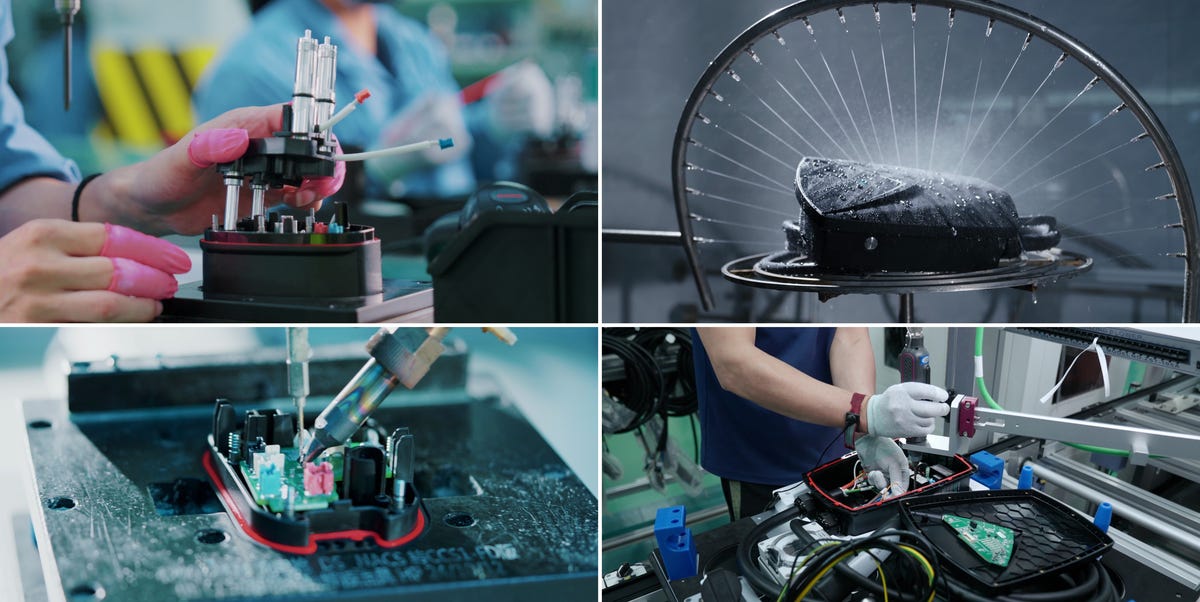
This is where Lectron assembles its charging adapters as well as its new Nexus Level 2 home-charging unit. With more and more EVs switching to the NACS charging port, and also more automakers doing deals to let its vehicles charge on Tesla's Supercharger network, we're living in the age of the charging adapter. Almost every new EV comes with one or more to accommodate plugging in a SAE charger into a NACS port or vice versa.
What you probably don't realize is the company that makes the vast majority of those adapters is Lectron, which is also a popular provider of Level 2 home-charging units. That's because car companies can be very stingy about allowing suppliers to speak openly about which parts they produce.
Lectron invited us to take a peek behind the scenes at the assembly process of its adapters and its new Nexus Level 2 home charger at one of its contract manufacturers in southeast China. One of the most mind-blowing steps in the highly automated production of the printed circuit boards is where a machine affixes all of the various electrical components—capacitors, resistors, diodes, etc.—which happens in a matter of seconds.
 View Price on Amazon
CEO Christopher Maiwald says that having engineers from many automakers scrutinizing its validation and assembly processes during the vetting process to supply adapters has made the company up its game across the board, including for its Level 2 charger. For example, on the Nexus Level 2 assembly line, every fastener is tightened by a preset automated torque wrench, and each of those values is stored by the unit's serial number, just like in vehicle-assembly plants.
That data can then be used to diagnose and isolate any build issues. Every unit also gets a leak test to ensure it's waterproof. While the test uses high-pressure air, it's designed to be correlated with what it takes to keep it dry inside, and the Nexus earns an IP67 rating for resistance to water and dust intrusion.
Lectron touts that the Nexus's mechanical relay is designed for 30,000 cycles and the charging handle itself can handle plugging in your EV 10,000 times. That's more than 27 years if you plug in daily.
Source: caranddriver.com

