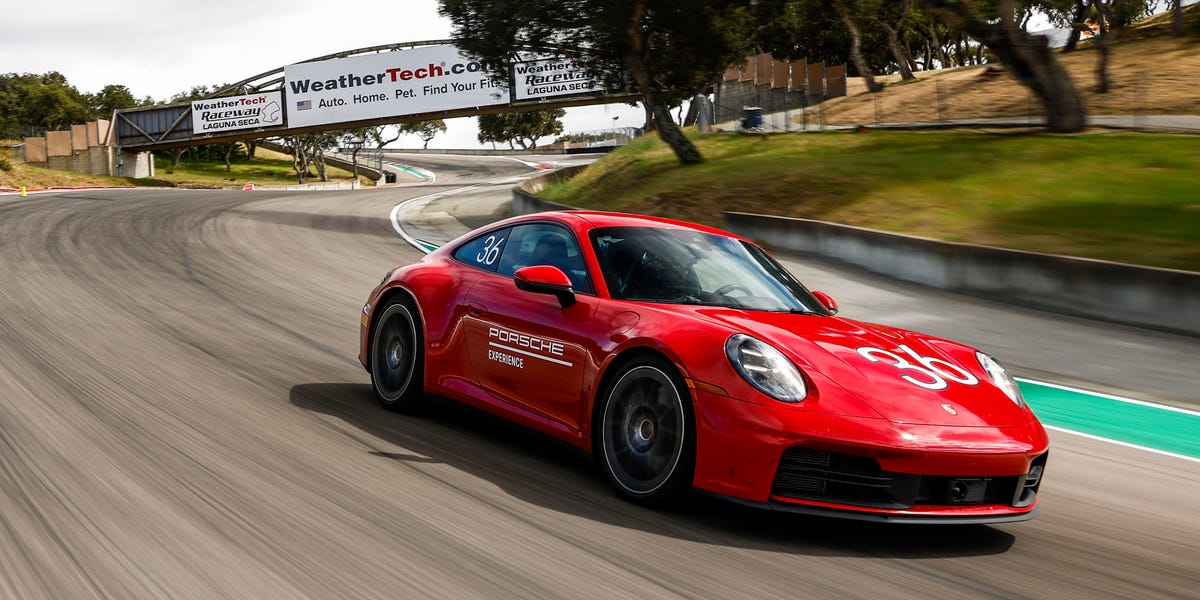
Porsche brought its Track Experience to California and let me live out my childhood fantasy in one glorious day of driving school.
My first memory of Laguna Seca Raceway came through the pixelated lens of Gran Turismo 2. The racing video game features a series of license tests, including one that requires conquering Laguna Seca's famous Corkscrew with a Dodge Viper GTS. It took my 9-year-old self days to master the daunting downhill chicane within the time limits, but I had the determination of the late Alex Zanardi and several liters of Mountain Dew to eventually help me succeed. I vividly remember that triumphant feeling, and ever since, I've dreamed of one day driving on that iconic racetrack.
Lucky for me, I have a job that often makes the dreams of a lifelong car nerd come true, most recently when Porsche invited auto journalists to its newly opened driving school held at WeatherTech Raceway Laguna Seca near Monterey, California. Known as the Porsche Track Experience (PTX), the academy also operates near Birmingham, Alabama, as well as 11 locations in Europe, including Germany's Hockenheimring racetrack. That's where PTX—originally called Porsche Sport Driving School—was introduced in 1974 as a launchpad for the OG 911 Turbo.
Porsche's first driving school was run by its engineers, but today's instructors are all current or former professional racing drivers, so they know a thing or two about what it takes to turn a fast lap. While I participated in a one-day program that normally costs $3500, Porsche offers several multi-day classes ranging from $6500 up to $20K, with the latter catering to advanced drivers and featuring cars on racing slicks. And with about 230 days of programs available every year, there's a good chance you can find the time to get into a 911 Carrera S, 718 Cayman GTS 4.0, or 911 GT3.
 View Price on Amazon
I'm not a total noob when it comes to on-track driving, with my skill level landing somewhere at the beginning of the intermediate spectrum. Still, I appreciated the initial classroom session that covered basic racing principles, specifically the importance of balancing the car's weight when accelerating, braking, and cornering.
My class was led by Nick Galante, an affable dude and professional racer who's also a two-time IMSA SportsCar champion. He's been a driving instructor since 2010, and I thought he shared a smart way to think about the relationship between steering and pedal inputs on the racetrack. To help mitigate oversteer and understeer and preserve the racing line, he said to pretend there's a string between the top of the steering wheel and your feet. When the wheel is at the 12 o'clock position, you can apply 100 percent pressure to the gas or brake pedal, but as you increase the steering angle, the imaginary string should remind you to decrease the pedal pressure in equal measure. Groundbreaking? Maybe not, but I found that pro tip useful when I finally strapped on my open-face helmet and climbed into the driver's seat of my red Porsche 911 Carrera S for several hours of instructor-led, lead-follow track sessions.
Full disclaimer: I petitioned for seat time in the 911 GT3 training cars that are also available through the PTX program, but I was politely denied. The reason being there weren't enough cars for the whole class, and Porsche wanted us to experience the same car throughout the day's multiple on-track sessions to best evaluate our progress. I was admittedly bummed, but Porsche's bestselling 911 model proved to be an impressive consolation. After all, the rear-drive Carrera S is damn-near perfect, featuring a 473-hp twin-turbo 3.0-liter flat-six and an eight-speed PDK transmission that's infinitely quicker and more coordinated than my left foot and right hand will ever be.
The original Laguna Seca Raceway was created as a safer alternative to the nearby Pebble Beach road races.
Source: caranddriver.com