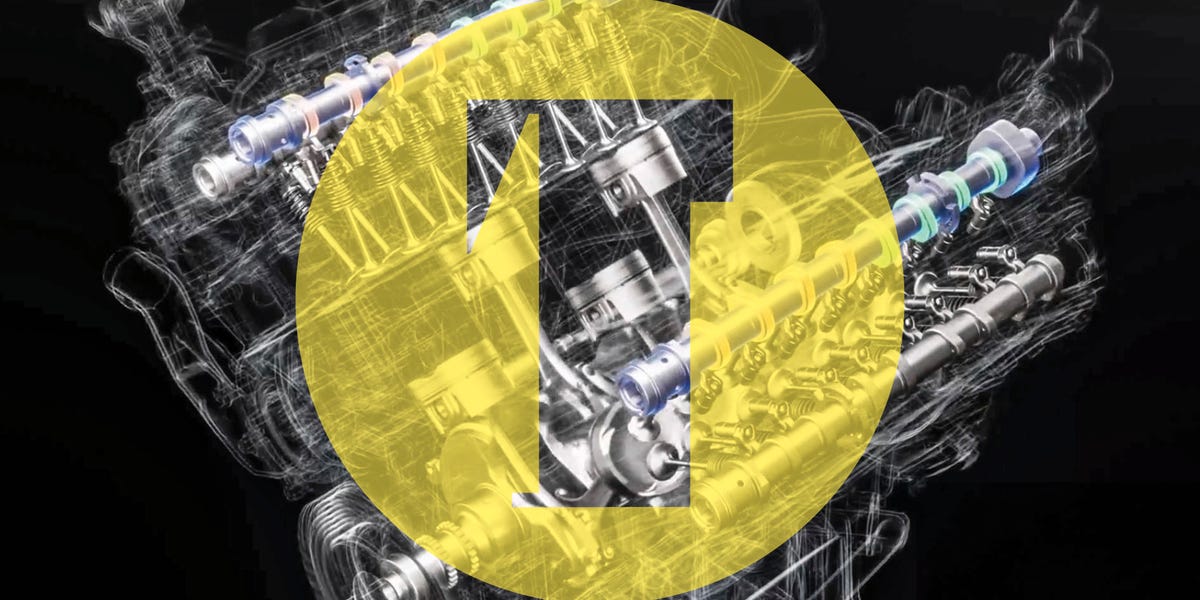
It turns out that flat-plane crank V-8s can find homes outside of sports cars and supercars if you throw enough engineering might behind them. One of the more interesting byproducts of Europe’s stringent Euro 7 emissions regulations going into effect is a small flurry of internal combustion innovation. Porsche introduced its new T-Hybrid powertrain; now, Mercedes has a new flat-plane crank V-8, the M177 Evo.
This isn’t the only V-8 engine Mercedes has released recently with a flat-plane crankshaft. You might recall the previous-generation AMG GT Black Series and its high-power, motorsports-inspired M178 4.0-liter twin-turbo flat-plane-crank engine. This new motor is not that. The M177 Evo’s first home is the heavily refreshed S-Class, which is one of the last places I’d expect to find such an engine.
As you likely already know, the most common applications for a V-8 featuring a flat-plane crank design are in high-end sports cars and supercars. Exotics from Ferrari, McLaren, and others are the usual suspects, but Ford broke new ground last decade by implementing the design in the Ford Mustang GT350, and the C8 Corvette Z06 followed in its American footsteps. You might get slightly different answers as to why each automaker decided on a flat-plane crank, but the benefits are consistent across the board.
 View Price on Amazon
For one, they have excellent primary balance properties, eliminating the need for the heavy crankshaft counterweights needed in a cross-plane crank design. This naturally reduces the weight of the rotating assembly, allowing the engine to rev faster and higher. The flat-plane crank arrangement also comes with exhaust benefits: since combustion happens every 180 degrees with the firing order alternating bank-to-bank, exhaust gases exit at the same intervals, allowing for improved flow. The sound emanating from those exhaust pipes is also quite distinctive in a great way, allowing you to easily identify when a Ferrari or C8 Z06 is coming at you.
But the natural goals and benefits of the flat-plane crank design are in direct conflict with the priorities of an S-Class powertrain, where refinement and effortless low-end torque are crucial. After hearing from digital director Aaron Brown about his experience driving the new S-Class’s V-8, though, it sounds like Mercedes has managed to retain its classic, cross-plane V-8 experience despite the huge design change. It’s quiet, has plenty of low-end torque, doesn’t feature any of the annoying secondary vibrations inherent to flat-plane designs, and otherwise melts into the background. Speaking with Mercedes engine powertrain development engineer Roman Hasselkuss, I found out how.
“That's why we added two balance shafts, and they are compensating for all the vibrations,” Hasselkuss said. “So basically, what you get now with adding these features to the engine—you're getting the benefits of that harmonic, symmetric behavior of the flat plane without the vibrations that you would cause by this mass movement; that's already eliminated.”
The two balance shafts, pointed out in the graphic above, are offset from the crankshaft and rotate in opposite directions, effectively cancelling out vibrations. The presence of these balance shafts is really what sets this Mercedes flat-plane crank V-8 apart from all the others on the market; supercar makers are less concerned with the rough, secondary vibrations the flat-plane crank design naturally results in, so they choose to omit balance shafts to save weight.
The penalty for Mercedes adding weight is similar to the penalty for crankshaft counterweights. This engine doesn’t rev as high or as quickly as flat-plane crank V-8s in cars without balance shafts; that said, such a compromise is almost exactly what Mercedes desires in an S-Class, where the engine will live in the lower half of its tachometer most of the time. Peak horsepower arrives at 5500 rpm, exactly the same as the previous V-8. However, peak torque is shifted upwards, as all 553 pound-feet are available.
Source: roadandtrack.com

