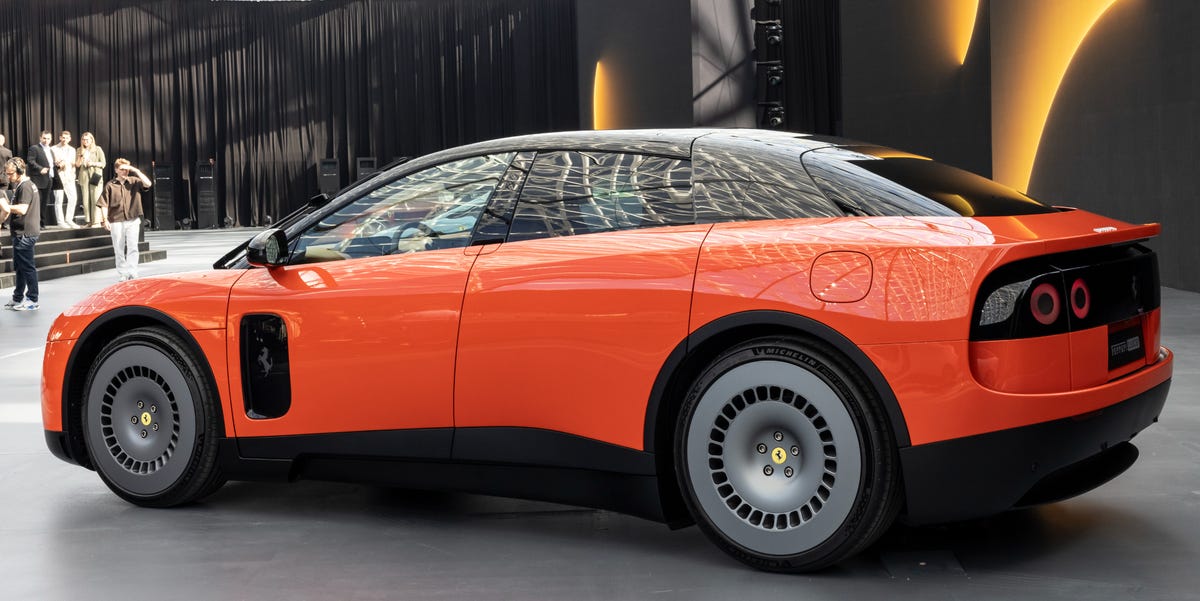
The Luce's exterior is supposed to invoke two different body shapes, one stacked atop the other, with each emphasizing a different trait of the car. Ferrari's first electric vehicle, the Luce, made its debut on Monday and caught the automotive world off guard with its radical design. The design has become the subject of discourse, jokes, and even confusion, with share prices falling and former executives complaining. Even Pope Leo XIV weighed in after getting a look at the car on Tuesday.
The design itself started with the choice to build a five-door, crossover-adjacent EV. Ferrari product manager Pietro Virgolin told Road & Track at the Luce launch event that this decision was a matter of form following function, a packaging choice made to slot a huge battery and four-motor powertrain underneath whatever the brand was going to build. He mentions that internal combustion Ferraris have their own sacrifices, like transaxles that have to sit between the rear seats, and the EV's nature allowed for a more spacious cabin with a Ferrari-first third seat in the second row.
 View Price on Amazon
Marc Newson, another former Apple designer at LoveFrom, tells R&T that the firm's work on the car started from the company's decision that it would be a four-door, five-seat EV. He says that the idea of separating out the interior and exterior shapes of the body was an idea his team started exploring early in the design process, something now clearly highlighted in the two-tone look of every Luce shown since its debut on Monday. The passenger cell is designed to be efficient, with a rounded shape that emphasizes aerodynamics, while the exterior shape emphasizes wing designs in both the front and back of the car, contributing downforce and keeping the car's blocky proportions without spoiling the drag coefficient with big, flat surfaces.
The interior is another major shift from what Ferrari is doing in its internal combustion models, but unlike the exterior, its emphasis on physical controls drops modern trends to harken back to the recent past. Newson describes the roomy cabin as "like a TARDIS" from Doctor Who—bigger on the inside than you would expect. He jokes that the rear-hinged door is mounted that way because "it's better," before clarifying that his team "wanted to create as clean a possible intersection between these two spaces, between the outside and the inside."
Source: roadandtrack.com

