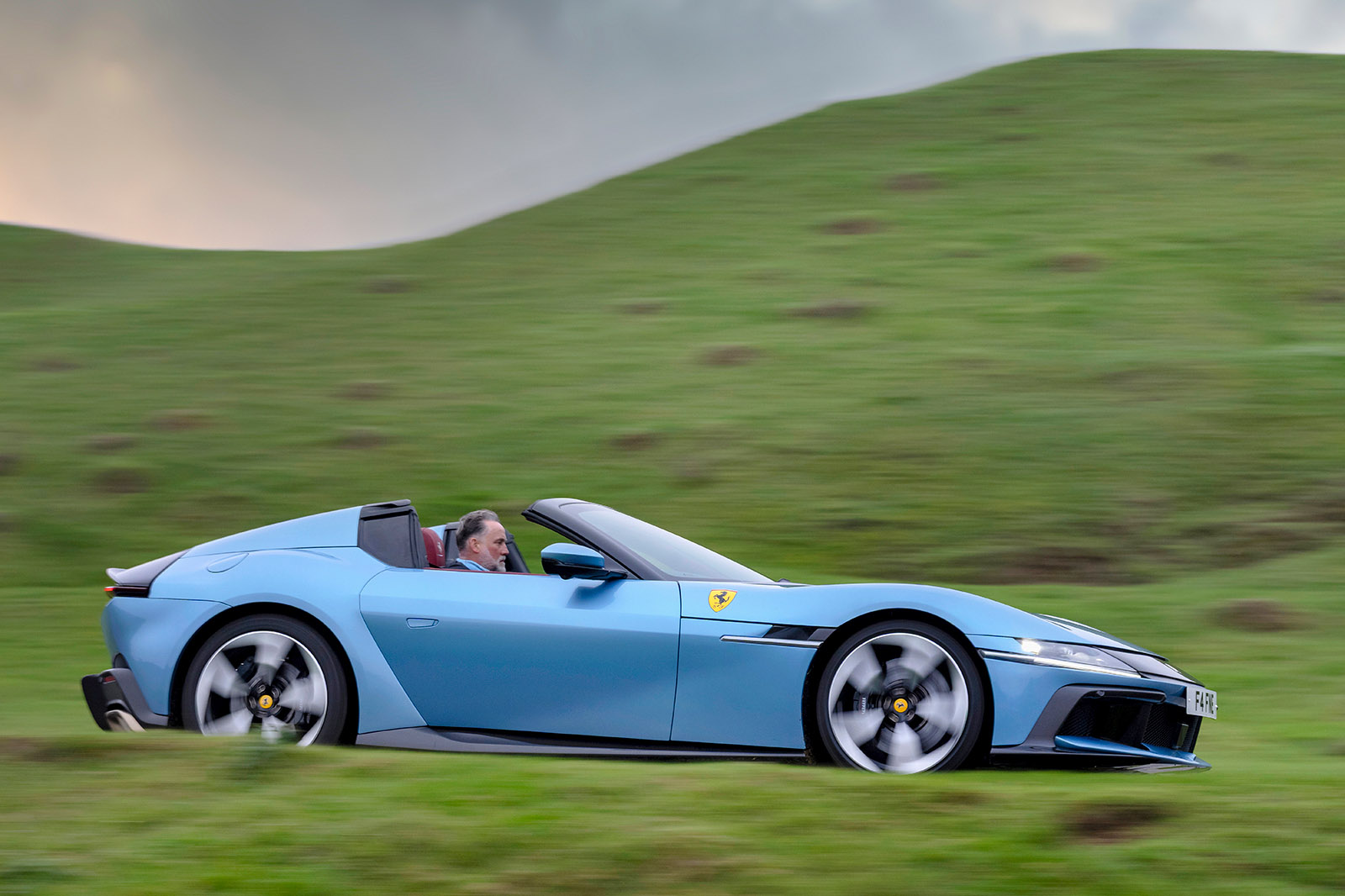
When Ferrari unveiled the 12Cilindri two years ago, it marked a significant shift in the company's approach to its front-engined, twelve-cylinder model. The design, which pays homage to the legendary 1960s Daytona, signaled a move towards a more classic grand touring character, rather than the outright performance focus of its predecessors, the 812 and F12.
The likes of Aston Martin and Bentley might not have been thrilled about this development, but for those who appreciate a more laid-back, classic-mold, front-engined Ferrari, the 12Cilindri Spider is an even more enticing proposition than the fixed-head coupe. We recently had the opportunity to drive the Spider in the UK for the first time, and it did not disappoint.
In terms of its mechanical makeup, the Spider is broadly similar to the coupe: a front-engined V12 GT in the old tradition. The primary changes are those made to reinforce the body to cope with the removal of the roof. Ferrari claims a 15% increase in body rigidity over its 812 GTS predecessor, although no figures are provided for overall rigidity or a comparison with the coupe. Chassis modifications, including reinforcement around the A- and B-pillars and thicker sills, along with the roof folding mechanism, add 60kg to the coupe's 3,461-pound (dry) weight.
 View Price on Amazon
A fabric roof would have added less weight, but as head of GT exterior design Andrea Militello explained to Autocar, a soft top like that on the Roma Spider is a "more romantic" alternative. The 12Cilindri's roof, which folds in 14 seconds at vehicle speeds of up to 28mph, is "a technical roof, a shell that suits speed. You wouldn't go to space with a soft top." Some of the sci-fi-inspired elements of the coupe's design have been toned down in the Spider, but it remains a striking vehicle, with an imposing bonnet length and a presence that belies its 4.7m length and 2.0m width.
The 12Cilindri Spider's cockpit is a strict two-seater, making it a more intimate space than some of its competitors. While there is little to no useful space behind either seat, small storage compartments in the door panels, a smallish one under the central armrest, a reasonably sized glove box, and a 200-litre boot at the rear separate from the storage area for the roof all contribute to a sense of practicality. Unlike the 296, the 12Cilindri features a central touchscreen infotainment system, which improves usability and reduces driver distraction.
From the driver's seat, the car feels similar to an Aston Martin in terms of comfort, luxury, and ergonomic consideration, although it falls short of Bentley's standards. The driving position is straight and comfortable, with a seat that is soft and supportive enough, although it lacks adjustability and couldn't be set as low as this 6ft 3in tester would have preferred. The cabin's fixtures and fittings range from tactile and metallic to slightly flimsy and plasticky, an area where the car could benefit from more substantial materials, similar to those found in the new Luce.
Source: autocar.co.uk

