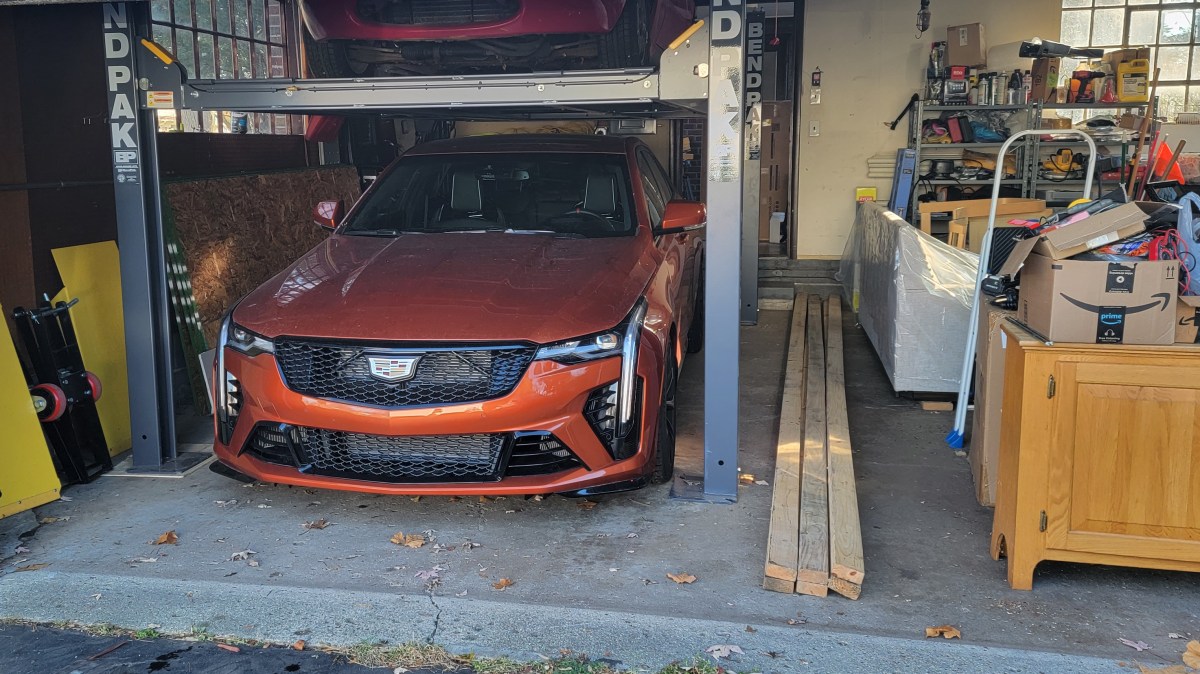
If you’re a car enthusiast with a home and garage to call your own, chances are you actually store a vehicle in it. At least, that’s the case based on a brief and completely unscientific survey of my immediate circle of friends/colleagues. But if you believe surveys of the general public, only about a third of people with a garage actually use it to store a car.
The answer to that question is twofold. The first is pretty straightforward. If you’ve been paying attention over the past 30 years, you’ve noticed that cars and trucks are getting bigger. Meanwhile, garages are getting smaller.
Let’s put some numbers to it. The typical F-150 (a SuperCrew with the 5-foot-5-inch bed) is 19 feet long. That means you could just squeeze it into a garage that is about 20 feet deep, assuming you have full clearance inside, but unless you don’t care about your bumpers (or for that matter, your drywall job), the smallest garage most people would feel comfortable parking it in is about 22 feet deep.
 View Price on Amazon
That’s long enough to park a typical compact crossover (think Honda CR-V or Toyota RAV4) with room to walk around it. Even a midsize truck would fill the space; the shortest Toyota Tacoma on the market is still nearly 18 feet long.
What gives? It should be no surprise that this comes down to dollars and cents. For starters, real estate is at a premium near urban centers, and local building code often prevents the obvious alternative of simply expanding the home’s footprint.
Developers instead cannibalize garage space to create more livable square footage. To make matters worse, these attached garages often need steps up to the main house that can further compromise the actual interior space.
Source: thedrive.com