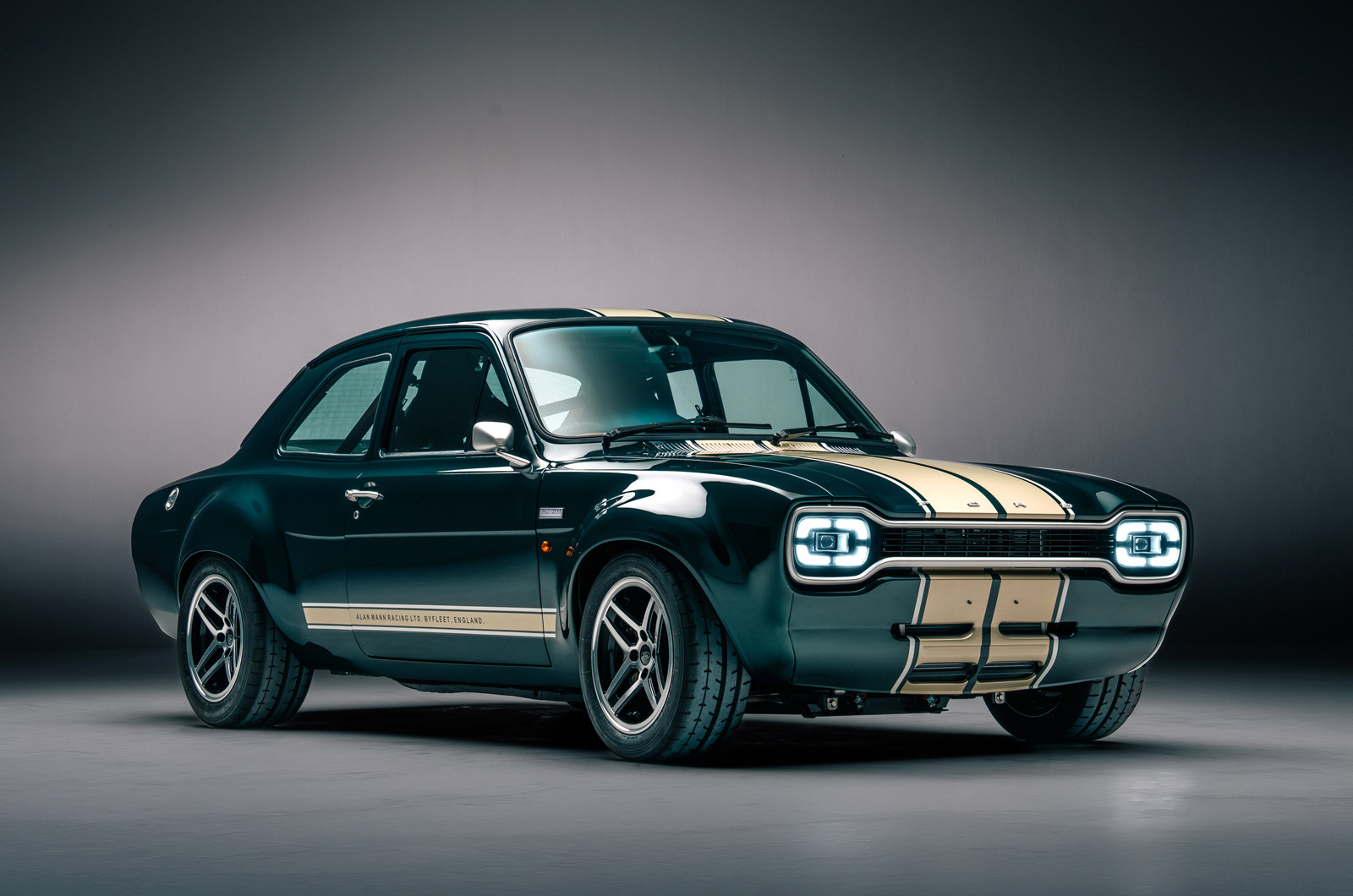
British engineering firm Boreham Motorworks has revealed its $300,000 Ford Escort RS 'continumod' in production form for the first time - and claimed it will be "one of the most focused lightweight performance cars of the modern era". Unlike a conventional restomod, Boreham's super-light Escort is an entirely new creation, rather than being a modernized or re-engineered version of an existing classic car.
It's officially licensed by Ford and described as "the first brand-new road-going Ford Escort Mk1 in more than 50 years". The RS was revealed initially in 2024 and has now been shown in full – with final specs – at the London Concours classic car show, ahead of Boreham beginning production in the coming months.
Pricing starts from $295,000 before options and taxes – so $354,000 in the UK – and just 150 examples will be built in total, in right- or left-hand drive. Weighing just 1,970 pounds, the RS is available with a bespoke naturally aspirated four-cylinder engine that's said to combine motorsport learnings with "modern engineering precision" to deliver a "visceral, analogue driving experience".
 View Price on Amazon
Named Ten-K in reference to its screaming 10,000rpm redline, the 2.2-liter lump weighs just 187 pounds yet sends an impressive 326 horsepower and 155 lb-ft of torque through the five-speed dog leg manual gearbox to the rear axle. Boreham has yet to release performance figures but, based on a power-to-weight ratio of nearly 300 horsepower per ton, the RS should be well capable of keeping pace with most modern sports cars off the mark.
The RS will also be available with a reworking of the storied Twin Cam engine that powered the Escort to competition success and a powerplant derived from Ford’s current offerings. The Twin Cam has been upsized from 1,558cc to 1,845cc and its twin Weber carburetors have been replaced by fuel injection. The changes net an extra 73 horsepower for 182 horsepower.
The RS is based on the two-door Escort RS bodies that were produced by Ford’s Advanced Vehicle Operations in Aveley, Essex, before it was shut in 1975. Boreham digitally recreated the shell and used computer simulations to re-engineer it for improved handling, adding extra bracing and widening the wheel arches.
It also developed a new rear axle made from aluminum and titanium and moved the rear dampers from their original canted position to a more conventional vertical orientation. Power steering, anti-lock brakes, and traction control are omitted to match the driving experience of the original car.
Source: autocar.co.uk