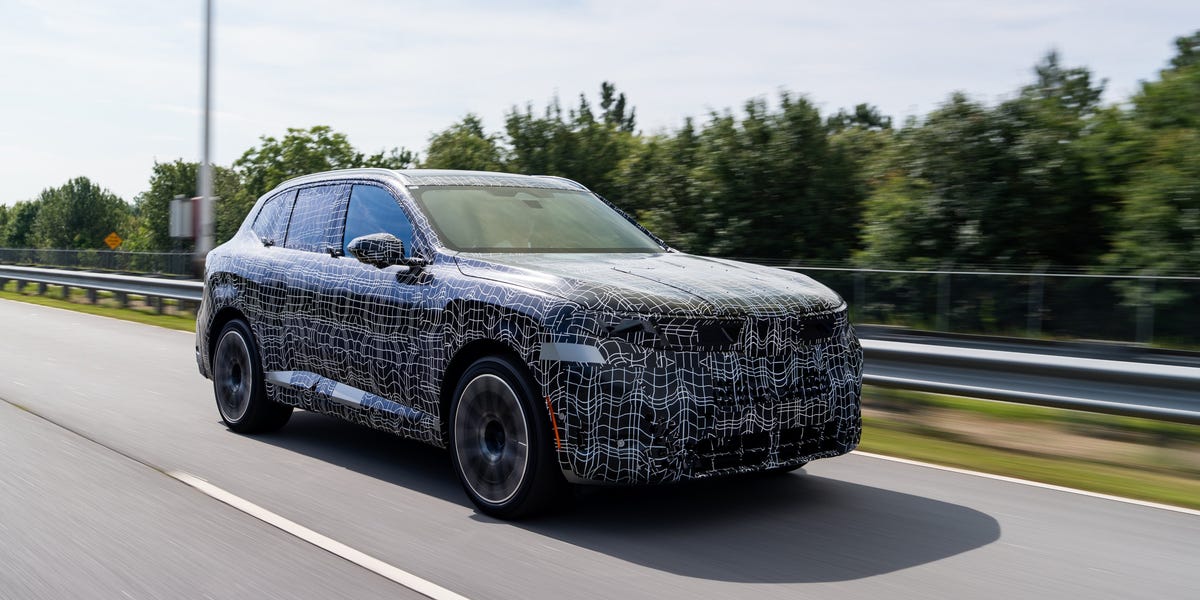
We experience the new X5 in gas, PHEV, and EV forms before its reveal. The soon-to-arrive fifth-generation BMW X5 is like a buffet of similarly looking but wildly different-tasting dishes. Globally, there will be five different powertrains all wrapped in the same bodywork. These are gas, diesel, plug-in hybrid, full EV and even a hydrogen variant. That’s ambitious, and the only version not coming to the U.S. will be the diesel.
Before the full unveil later this month BMW gave R&T the chance to experience prototype versions of the gasoline, plug-in hybrid and EV to preview how the finished cars will drive. Naturally, my testing miles were mostly on the winding mountain roads near the X5’s production facility in South Carolina.
 View Price on Amazon
BMW’s bread-and-butter X5 isn’t going anywhere. The entry-level model will continue to be the X5 40 xDrive, this one equipped with a redesigned version of the long-lived 3.0-liter turbocharged inline-six and aided by a 48-volt mild-hybrid system. Output rises to 400 horsepower and 428 lb-ft of torque, increases of 25 hp and 30 lb-ft, respectively. When queried about what’s new with the B58, engineers were quick to say “everything.” It has a new cylinder head, runs on the emissions-friendly Miller cycle, has a new turbo, and a fresh exhaust system now equipped with a particulate filter, even the U.S. version. This evolution of the inline-six is debuting in the X5, but expect it to be sprinkled across the BMW lineup as models are refreshed.
Thankfully, the experience is familiar. The new motor has a quick response and pulls across its whole rev band, with peak torque coming on at a low 1950 rpm. BMW claims a 0-60 time of 5.4 seconds and a top speed of 155 mph. Shifting is as smooth as ever with the ZF eight-speed automatic transmission carrying over unchanged. That said, I found shifting myself via the paddles took some getting used to, because the tachometer finds its home way out ahead of the driver in the new Panoramic Vision display. This Neue Klasse touch replaces the instrument cluster, and then some. While it would be cause for consternation in an M car, this new-age tach is much less offensive in a base X5, where the vast majority of owners would likely ignore it anyway.
Of all three versions, the 40 was the sneaky dynamic winner. It’s the lightest of the bunch, but still made a great (albeit speaker-enhanced) inline-six sound in the cabin. New electronically-controlled adaptive dampers come standard, but three big options can change how the X5 drives: two-axle air suspension (updated with more air volume), active roll stabilization, and rear-axle steering. These are all offered on the current X5, though that doesn’t make them any less important for the new generation. If you want them all, the M Dynamics Professional package is the box to check.
One of the most impactful updates to the X5 is the new car-like driving position. Despite mighty fine handling and high limits before, the previous X5 always drove like it was up on its toes. This new generation flips it completely. The redesigned platform and interior ensure the driver sits in the car, not on top of it, shrinking the body around you and instantly increasing handling confidence and lessening the sensation of roll. If you’re after a commanding, up-high seating position, prepare to be disappointed. Despite it being the second-largest SUV in BMW’s lineup, engineers will tell you this X5 is a driver’s car over and over. The only small caveat here is that the pillar-to-pillar Panoramic Vision display forces you to lift the seat a little higher than preferred. A bunker-like seating height fully cut off any sight of the hood and my sense of place along with it.
The plug-in hybrid X5 was an excellent proposition before, and it gets a little bit better in this new generation. A more powerful electric motor, still integrated with the transmission, helps lift combined output to 490 horsepower and 516 lb-ft of torque, resulting in a 0-60 time of just 5.3 seconds. This is the version that will likely make the most sense to the majority of buyers.
Source: roadandtrack.com

