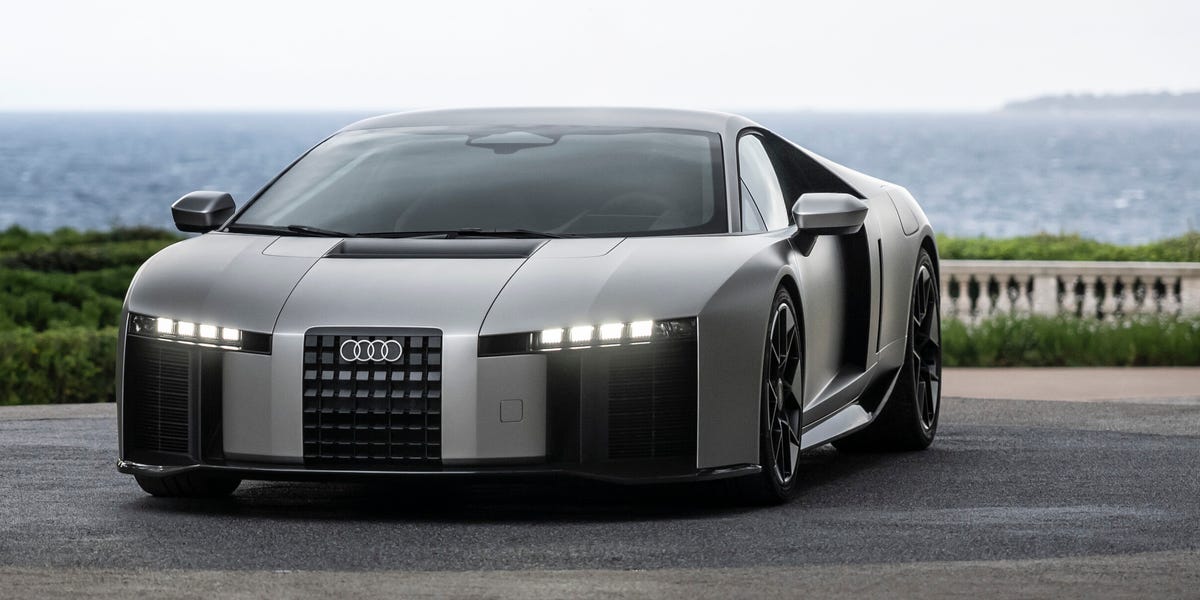
The Audi Nuvolari has a carbon-fiber body, but its design is a tribute to metal. To say that 2026 has been an interesting year in the history of automotive design would be an understatement. While there have been a few rather public duds in the mix, arguably no car has pushed the envelope quite as much as the Audi Nuvolari, at least so far. The Bavarian exercise in Bauhaus sensibilities represents a radical departure from Audi’s recent products, embracing a bold new design language known as "Radical Next."
The team wanted to give the appearance of a car honed from a single ingot. The car's design is, in many ways, a natural evolution of the Concept C that debuted back in September 2025, though the Nuvolari is notably not an electric vehicle. Instead, it shares its bones with Lamborghini’s Temerario.
 View Price on Amazon
“For us in Audi, I think the brand is always related to something that's made out of metal, and this is key for us,” Tobias Hoess, Audi’s head of exterior design, told R&T. “The intention that we have with a new design language is that first of all, the products should look like they are really made out of metal, almost like made out of a block of metal, to give you this kind of very solid, very kind of sophisticated and rich kind of feeling.”
Given that Audi wanted the new range-topper to look like it's made from metal, you’d be forgiven for assuming it has metallic bodywork. In reality, the brand leaned on the expertise of its Formula 1 program and its international partners within VW Group to craft the Nuvolari from carbon fiber reinforced polymer. That decision actually allowed the brand to make the Nuvolari have that “metallic” appearance in a way that traditional materials simply could not.
The tight shut lines in particular are a subtle yet effective part of the Nuvolari’s styling, particularly as they relate to the hidden aero elements. You wouldn’t know from glancing at it that the car even has a large rear spoiler, nor that it's capable of producing 882 pounds of downforce. The S-duct front end works in tandem with the rear element to keep the car planted without the use of often-garish splitters, dive planes, and wings.
Source: roadandtrack.com

