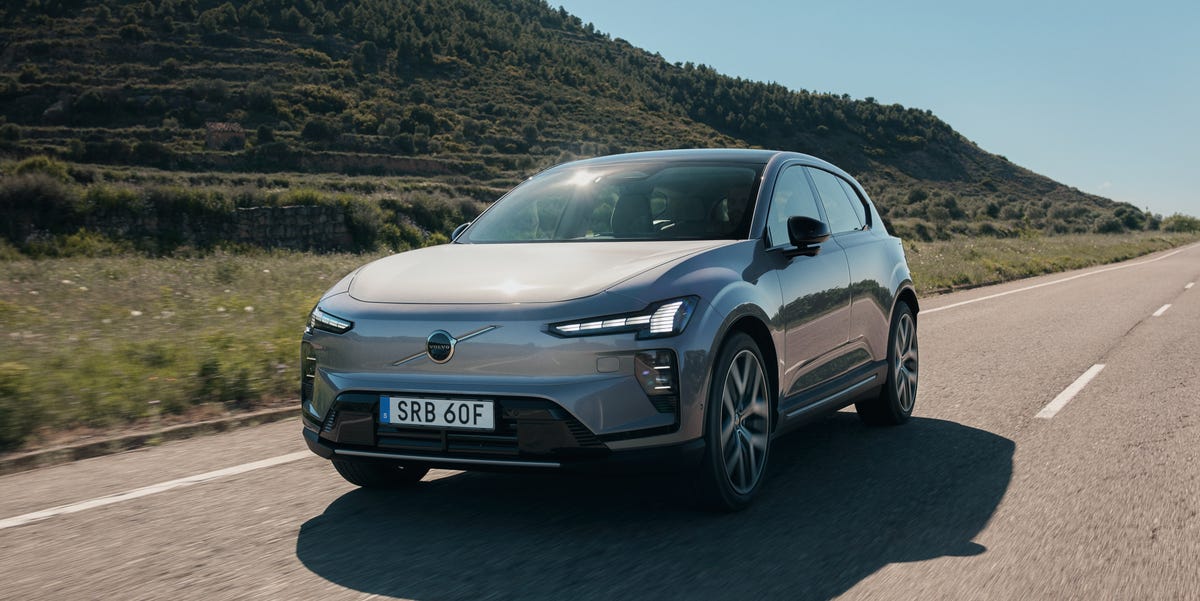
Prodigious computer code and coddling refinement wrapped in Scandinavian minimalism. Technology is consuming the world at a furious pace, often with the promise of greater convenience, productivity, and safety. How that's going depends on who you ask. But most automakers will give a vigorous thumbs-up as they stuff their latest vehicles with all the screens and silicon they can muster. Volvo, in billing its 2027 EX60 SUV as a harbinger of the Swedish manufacturer's software-defined future, is no different.
The new two-row EX60, which we've just driven through the Spanish countryside near Barcelona, is more than an electric alternative to Volvo's gas-burning XC60. It's a showcase for the brand's new digital ecosystem, highlighted by a new HuginCore central nervous system comprising hardware and software developed both in-house and in conjunction with the likes of Google, Nvidia, and Qualcomm. High-level benefits include more meaningful over-the-air updates during the EX60's lifecycle, plus the optimization of its active-safety arsenal to improve both situational awareness and its ability to tailor responses to front-seat occupants.
Framing this network is Volvo's new SPA3 platform with its 800-volt electrical architecture, which scrums with the EX60's myriad systems to enhance energy efficiency and quicken charging times. Additional advantages are said to relate to packaging and mass reduction, thanks in part to situating the EX60's battery cells in its floor as partial structural elements, rather than as a fully separate pack. Another weight saver is the aluminum megacasting of the vehicle's rear subframe, replacing what would otherwise be more than 100 individual structural components.
 View Price on Amazon
When it launches in the U.S. this summer, the Swedish-built EX60 will join an increasingly crowded segment of electric compact luxury SUVs, including the similarly endowed and proportioned Audi Q6 e-tron, BMW iX3, and Mercedes-Benz GLC Electric. The starter model is the single-motor, rear-wheel-drive P6, which makes 369 horsepower and gets an 80-kWh battery that can fast-charge at up to 240 kW. The dual-motor, all-wheel-drive P10, on the other hand, produces a stout 503 horses and sports a 91-kWh pack that can charge at a max of 280 kW—provided you can find a sufficiently powerful charging station. Wait a little longer, and a 670-hp P12 model with a 112-kWh battery is expected later this year, while a rugged Cross Country variant (in both P10 and P12 tunes) will fill out the lineup as a 2028 model.
Volvo says both the P6 and the P10 can recoup about 160 miles of range in as little as 10 minutes, with a 10 to 80 percent charge requiring 18 minutes (a standard NACS port should make for easy hookups at Tesla Superchargers). Depending on wheel size (20-, 21-, or 22-inchers), EPA range estimates for the P6 are either 295 or 307 miles, while the P10 is rated at either 312 or 322 miles.
Compared with the XC60, this EV is 3.7 inches longer and rides on a 4.1-inch larger wheelbase. Both Volvos have roughly the same amount of legroom up front; the gas car has a smidge more space in back, though the EX60's second row remains generous, and its low floor helps earn it more headroom throughout. There's 20 cubic feet of cargo volume in the EV's tail, not including a large underfloor storage bin; plus, there's a small frunk. Folding the rear seats down expands the space to 58 cubic feet.
Like its sleek, chiseled exterior that has an almost wagon-like aura, the EX60's clean and restrained cabin is a study in Scandinavian chic. Fit and finish of the many visually and tactilely pleasing materials is excellent. The fabric-covered dashboard, for example, brings texture and warmth to what is an already inviting atmosphere, balancing some of the more industrial forms. A standard glass roof with optional electrochromic dimming lets in plenty of natural light.
Source: caranddriver.com