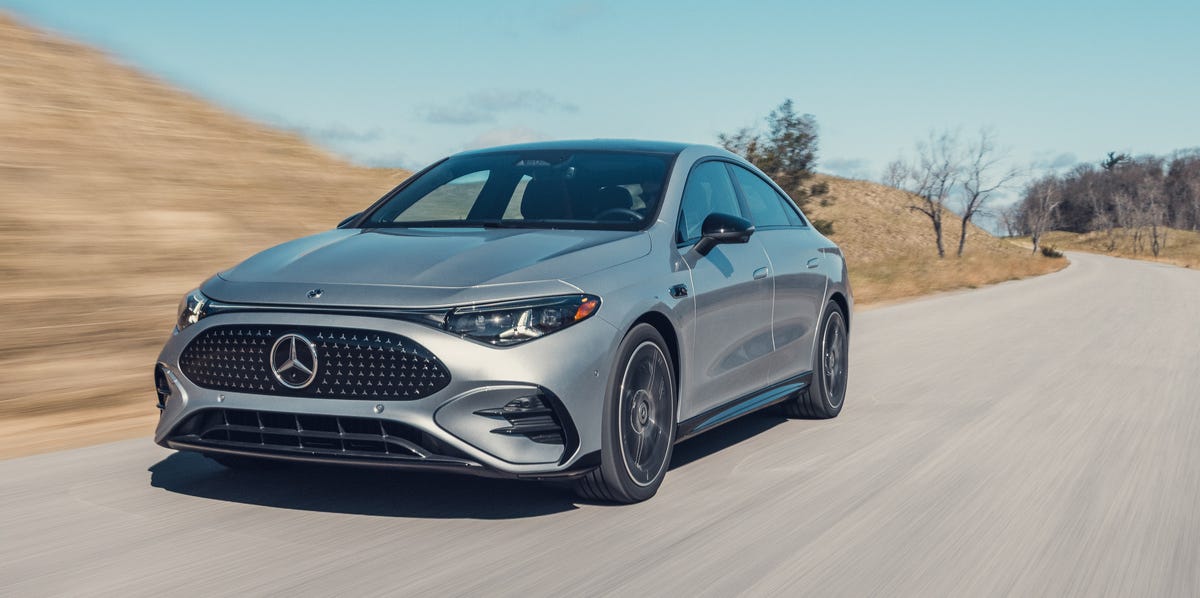
Can a new entry-level sedan be the fresh start Mercedes-Benz's electrified division needs? Maybe, but one thing's for certain: The CLA250+ is different than any other Mercedes EV to date. From the July/August 2026 issue of Car and Driver.
Automakers rarely admit product missteps. But how else should we interpret a complete about-face in strategy? This all-new CLA is the first vehicle in Mercedes-Benz's second generation of EVs, and the execution couldn't be more different. Rather than build EVs on separate architectures, like Mercedes did with the EQS, EQE, and most other EQ-prefixed vehicles, the automaker houses both electric and internal-combustion powertrains in the new CLA, mimicking BMW's approach. Gone is the "EQ" naming convention too. The distinct, bloblike styling is out, as is an aversion to frunks—owner's manuals for the previous EQ vehicles admonished owners never to open the hood. When buying the new CLA, you simply choose between the gas and electric versions.

Mercedes already had solid EV tech in place, and its EQ models have put up extremely competitive range figures in our real-world testing. Nevertheless, the new CLA doubles down with M-B's first 800-volt electrical architecture and revised battery chemistry that reduce charging times, permanent-magnet electric motors designed in-house that employ hairpin windings, and a two-speed gearbox at the rear axle—just like the Porsche Taycan—to improve both low-end responsiveness and high-speed efficiency.
The most efficient version is the 268-hp, rear-drive CLA250+, which starts at $49,300 and has a single motor in back, while the CLA350 adds a front motor and another 81 horses. We tested the CLA250+, but unfortunately, Mercedes didn't send us the technological showpiece on 17-inch wheels, the variant with a whittled-down drag coefficient of a minuscule 0.21. That one earns a 374-mile EPA range estimate; opting for 18s knocks that down to 317. Our loaded example was on 19-inch wheels and Bridgestone Turanza 6 summer tires, which are expected to be such a low-volume option that this version doesn't get a separate range figure and instead shares one with the 18-inch setup. But even this worst-case CLA250+ went a very impressive 340 miles in our 75-mph highway range test. This puts it in the top 10 of the longest-range EVs we've tested. And it's the vehicle in that esteemed company with the smallest battery (85 kWh), but on 17s, it might've gone 400 miles.
The best EVs are both efficient and fast-charging, and the CLA nails that duality. To prove it, Mercedes used the CLA to one-up the 24-hour range record previously held by the Porsche Taycan. The Mercedes crew employed a very short-stop strategy, with 40 charges, all 10 minutes long, each time boosting the battery from a roughly 10 percent state of charge to 55 percent. For the less than half-hour between stops, drivers kept the CLA pinned to its 131-mph top speed, accumulating 2309 miles over 24 hours—181 miles more than the Porsche—for an average speed of 96 mph. Mercedes determined that doing all the charging in the zone where the pack charges most speedily made up for the extra stops, and the CLA incorporates this technique into its navigation routing logic. Enter a faraway destination, and many of the recommended stops are for short bursts of charging, regularly 20 minutes or less.
Source: caranddriver.com