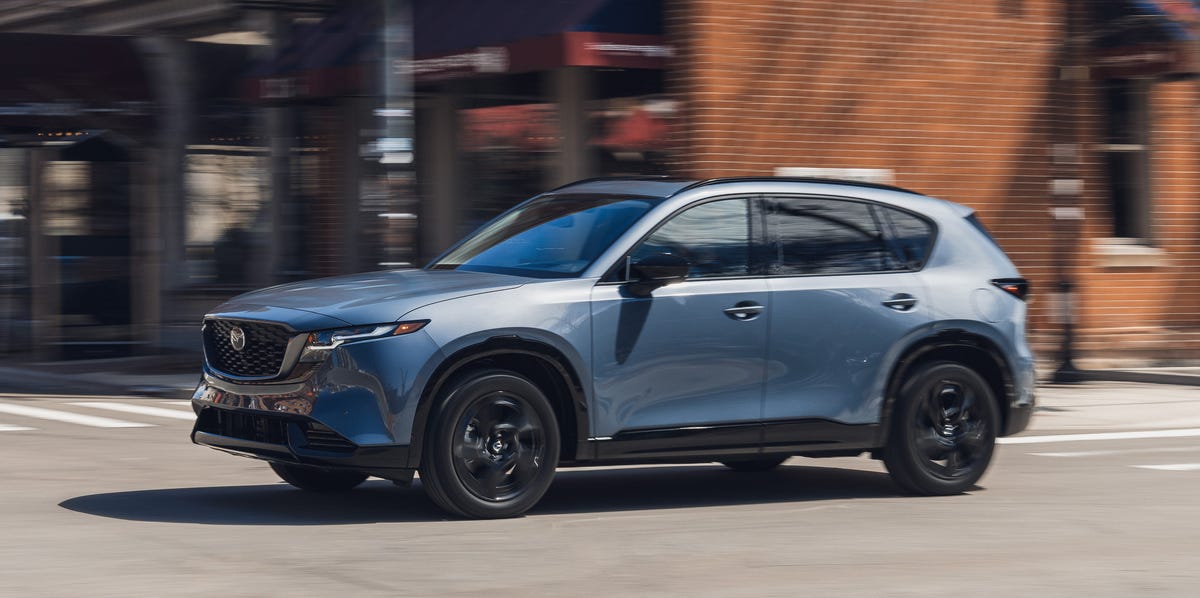
The redesigned 2026 Mazda CX-5 moves even closer to the CX-50 in terms of size and features. When the CX-50 appeared on the scene for 2023, it was positioned as slightly larger and more upscale, although there was plenty of overlap between the two.
Mazda North American Operations president and CEO Tom Donnelly describes the CX-5 as "slightly more urban" than the CX-50, which he characterizes as "rugged" and "outdoorsy." Those distinctions strike us as mostly imaginary. The truth is that the freshly redesigned 2026 CX-5 narrows the gap, and these two SUVs overlap more than ever.
The new CX-5 adds 4.6 inches between the axles, meaning that it now shares the same 110.8-inch wheelbase as the CX-50. A 4.5-inch increase in overall length puts the new CX-5 just 1.2 inches shy of the CX-50. The CX-50 remains just over two inches wider, while the CX-5 is some three inches taller than its in-house rival.
 View Price on Amazon
As a result of that growth spurt, the CX-5 now exceeds the CX-50 in both passenger and cargo space. Mazda paid particular attention to rear-seat room, with more rear legroom and over two inches of additional knee room than before; rear headroom is greater as well. Whereas the rear seat previously couldn't match competitors such as the Honda CR-V and the Volkswagen Tiguan, it now has plenty of legroom and knee clearance for a six-footer sitting behind a similar-sized driver.
Wider and taller rear doors also enhance access. Out back, a larger liftgate opens to the more generous cargo area, where a lower floor eases loading of luggage, and the rear seatback is split 40/20/40 to allow long, narrow items (such as skis) to nestle between the rear-seat passengers.
Up front, there's a new steering wheel that incorporates more controls and has a smooth leather rim that feels great. The gauge cluster is now a 10.3-inch digital display, and the available head-up display is more than twice as large as before. The big change, however, is the infotainment system. The display grows from the previous 10.3 inches to 12.9 inches, or 15.6 inches on the Premium Plus.
The long-serving rotary controller has been kicked to the curb; Mazda has finally embraced the touchscreen. It has done so with a convert's fervor, scrapping even the audio system's volume and tuning knobs. Mazda has also embraced voice control, via Google's built-in software. Other Google apps include Google Maps and Google Play, as well as Google's AI helper, Gemini.
The front seats are a comfortable blend of softness and support, and the door armrests are thickly padded. There's a new two-tone color treatment for the mid-level models too. Still, the top-spec Premium Plus interior finishes aren't as nice as those in the equivalent CX-50, with fewer soft-touch surfaces and more hard plastic.
The 187-hp 2.5-liter engine with standard all-wheel drive carries over from before, although Mazda claims to have tweaked the powertrain logic. The combo of the naturally aspirated engine and the six-speed automatic provides more linear response than some turbo fours and CVTs, but this powertrain isn't a fireball. In the old CX-5, the 187-horse four managed a class-competitive 7.9 seconds to 60 mph.
Source: caranddriver.com