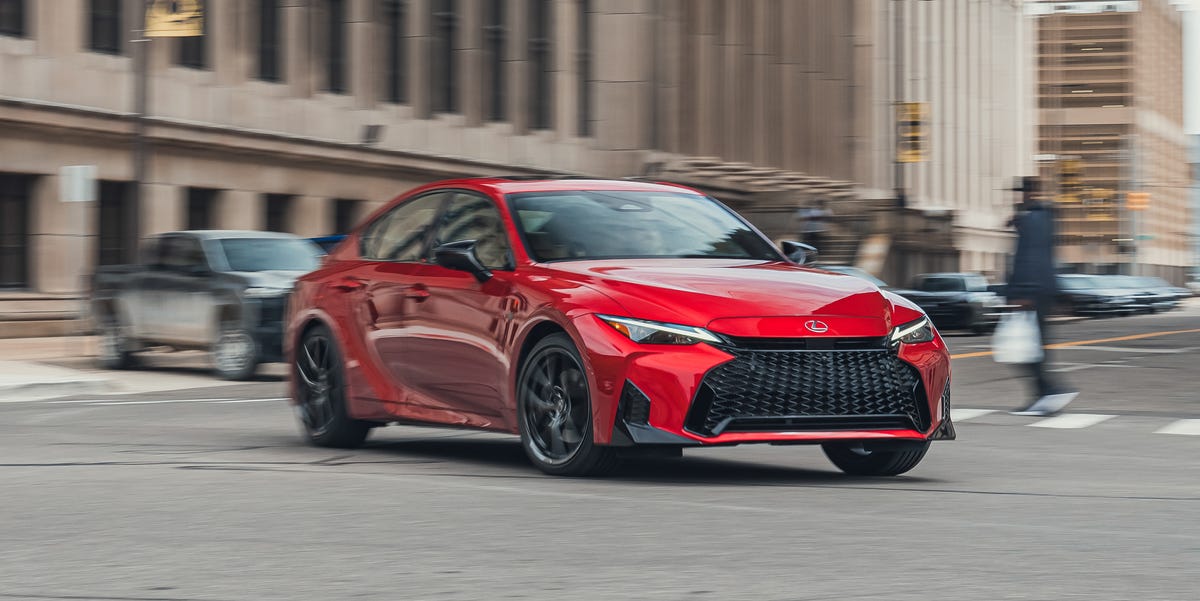
Lexus tweaks its compact sports sedan yet again. Sedans are down—but maybe not out. Sure, there's been a sea change toward SUVs, but sales of traditional four-doors have seen a blip in recent months. At Lexus, the brand-defining LS is being ushered offstage, but the ES was just redesigned. Meanwhile, the IS sees a reduced lineup for 2026 but also gains some worthwhile improvements.
The current-generation IS rolls into its 12th model year, burnished by yet another mid-cycle update, its third. There's new front-end styling that looks contemporary and manages to play nicely with the rest of the exterior design. In pruning the IS family tree, Lexus trimmed from the top and the bottom. It cut the entry-level IS300 and the range-topping IS500, leaving just the IS350, in two trim levels: F Sport Design and F Sport.
 View Price on Amazon
"Design" serves as the base version, which is the one tested here. The uplevel, regular F Sport comes at a $2450 premium and gets model-specific suspension tuning, red-painted brake calipers, power lumbar and four-way adjustable headrests for the front seats, a heated steering wheel, and some special interior trim items. There's also an available Handling package, which brings additional drive modes, adaptive dampers, and a Torsen limited-slip differential (the last item on rear-wheel-drive models only), as well as a Technology package, which adds full-LED headlights, front-cross-traffic alert, lane-changing assist, and Traffic Jam Assist.
With the base four-cylinder and the V-8 jettisoned, the naturally aspirated V-6 is the sole engine on offer. Its transmission partner depends on whether the IS350 is equipped with rear- or all-wheel drive. Rear-drive models get a more modern eight-speed automatic, while all-wheel-drive versions stick with a six-speed. Despite the difference in gear count, EPA fuel economy numbers for the two variants are nearly identical, with the rear-wheel-drive model posting estimates of 19/27 mpg city/highway, while the all-wheel-drive version sits at 19/26 mpg.
Those figures are well short of turbocharged four-cylinder rivals like the Audi S3 (23/31 mpg) and the BMW M235 Gran Coupe (24/33 mpg). In our 75-mph real-world highway fuel-economy test, though, our all-wheel-drive IS350 overachieved with a 28-mpg result. You wouldn't expect the test numbers for a 12-year-old car to beat newer rivals—and they don't. The V-6's 311 horsepower and 280 pound-feet of torque look respectable in this company, but the 60-mph time of 5.6 seconds is well off the pace of the S3 and the M235, both of which hit 60 in 4.2 seconds.
The same is true on the skidpad, where the Bridgestone Turanza EL450 all-season tires deliver just 0.87 g of grip, versus 0.94 g for the M235 and 0.95 g for the S3 (both wore Goodyear Eagle F1 SuperSport summer rubber). In braking, the Lexus stopped from 70 mph in a respectable 165 feet, but the Audi (152 feet) and the BMW (154 feet) were better.
And yet, the Lexus has appeal for those who look beyond the objective figures. A naturally aspirated engine is an increasing rarity, with linear throttle response that's becoming novel. Ditto the torque-converter automatic's smooth low-speed behavior. Granted, without the down-low torque of a turbocharged engine, you need to rev this V-6 to get the most out of it, but that's a pleasant experience; crest 4000 rpm, and it emits a satisfying growl that sounds better than any turbo four. On the move, this powertrain doesn't feel sluggish; note that the IS350's rolling-start, 5-to-60-mph time of 5.9 seconds is only a shade behind its 60-mph time, while the Audi's falls to 5.2 seconds and the BMW's to 5.9.
Source: caranddriver.com

