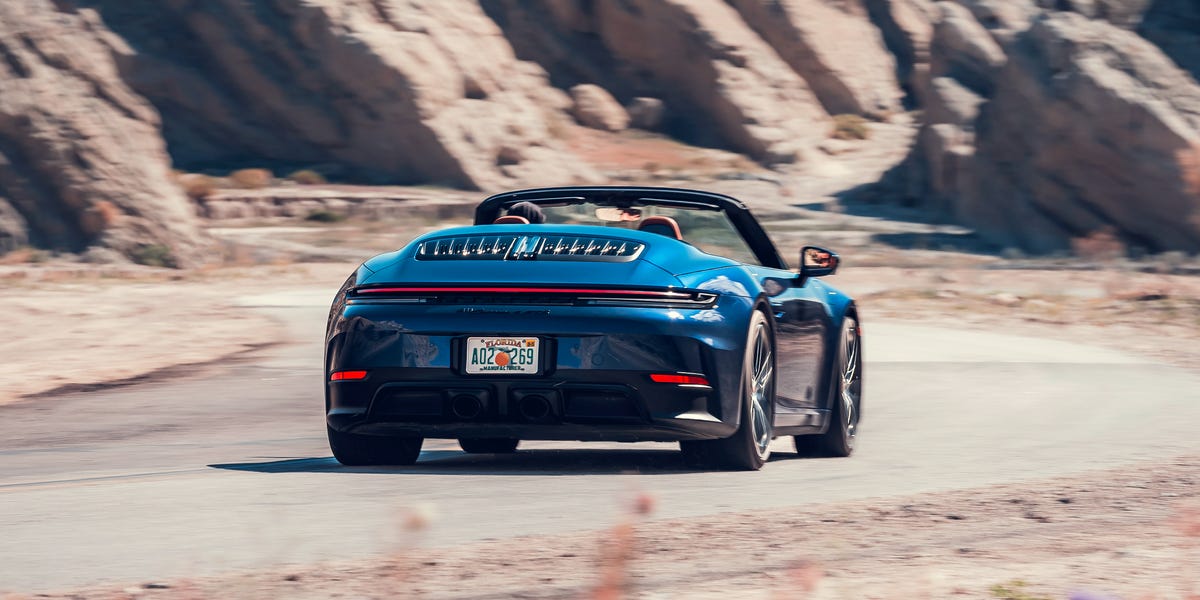
Does all-wheel drive make this Porsche quicker and stickier, or just heavier and more expensive? Ever wonder if all-wheel drive is really worth it on a Porsche 911 Carrera? I mean, sure, if you live where it snows, it makes some amount of sense in this otherwise rear-engine, rear-drive wundercar. But what about the Cabriolet version? That model isn't likely to be winter-driven, so why bother? We wondered too, and it just so happened that the rear-drive GTS Cabriolet we'd recently tested was replaced by an all-wheel-drive 911 Carrera 4 GTS Cabriolet in the same LA press fleet. It allowed for a back-to-back comparison of RWD and AWD, right down to the 2025 model year, test location, and track test driver, which was yours truly.
Each of the two cars was equipped similarly, both being 2025 911 GTS droptops. The base price of the all-wheel-drive Carrera 4 GTS Cab is $187,995—exactly $7,800 more than the $180,195 for the Carrera GTS Cab. The two cars both had similar options too, including the Premium package ($4,600), adaptive 18-way sport seats ($3,030), front-end lift system ($2,980), Carrera Exclusive Design wheels with carbon-fiber blades ($1,040), and ventilated front seats ($840).
 View Price on Amazon
In the end, this car's as-tested price of $208,625 largely comes down to the all-wheel-drive premium and colorway differences. Our lidless GTS 4 is painted a more expensive color (Gentian Blue Metallic), has a more upscale interior turned out in Basalt Black and Classic Cognac, and features fetching dashboard and door panel premium leather trim. It also has an aluminum PDK gear selector, but it's anodized gray so it doesn't jump out. It's more of a feel thing.
On the scales, the difference is a scant 67 pounds (3,886 to 3,819 pounds), which seemed low to us for an all-wheel-drive system. Then we noticed another equipment difference, the optional 22.1-gallon fuel tank, which was present on our RWD example but not available on our AWD model. The larger tank's forward location is apparently incompatible with the added front prop shaft. This matters because we weigh and test cars with a full load of fuel. Okay, the tank holds just 5.5 gallons less in our AWD car, which means the real weight penalty for all-wheel drive is closer to 100 pounds or so, which is more like it.
The GTS powertrain is exactly the same in these two cars, with a single turbo pressurizing a 3.6-liter flat-six. There's also a supplemental electric motor built into the eight-speed dual-clutch transmission and another smaller one affixed to the intake side of the turbocharger. The former helps produce 532 horsepower and 449 pound-feet of torque, and the latter obviates turbo lag. Driving around town, the GTS is absolutely glorious, with no hint whatsoever that you are driving a hybrid. It pulls hard when you boot it and never falters. The PDK transmission just fires off shifts whether you command them with the paddles or just allow the gearbox to do it for you.
Porsche says the two cars will generate the same 3.0-second 60-mph time, but that's not what we found. The extra grip of all-wheel drive propelled the GTS 4 Cabriolet to a stunning performance of 2.6 seconds to 60 mph and 6.5 seconds to 100 mph. The rear-drive GTS Cab did 60 mph in 2.9 seconds and 100 mph in 6.7 seconds. Horsepower is equal in these two beasts, and that's why we see the same quarter-mile trap speed of 129 mph, although the GTS 4 does get there sooner, 10.8 to 11.0 seconds.
Both cars wore the same Goodyear Eagle F1 SuperSport R-compound tires, sized 245/35ZR-20 in front and 315/30ZR-21 out back. And that's why they stop pretty much the same, with each managing a 70-mph panic stop in mere 139 feet. As anyone who lives where it snows can tell you, AWD may get you going faster, but it does nothing to help slow you down. It does, however, help the car turn better, as there is a tad more weight on the front axle.
Source: caranddriver.com