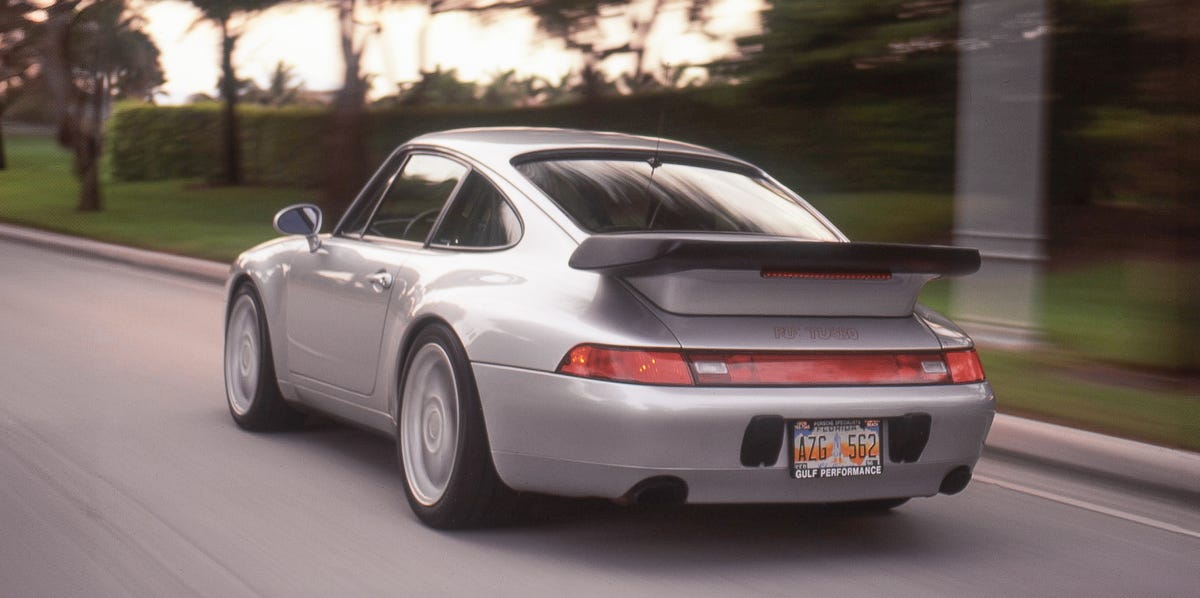
From the archive: What to buy when the 911 Turbo just won't do. The 1997 Ruf Porsche 993BTR is a rolling showcase of parts Ruf sells for the current 911, known inside Porsche as the 993. At first glance, tuning Porsches for more power and performance might seem like sending Tiger Woods to golf school for a few pointers. Porsches are not, after all, machines lacking in agility or speed.
A 911 Turbo, in fact, won our last five-vehicle supercar comparison test. The few speed junkies unsatisfied by this brutally fast, sophisticated exotic should probably seek out a different fix. That doesn't mean the Stuttgart automaker has all the answers for every customer. Proof of that is Ruf Automobile GmbH, the aftermarket Porsche tuner.
In Europe, Ruf is to Porsche what Lingenfelter is to Corvettes on this side of the Atlantic: a well-known purveyor of legal, reliable, and often indomitable speed. Ruf, however, doesn't stop with engines. Its catalog covers a spectrum of Porsche modifications from aero aids to brake packages to new transmissions, some with automatic clutches.
 View Price on Amazon
The BTR is a showcase of parts Ruf sells for the current 911, known inside Porsche as the 993. Its centerpiece is a single-turbo engine-conversion kit for the two-wheel-drive Carrera 2. It includes an intercooler, new camshafts, a freer-flowing catalyst-equipped exhaust system, and higher-flowing fuel injectors regulated by a revised Bosch Motronic engine controller, and a new engine-wiring harness. An extra oil cooler fits behind slots carefully cut into the front bumper, and a whale tail is included to house the intercooler.
Machined factory Mahle pistons reduce the 3.6-liter flat-six's compression ratio from 11.3:1 to 8.4:1, helping to prevent meltdown from the single KKK turbo's 11.6 psi of boost. The result—a gut-busting 420 horsepower at 5700 rpm, 420 pound-feet of torque at 4800 rpm—demands a wallet-busting $29,900 sacrifice from your bank account.
With this engine, Ruf also requires the installation of a $2590 suspension kit, which includes springs and Boge shocks that lower the body by 30 millimeters, a solid aluminum-billet front shock-tower brace, and anti-roll bars twice as stiff as the stock ones. The goal is to make sure the 993's chassis can cope with the newfound power.
Oh, one last thing. The stock Carrera 2's rear 245/45ZR-16 tires aren't quite up to the task of an additional 138 horsepower, so Ruf requires 18-inch rubber. It sells a set of jaunty Ruf 18-inch alloy wheels made by Speedline for $2390. Figure another $1250 for the four Michelin Pilot SXs (235/40ZR-18s on the front, 285/35ZR-18s in back) our test car had.
Add it up, and for $106,065 you get a two-wheel-drive 911 with slightly more power than the four-wheel-drive 911 Turbo priced at $114,293. The 993BTR's acceleration is virtually identical as well—0 to 60 mph in 3.7 seconds (same as the Turbo), the quarter-mile in 12.2 seconds at 115 mph (0.1 second faster than the Turbo), 150 mph in 26.2 seconds (0.1 second slower). Considering that the 993BTR manages that thrust with just two-wheel drive, Ruf's power claims are certainly plausible.
Source: caranddriver.com

