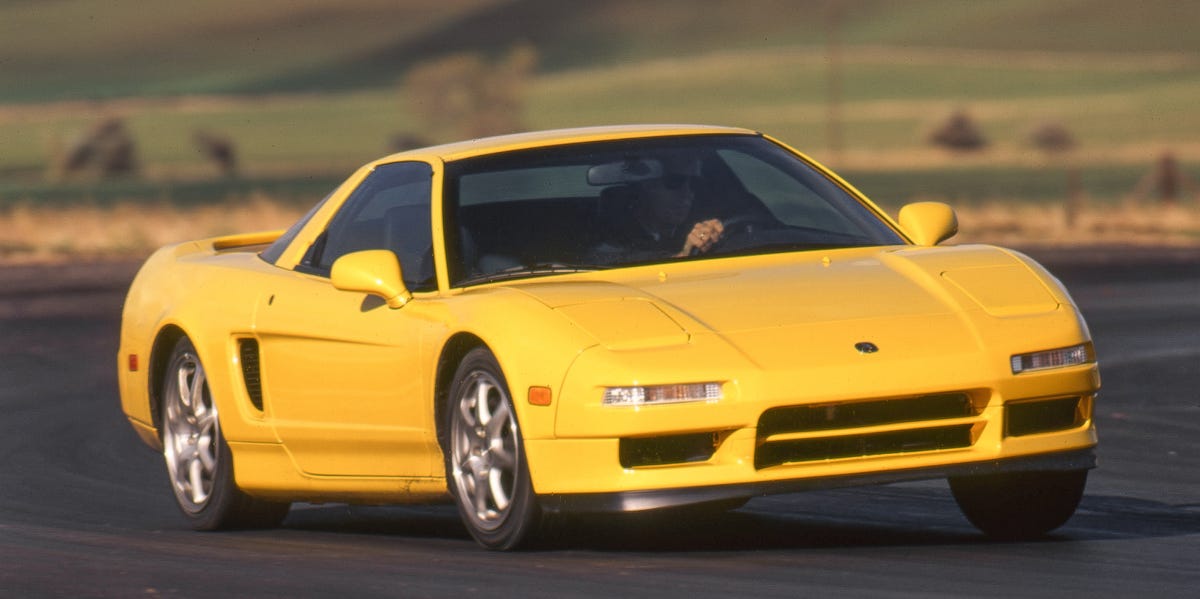
From the archive: Well, it's damn near perfect now, although the price could use a little work. The last time we featured an Acura NSX-T in a comparison test (C/D, July 1995), we "fantasized openly...about obtaining more power," and we also wondered whether a six-speed gearbox might not make life with this great car even better. Think of that story as a letter to Santa from a very deserving kid, because for 1997 Acura has granted both wishes.
The new NSX has been given a sixth cog and a larger-displacement 3.2-liter engine making 290 horsepower to go with it. The first five gears of the new transmission have been shortened relative to the old five-speed, and the sixth ratio is seven percent higher (at 0.72:1) than the former top gear. This makes for a quieter ride and more economical highway cruising. In fact, at a low 2850 rpm at 70 mph, you can hear the Bose stereo reasonably clearly, climb hills without a downshift, and obtain respectable pickup when you step on the accelerator.
 View Price on Amazon
The top-gear passing results are a bit slower for the new car than for the old, due to the high-ratio sixth gear. Flip the gearshift into fifth, and you find a very bright cruising gear (0.91:1 versus the old car's 0.77:1), which offers urgent throttle response. Naturally, in flat-out acceleration tests, the new car smokes the old one, reaching 60 mph in five seconds flat (versus 5.2), and running the quarter in 13.5 seconds at 106 mph (versus 13.8 at 103).
Okay, the differences aren't that great, but then the NSX-T of 1995 was no slug to start with. In fact, given the carefully rationalized, pared-down design of the original, it's amazing that so much upgrading was possible. The 3.0-millimeter increase in cylinder-bore size was made viable by Honda's fiber-reinforced-metal (FRM) engine-block technology, which allows very thin aluminum liners—reinforced with carbon and aluminum-oxide fiber—to take the place of the original steel units. Ditching the steel liners saved weight but required iron coatings on the aluminum piston for optimal wear characteristics.
To help the engine move larger air volumes, the intake valves were enlarged 1 millimeter to 36 millimeters, and a new stainless-steel exhaust manifold replaces the old cast-iron system for better flow. Acura engineers credit those changes more than any others for making the horsepower increase possible. The other high-tech features of an NSX engine are all retained—including titanium connecting rods, variable valve timing and lift on all four cams, a variable-volume induction system, a drive-by-wire throttle, and direct ignition.
Other major upgrades include structural reinforcements in major areas and body panels formed from alloy that bake-harden to a greater extent than the material used on earlier NSXs, allowing the use of thinner panels without a loss of solidity. The car certainly feels stiff enough on the road, despite an occasional squeak from the roof panel when driving over bumps. The car also feels as razor-sharp as ever, aided by steering that has no slop whatsoever on center and that moves the car in response to the lightest pressure at the wheel.
Source: caranddriver.com

