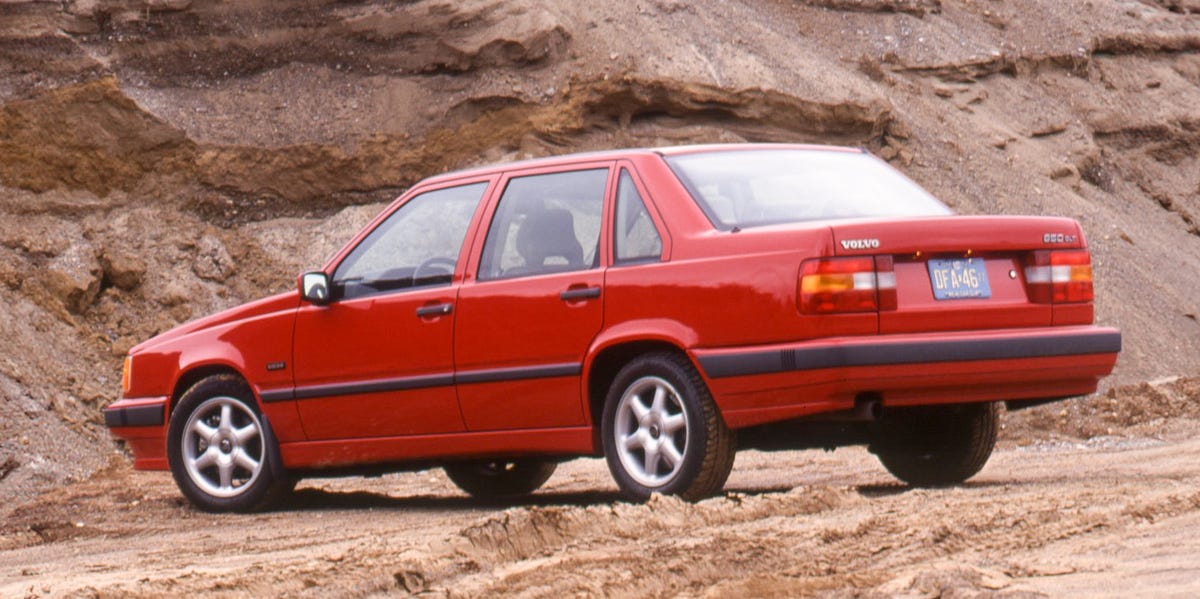
If cars were men, you'd want your daughter to marry this one. The 850GLT, the latest addition to Volvo's menu in the U.S., is all-new from the front to the back, and it only takes one good look to notice nothing of the sort.
Is this bad? Certainly, it's not surprising. The Volvo name is practically a synonym for "sensible," as in, "My, what a Volvo outfit you have on today. Going on an interview?" Still, considering the time that the Swedish maker has invested in this project—the 850 was conceived in the late 1970s, and design work began in 1986—we had hoped that the final shape would be more, well, inventive.
In its defense, the automaker believes that familiar styling improves brand awareness in today's crowded sedan market. But we remain disappointed that Volvo did not take this opportunity to break from its rigidly traditional form.
 View Price on Amazon
So the 850 is another no-surprises Volvo, right? Well, not quite. There's no question that this car is chock-full of Volvo trademarks. But there are surprises. For one, the 850 is a front-driver—the first such Volvo ever sold in the U.S. For another, it's powered by a new inline five-cylinder engine that is mounted transversely—a downright radical layout considering the difficulty of shoehorning anything more than an inline four into an engine bay sideways.
The sensible styling does have a payoff though. For its size, the 850GLT is a remarkably roomy four-door sedan. Roughly the size of a Saab 9000, it rides on a tidy 104.9-inch wheelbase and is more than eight inches shorter overall than Volvo's flagship, the 960. At 3229 pounds, the 850 is almost 300 pounds lighter than the 960. Yet, thanks to the packaging economies of the 850's front-drive/transverse-engine layout, the trim body does not exact penalties in cabin room.
The 850's engine also says "leaner 960." Under the hood is a new double-overhead-cam, 20-valve, 2.4-liter five-cylinder engine—basically the 960's 24-valve inline six minus a cylinder. The all-aluminum engine is light and compact—as it has to be to fit sideways between the front wheels. Output is 168 horsepower at 6200 rpm, and the torque curve is notably broad—thanks to a variable induction system.
Two new transmissions are offered: a cable-linkage five-speed manual and an electronically controlled four-speed automatic with three driver-selectable modes: sport, economy, and wet/winter. The 850 rides on struts up front and, in back, a novel new semi-trailing-arm design that allows some passive rear-wheel steering during hard cornering.
Source: caranddriver.com