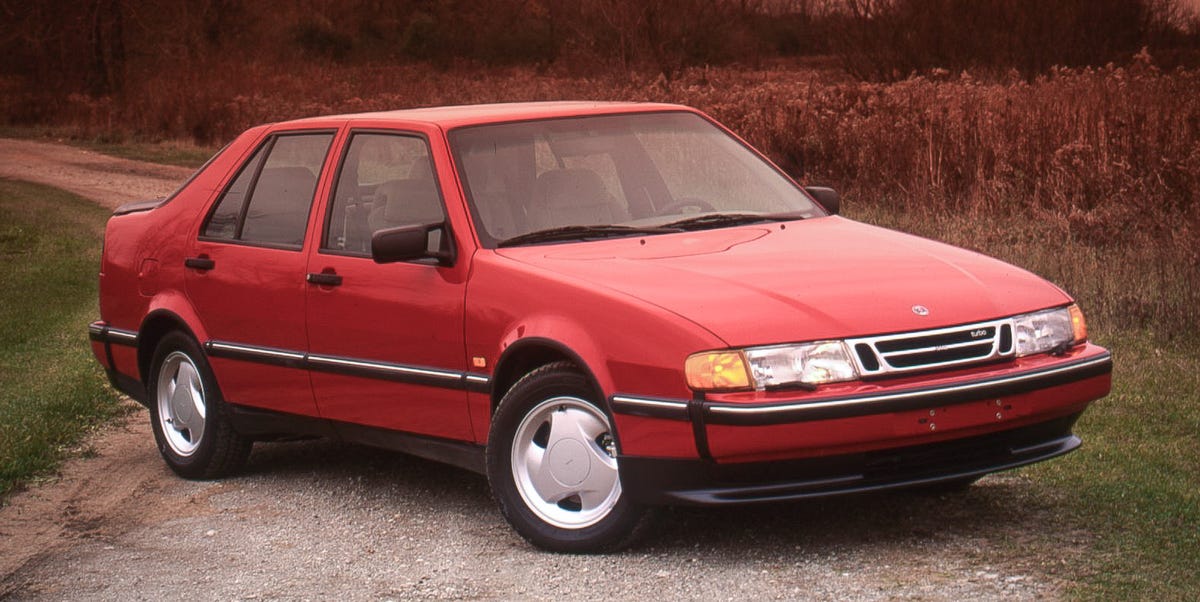
Take it off. Take it all off. From the February 1993 issue of Car and Driver. Despite his strong protectionist sensibilities, even Ross Perot would be impressed by the 1993 Saab 9000CS Turbo. It's an import, sure, but it's one whose earnings wind up in the sales chart of its parent, General Motors. And in the current atmosphere of frugality, the car is a modest gobbler of material resources.
Even if Mr. Perot could somehow overlook the 1993 car's various upgrades, such as torsional rigidity that has been improved by 25 percent and a nose trimmed to cut aerodynamic lift by a similar amount, he would like the bottom line. Which is this: order a 1993 CS Turbo without the sunroof, leather, or power-seat options and the price plunges to $30,176. That's cheaper than Saab's 900 Turbo. But best of all, the company's new options policy allows the base 9000CS Turbo to underprice last year's 9000 Turbo by $7000, yet doesn't strip the car of its essential luxuries.
Chief among these niceties has to be the 2.3-liter turbocharged engine. This balance-shafted smoothie is now equipped with Saab's Trionic engine-control system, which features a new combustion-monitoring technique wherein the spark-plug electrodes sense gas ionization in the combustion chamber between ignition impulses. This allows such fine engine control that Saab has been able to delete conventional acoustic knock sensors.
 View Price on Amazon
With its ignition, injection, and turbo waste-gate control now integrated in one 32-bit microprocessor-based unit, the 200-horsepower engine boasts improved fuel economy and emissions performance. So it's ironic that the Saab is now a whisker lower to 60 mph than last year's car (6.8 seconds versus 6.4). That should be attributed to the slightly taller final-drive ratio for 1993 and not the few pounds added by the new rear-passenger rollover protection hoop and improved side intrusion bracing. In fact, our car was actually lighter than the 9000 Turbo we tested in February 1991 because of deleted equipment options.
The new CS Turbo's quarter-mile time is slightly slower, too (15.3 seconds compared with 14.9 seconds). But its taller final-drive ratio helps quicken midrange acceleration, taking it to 100 mph almost a second faster than last year's car. Interesting as these figures are, they do not reveal how fast the Saab 9000CS Turbo feels on the road. With large doses of boost available even down at 2000 rpm, emphatic increases in speed are just a poke of the pedal away.
There's no turbo whistle to presage the onset of acceleration; the car just surges forward in response to the throttle. Boost rise time is so short that the CS Turbo's standard-equipment traction-control system, which conspires with a redesigned front differential to greatly reduce the wheelspin and torque steer that often greeted enthusiastic starts in previous 9000 Turbos, is warmly welcomed.
Not only does the traction control preempt any disquieting wheelspin and directional waywardness, but it is also fairly subtle in action. It steps in somewhat tentatively when you've used too much throttle and gently applies the brake to whichever wheel is spinning. At higher speeds, it simply reduces power. Unlike systems in some other cars, it does not suddenly cut engine power as if the throttle cable had snapped.
In fact, you can still peel out of parking lots with an audible degree of wheel slip. A measure of its high-performance calibration priority is that skidpad performance deteriorated by 0.01 g when the TCS was inactivated. And although it can be overridden by a determined right foot, the TCS is adequately sensitive in slippery conditions when used with an appropriately gentle throttle.
Source: caranddriver.com