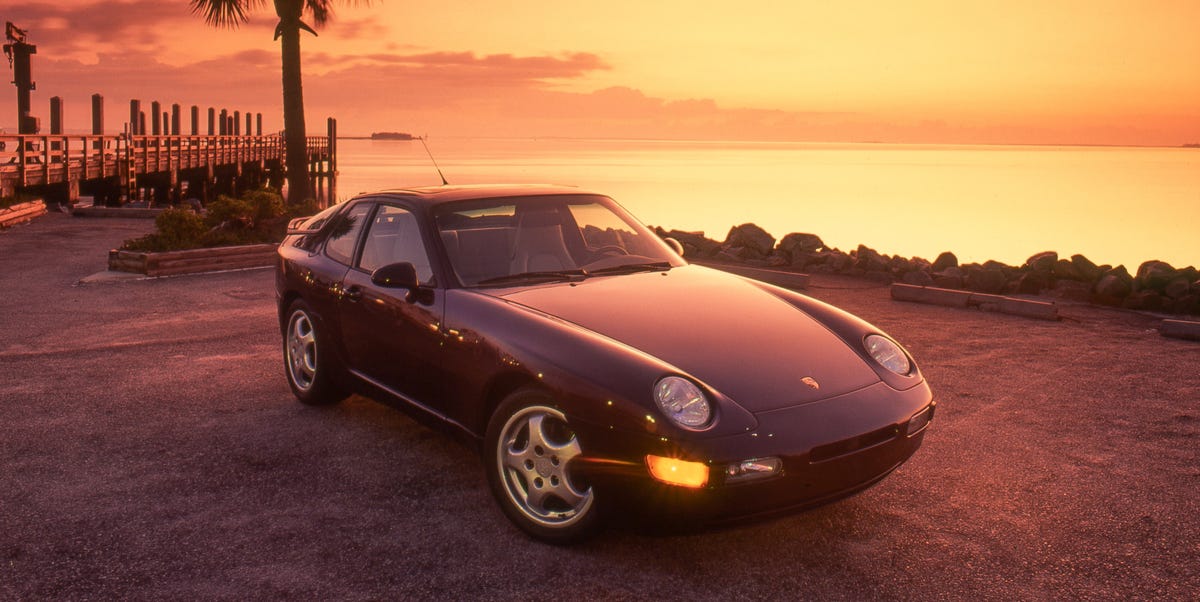
From the archive: Days late and dollars high, but hot to trot. Last month in the Carolinas, we threw three of the fastest sports cars in the business at each other—and tossed in a fourth choice to fill the spot originally planned for the new Porsche 968, which didn't make it to our shores in time for the festivities. So the perennially favored Nissan 300ZX Turbo, the thrilling new Mazda RX-7 Turbo, and the reborn Corvette LT1 from Chevrolet finished a tight one, two, three. As for the 968's stand-in, the Lotus Elan, its turbo four-banger huffed and puffed but left it fourth. Too bad the 968 missed the melee.
Now that we've gotten a 968 under our foot at last, we wish Porsche had moved mountains—or oceans, or whatever—to get its 944 successor to the comparo. This road-eater gobbles ground like a starving man in a pie-eating contest, except that it feels leeeeean when you stretch it out to fly, which it does right up to 153 mph. The 968's upgraded 3.0-liter engine—a truly vigorous four-cylinder—makes 236 horsepower. Works great with the two-plus-two's dandy chassis and 3154-pound weight. Your memory will long retain the sensations you absorb at the wheel. That makes the 968 rare, even among memorable competitors that may represent better values on the grand scale where you compare speed, fun, and price.
 View Price on Amazon
See all results for used cars for sale near 10025. Oooo, price—the trip line where the 968 may fall on its face (skiers call that a "face plant"). The bad news is spelled out in big numbers: base price, including luxury tax and destination, is $41,605. Our test car, with options, ran $47,177. If instead of a six-speed gearbox you crave Porsche's Tiptronic automatic transmission, which lets you sit and git or row your own, jack up the bottom line another three grand.
Automotive appreciation often begins about skin deep, and we seek opinions about the 968's bulging skin. Its mass both cloaks and emboldens the basic lines of the 944 in prominent musculature. Its slotted nose, laid-back headlights, and furl of wing above the cleaned-up bustle show that Porsche lifted its functional character cues off everything from its 959 supercar, to today's 911-derivative Carrera models, to the bigger 928. They all mirror Porsche's image. People walk up to the 968 as if trying to place a face, thinking maybe it's an old friend. They lean back and open their arms as if to gauge and embrace it in one move. So what if it sometimes looks like a Datsun 240Z upgraded by two decades? It doesn't drive that way. And its doors slam with a solid metallic whamp that bespeaks a fine structure and closures that fit better than the cabin seals on all but other Porsches and a few Mercedes-Benzes.
Porsche fares less well once the cabin's beltline clasps around you. Outsiders who survey the interior in our test car often come away more immediately impressed than the driver. Whether you find the dove-gray leather a fey shade or a handsome come-on, it's tough to keep clean. The 968 also lacks cupholders for civilized travel with refreshment. And the obscure switches strewn around the doors, the dash, and the console mock the huge gauges and vents that keep information and ventilation flowing with equal ease. We suspect Porsche's peculiar blend of clear and cloudy thinking on ergonomics comes from its racing heyday, when engine information for the driver took precedence over switches. Those were one-purpose switches, unlike the multi-function controls integrated into most passenger cars today. Not many make it into Porsches.
On the other hand, the Teutonic instinct to combine performance with safety leads Porsche to fit the 968 with dual airbags. You'll also find excellent European-type safety belts. Press into any of the 968's seats—the front is roomy, the rear is tiny—and you can tug the harness to clamp yourself in place. That's good for hard driving and, all ot
Source: caranddriver.com

